
Loading…
30th Anniversary Show October 24, 2026 · Cochiti Pueblo · Contemporary Pottery
US$11,000
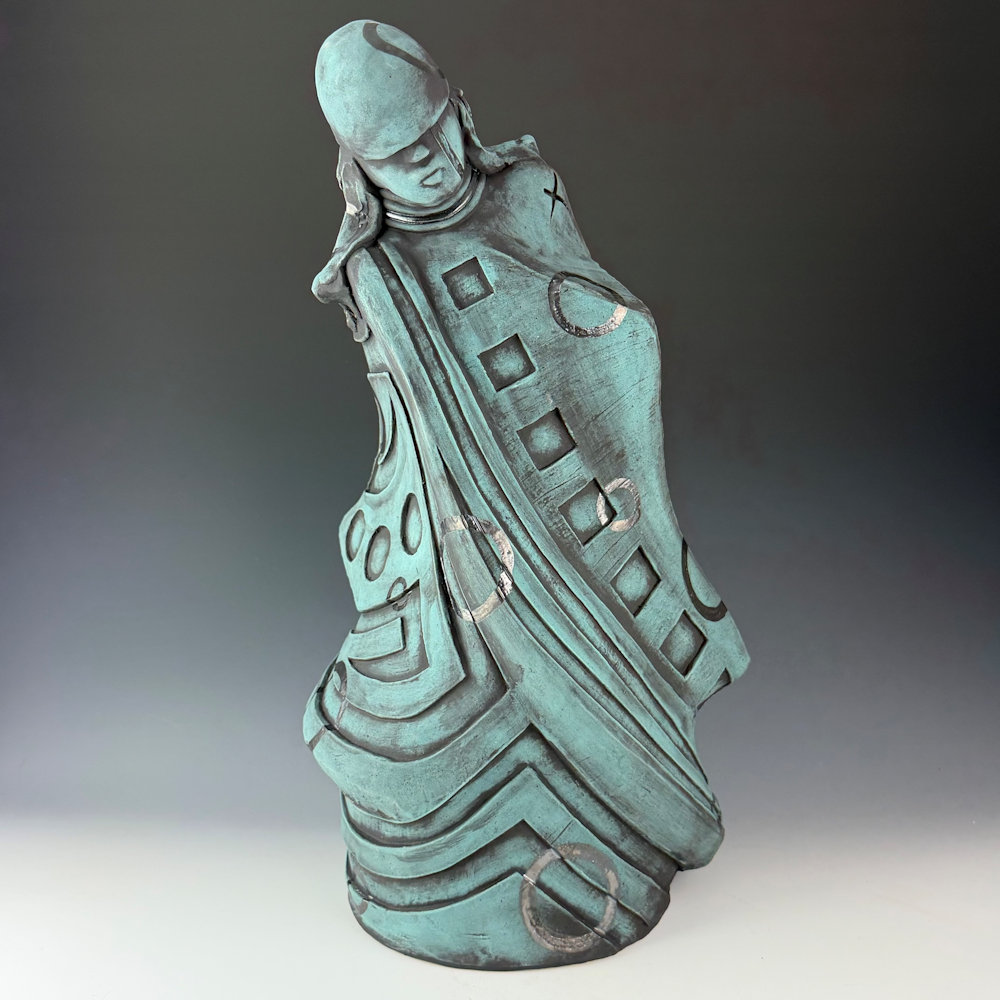
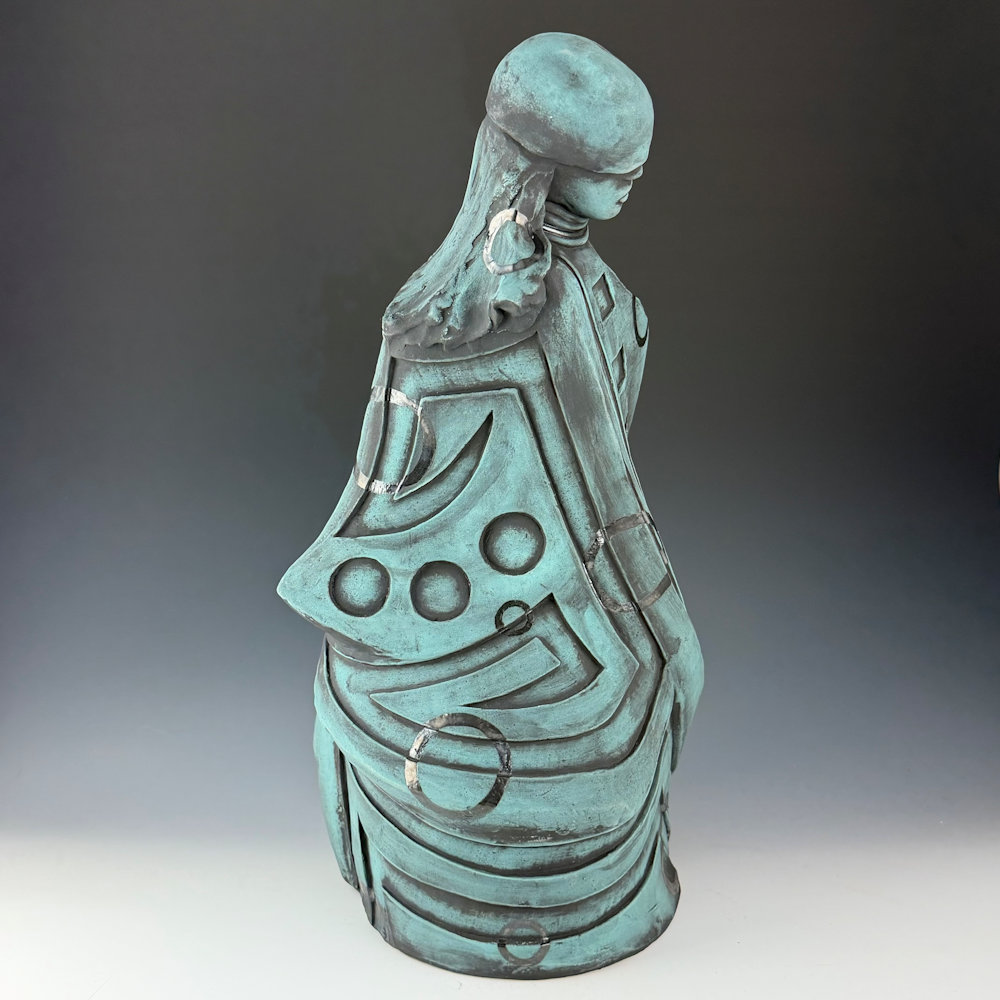
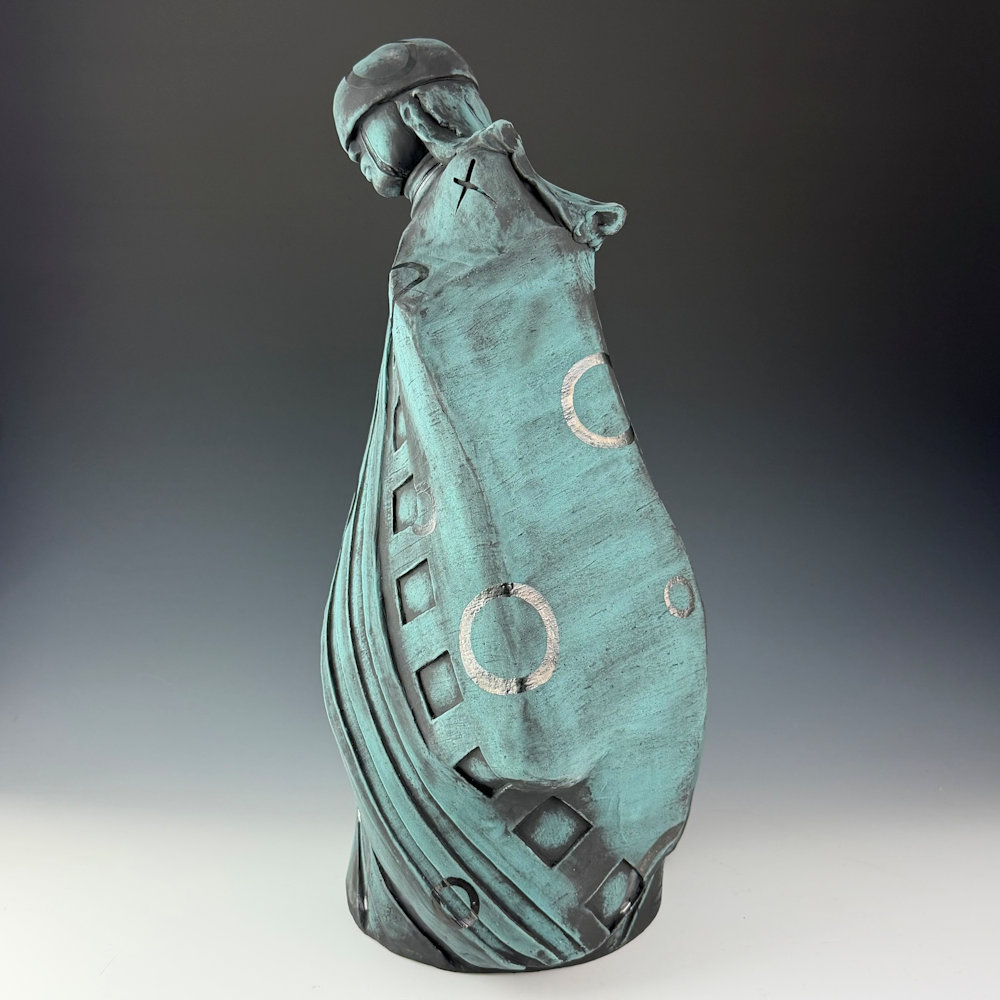
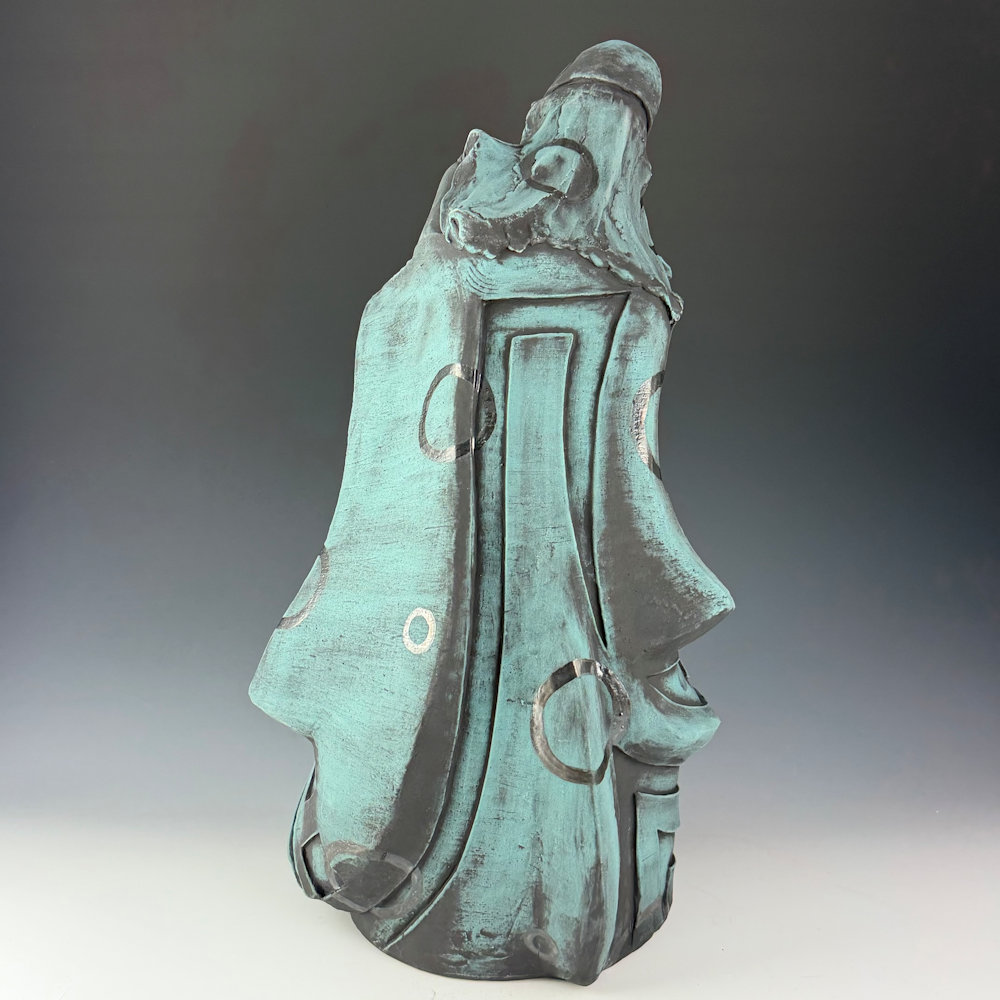
Virgil Ortiz is known for his innovative style of Cochiti pottery, inspired by the Monos figures made at the pueblo in the 1880’s. Over the past 20 years, his work has also told the story of the Pueblo Revolt 1680/2180. I’m very pleased to have a new piece from him for our 30th Anniversary show. The figure is Tahu, the Blind Archer. He has depicted her in a very modernist style, with painted designs and carved imagery. An exceptional piece that continues to tell his story of the Pueblo Revolt!
Virgil says of this piece;
A time-traveler between 1680 and 2180, Tahu is the unwavering Leader of the Blind Archers—a warrior guided by unseen perception, ancestral memory, and the echoes of resistance that guide her across eras. Cloaked in angular, wind-swept armor, she bends the temporal veil, her form carried by a current that exists in both timelines at once. The symbols across her robe—squares, circles, portals—mark the coordinates of her crossing: ancient Pueblo pathways converging with futuristic circuitry. Forged in the darkest moments of her people’s struggle, Tahu’s heightened perception grants her the rare ability to move between dimensions—carrying warnings, knowledge, and strategy to safeguard their future.
Virgil Ortiz is known for his innovative style of Cochiti pottery, inspired by the Monos figures made at the pueblo in the 1880’s. As I wrote in the book, “Virgil Ortiz: Pueblo Revolt 1680/2180,
“This use of the figures for social commentary is where they derived their name, monos. The word is a colloquial blend of Spanish and Keres, with inexact definitions that range from “mimic,” “mocking,” or “cute” to “monkey.” While “monkey” might have suggested the elongated bodies and arms or the simplified open-mouthed faces of the figures, it was also a subtle racial pejorative aimed at their Cochiti makers.”
This is one of Virgil’s traditional clay figures made from native clay and painted with native clays and wild spinach (black). The figure is one of the few with bare feet. The body is painted with traditional Cochiti designs. The back and legs have an early version of the wild spinach design. The stance of the figure creates motion and movement, which is something Virgil worked on with his early figures. The piece was traditionally fired. The earrings are also traditional red clay and added after the firing. It is signed on the bottom and is from 1994. It is in excellent condition with no chips, cracks, restoration, or repair.
Offered by King Galleries. See it on the gallery's website