
Vinci Stories · Francisco de Goya y Lucientes
The Sleep of Reason Produces Monsters: Inside Goya’s Nightmare
Plate 43 of Goya’s Los Caprichos shows the artist asleep at his desk while owls, bats and a cat close in. It was drawn as the title page of the whole series, moved to the middle, explained in manuscripts that do not quite agree, and sold for only a short time before Goya handed the plates to the king.
- Work
- The Sleep of Reason Produces Monsters (El sueño de la razón produce monstruos), Los Caprichos, plate 43, 1797–1799; published 1799
- Where to see it
- Impressions in many collections, including the Museo Nacional del Prado and The Metropolitan Museum of Art; copper plate in the Calcografía Nacional, Madrid, Madrid and New York
- Reading time
- 9 min
- Updated
What The Sleep of Reason Produces Monsters shows
A man has fallen asleep at his work. He sits on a chair and slumps forward over a block-like desk, his face hidden in his folded arms, his pens and papers pushed aside. Out of the darkness behind him come the animals of the night: owls, some of them with almost human faces, a cloud of bats, a dark cat crouched behind his back and, closest to us, a lynx lying alert on the floor at his feet. On the side of the desk, in white letters, is the sentence that has become one of the most quoted captions in art: El sueño de la razon produce monstruos, the sleep of reason produces monsters.
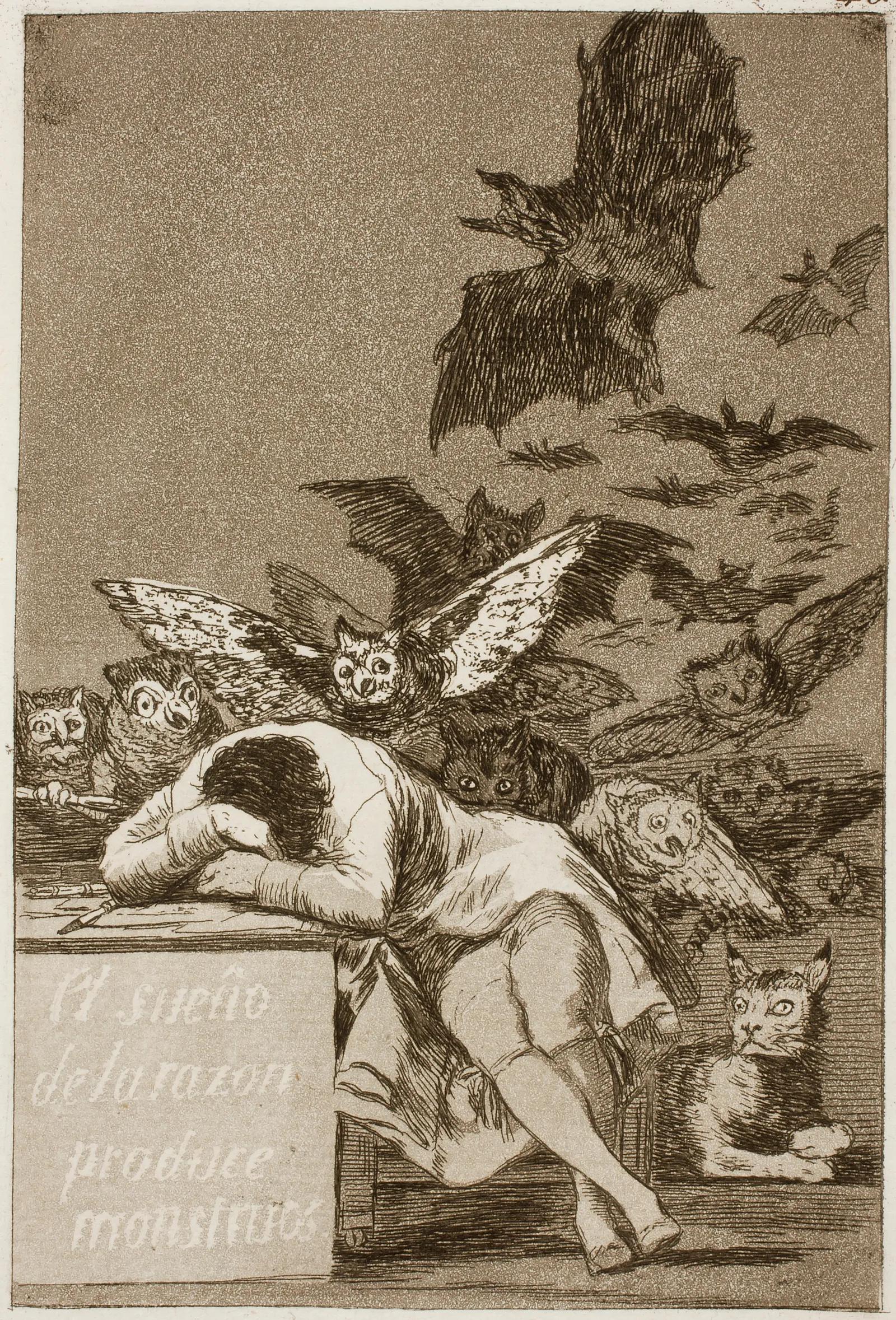
The print is plate 43 of Los Caprichos, the series of 80 etchings with aquatint that Francisco de Goya published in Madrid in 1799. The Metropolitan Museum of Art’s impression, given by M. Knoedler & Co. in 1918, measures 21.2 by 15.1 centimetres at the plate mark: small enough to hold in two hands. The Fundación Goya en Aragón, whose catalogue is the most detailed public record of the series, calls it one of the most complex prints of the set and one of the most interpreted, and notes that the copper plate itself survives in the Calcografía Nacional in Madrid.
The technique matters to the effect. Goya laid two tones of aquatint, a darker one for the background and a lighter one for the front of the desk, and stopped out the letters of the title with varnish so that they print white. The only strong light falls on the sleeper’s head and shoulders and catches the nearest owls, as if a lamp were trained on him. Everything else is shadow and grain.
The owl’s offer and the lynx that stays awake
Owls, bats and black cats are Halloween’s animals now; in Goya’s Spain they belonged to the world of witchcraft and night, and they recur throughout Los Caprichos in the prints about witches and credulity. Commentators have long read the owls as folly and the bats as ignorance. That is interpretation, not something Goya wrote, but the animals plainly come from the dark side of the sheet and close in on the one figure who cannot see them.
Two details complicate a simple reading. The first is the owl perched just behind the sleeper’s arm, which holds out a drawing tool towards him, a porte-crayon of the kind an artist used to hold chalk. The night creatures are not only threatening the man at the desk: one of them is offering him the means to draw. The second is the lynx. Every other animal is in motion or swooping; the lynx lies still, eyes wide open, looking out of the print. In Spanish, as in many languages, the lynx was proverbial for sharp sight, and it is the only creature in the composition that is fully awake. Whether Goya intended it as the watchful counterpart to the sleeping reason, or simply as another night animal, is a matter for the viewer, but it is the detail most people miss.
The word sueño adds a further ambiguity. In Spanish it means both sleep and dream. ‘The sleep of reason produces monsters’ is a warning about what happens when reason is switched off. ‘The dream of reason produces monsters’ can be read the other way round, as a remark about what reason itself imagines. Goya’s contemporaries, as their commentaries show, took the first meaning but kept a door open to the second.
The title page that moved to the middle of Los Caprichos
The print began as a frontispiece. Among the preparatory drawings for Los Caprichos in the Museo del Prado is a series that Goya headed Sueños, dreams. Their sheets show traces of having been through the printing press, which proves they were made to be transferred to copper. The first of them, inscribed ‘Sueño 1º’ at the top, shows the core of plate 43 already in place: the sleeping artist at his desk, a giant bat-winged shape above him and a cat at his feet. On the front of the desk Goya wrote ‘Ydioma universal’, universal language, followed by ‘Dibujado y Grabado pr. Frco. de Goya año 1797’, drawn and engraved by Francisco de Goya in the year 1797. That date is one of the anchors for dating the whole series.
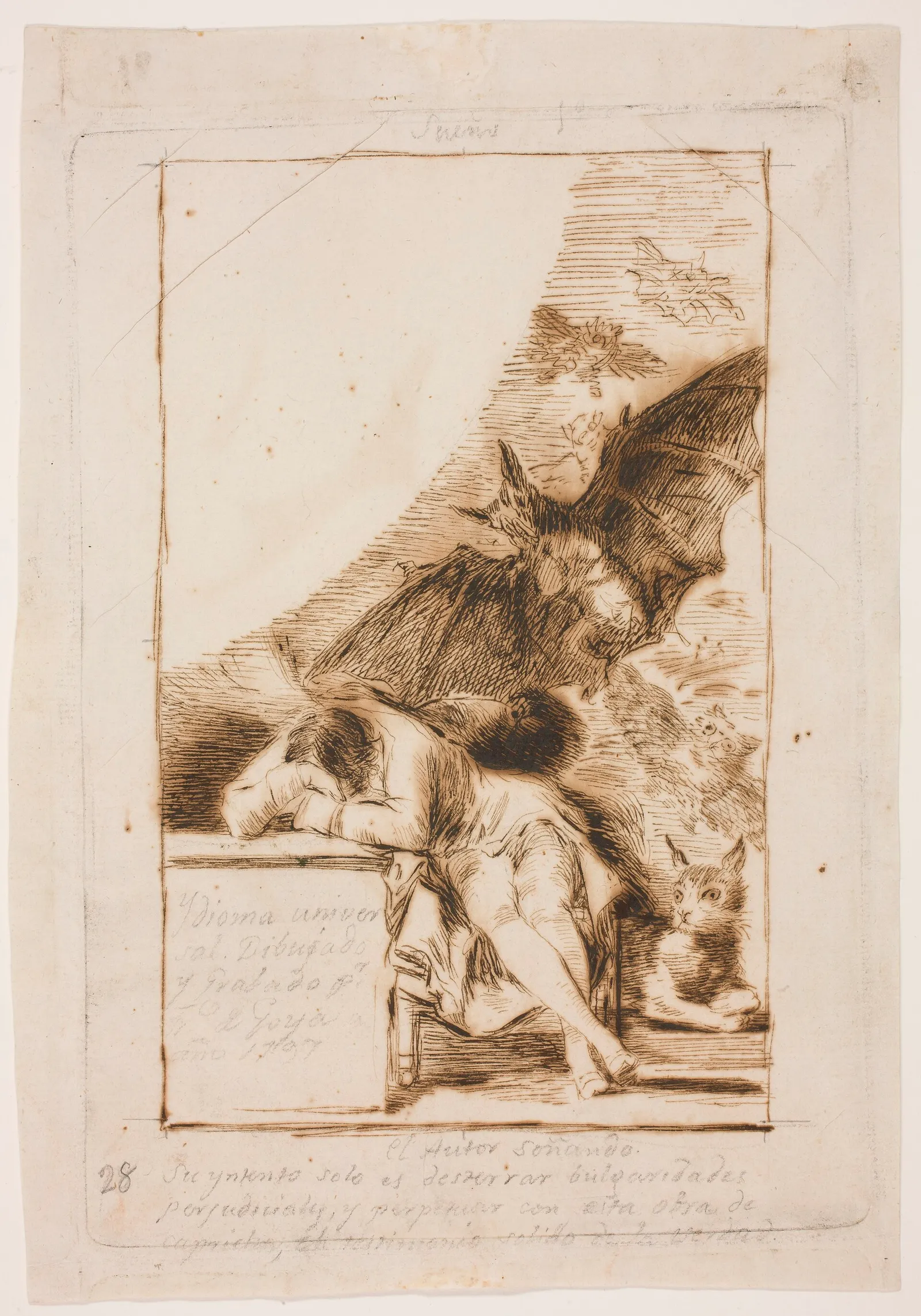
Underneath, in pencil, is a statement of intent for the whole project. In English it reads, roughly: ‘The author dreaming. His only purpose is to banish harmful vulgarities and to perpetuate, with this work of caprices, the solid testimony of truth.’ The original Spanish, as transcribed by the Fundación Goya en Aragón, is below.
El Autor soñando. Su yntento solo es desterrar vulgaridades perjudiciales, y perpetuar con esta obra de caprichos, el testimonio solido de la verdad
A second preparatory drawing in the Prado, in black chalk and iron-gall ink on laid paper, 23 by 15.5 centimetres, takes the idea further. From the sleeper’s head comes a fan of rays filled with faces, human and animal, laughing and groaning; among them the Fundación’s catalogue identifies a self-portrait of Goya, almost full face. Bats fly at right, a dog and a donkey appear above them, and beside Goya there is a lynx, almost faded out. Its provenance is recorded from Goya’s son Javier to Goya’s grandson Mariano, then the collector Valentín Carderera and his heir, until the Prado acquired it in 1886.
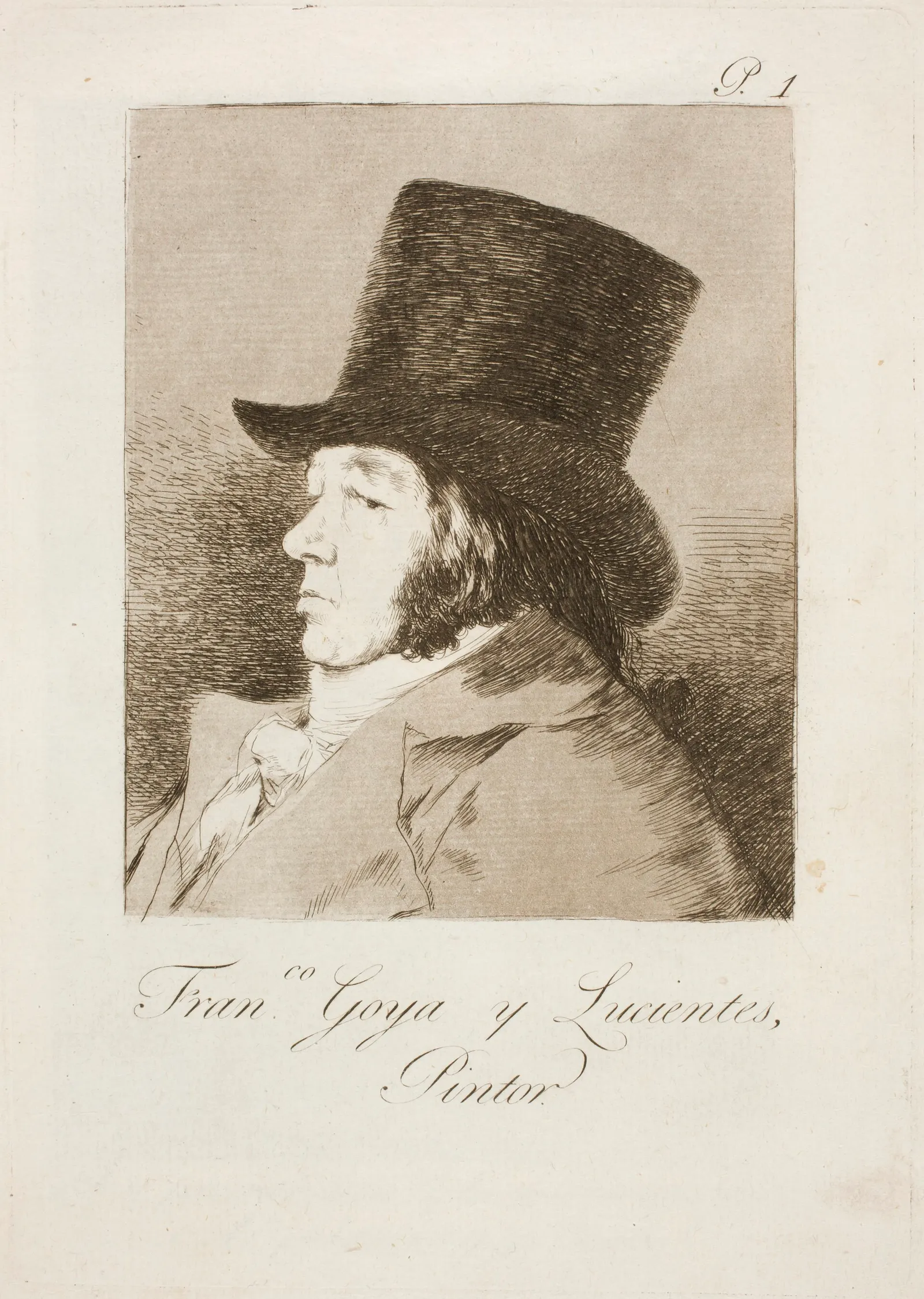
When the set was finally ordered, the dreamer lost his place on the first page. Goya chose instead an etched self-portrait in profile, wearing a tall hat and looking sideways with a sceptical eye, and the sleeping artist went to number 43, near the middle of the sequence. Scholars still argue about why. One view is that the move gave the series two openings: the satirical first half, about social folly, and a darker second half, dominated by witches and goblins, that follows the dream.
What does ‘the sleep of reason produces monsters’ mean?
Goya never published an explanation of his captions, but several handwritten commentaries on Los Caprichos circulated in Madrid in his lifetime. None is certainly in his hand, and they disagree in tone; three of the best known are the manuscript in the Museo del Prado, the one in the Biblioteca Nacional and the so-called Ayala manuscript. For plate 43 they converge. The Prado manuscript reads as follows.
La fantasía abandonada de la razón produce monstruos imposibles: unida con ella es madre de las artes y origen de las maravillas
Imagination abandoned by reason produces impossible monsters; united with it, it is the mother of the arts and the origin of marvels. The Ayala manuscript gives a shorter version of the same thought, and the Biblioteca Nacional manuscript a blunter one: when men do not hear the cry of reason, everything becomes visions. So the caption carries two meanings at once. It is an Enlightenment warning, in line with the reforming circle around Goya’s friend Gaspar Melchor de Jovellanos, that superstition and ignorance breed when reason sleeps. It is also a statement about art: fantasy is not the enemy, only fantasy left unsupervised.
Art historians have pointed to possible visual sources for the sleeping figure, among them Salvator Rosa’s Democritus in Meditation (1650, Statens Museum for Kunst, Copenhagen) and a frontispiece of a sleeping artist in Giuseppe Maria Mitelli’s Alfabeto in sogno. The literary ancestor is Francisco de Quevedo’s Sueños, the seventeenth-century satirical visions that also begin with a narrator falling asleep. None of these is a proven model, but they show that Goya was working inside a long tradition of the dream as a frame for satire.
Sold, then withdrawn: Los Caprichos and the Inquisition
Goya announced the set in the Diario de Madrid on 6 February 1799: 80 prints for 320 reales a set, on sale at a shop selling perfume and liquor at Calle del Desengaño no. 1, in the building where he lived. The advertisement insisted that none of the compositions mocked particular individuals, a disclaimer that few readers can have believed. Within a short time Goya withdrew the sets from sale. In a later letter he said they had been on sale for only two days; modern accounts suggest it was a little longer, but the withdrawal was quick by any measure.
The year was otherwise good to him. In October 1799 Goya was appointed first court painter to Charles IV. In 1803 he took the step that protected the series: he gave the king the 80 copper plates and the 240 unsold sets of the first edition for the Real Calcografía, the royal printing house, asking in return for a pension for his son Javier. Both the Real Academia de Bellas Artes de San Fernando, which now runs the Calcografía Nacional, and the National Gallery of Victoria give that account. The plates have stayed in Madrid ever since, and later editions were printed from them.
Royal protection did not end the danger. Late in life, in a letter of 1825 to his friend Joaquín Ferrer, Goya wrote that he had been denounced to the Inquisition over the Caprichos. No record of a trial has been found. A few years earlier he had painted the private murals now known as the Black Paintings in his house outside Madrid, where the monsters of plate 43 came back at full scale; the most famous of them is the subject of Goya’s Saturn.
1746
Goya born at Fuendetodos, Aragon, on 30 March.
1792–93
A serious illness leaves him permanently deaf.
1797
Goya dates the drawing Sueño 1º: Ydioma universal, planned as the title page of a series of Sueños.
1799
On 6 February the Diario de Madrid announces Los Caprichos, 80 prints at 320 reales a set; sale soon withdrawn.
1799
In October Goya is named first court painter to Charles IV.
1803
Goya gives the 80 plates and 240 unsold sets to the king for the Real Calcografía, in exchange for a pension for his son Javier.
1819–23
Goya paints the Black Paintings on the walls of his house outside Madrid.
1825
In a letter to Joaquín Ferrer, Goya says he was denounced to the Inquisition over the Caprichos.
1828
Goya dies in exile in Bordeaux on 16 April.
1886
The Prado acquires the Carderera preparatory drawing for plate 43.
Source: Fundación Goya en Aragón catalogue; National Gallery of Victoria, ‘Goya’s Caprichos’; Real Academia de Bellas Artes de San Fernando
Los Caprichos plate 43 at a glance
How to look at The Sleep of Reason Produces Monsters
Find an impression you can see in person or a high-resolution scan, and start at the lower right with the lynx. Then move clockwise: the cat behind the sleeper’s back, the owl with the drawing tool, the wide-eyed owls on the desk, and the bats thinning out towards the upper right. Notice how the creatures get less distinct as they recede, as if they were still forming.
Next, compare the print with the drawings. In the Sueño 1º sheet the desk carries the series title, ‘Ydioma universal’, rather than the famous sentence; the long caption sits below the image; and the bat-winged figure is a single great presence rather than a swarm. In the print Goya divided the threat into many smaller animals and added the lynx and the owl with the drawing tool. Those additions are where most of the meaning sits.
Finally, look at the series as a book. Plate 43 is easy to treat as a standalone image, but it was made to be turned to, after 42 satires and before 37 more. If you can page through the set, notice how the tone darkens after it. Goya had studied the Spanish royal collection closely, and two decades earlier had made etchings after Velázquez, whose Las Meninas is another picture about an artist and the people watching him. In plate 43 the artist cannot watch back.
Questions people ask
What does ‘The Sleep of Reason Produces Monsters’ mean?
The caption warns that when reason is asleep, superstition and fears take over. A contemporary manuscript commentary in the Prado adds that imagination abandoned by reason produces impossible monsters, but united with reason it is the mother of the arts. Because the Spanish word sueño means both sleep and dream, the line can also be read as a remark about what reason dreams.
When did Goya make The Sleep of Reason Produces Monsters?
Goya prepared it between about 1797 and 1799. A preparatory drawing in the Prado is dated 1797 on the desk, and the print was published as plate 43 of Los Caprichos, announced in the Diario de Madrid on 6 February 1799. It was first planned as the title page of the series before Goya moved it to the middle.
Is the sleeping man Goya himself?
Probably. The preparatory drawing is captioned ‘El Autor soñando’, the author dreaming, and it was conceived as the frontispiece, the place where an author’s portrait normally appears. A second drawing in the Prado includes a recognisable self-portrait among the faces streaming from the sleeper’s head. In the published series, Goya replaced the dreamer with an etched self-portrait in profile as plate 1.
Why did Goya withdraw Los Caprichos from sale?
Goya never fully explained it, but the prints satirised the clergy, the nobility and popular superstition, and the Inquisition was still active. He withdrew the sets soon after the February 1799 announcement, and in 1803 gave the plates and 240 unsold sets to King Charles IV for the royal printing house, in return for a pension for his son. In 1825 he wrote that he had been denounced to the Inquisition.
Where can I see The Sleep of Reason Produces Monsters?
There is no single original: it is a print, so many first-edition impressions exist. The Prado holds impressions and the two preparatory drawings, the Metropolitan Museum of Art has an impression (18.64(43)) available online, and the copper plate survives in the Calcografía Nacional in Madrid. Works on paper are shown in rotation to protect them from light, so check before visiting.
Sources and further reading
- El sueño de la razón produce monstruos (Caprichos 43/85), Fundación Goya en Aragón
- Sueño 1º: Idioma universal (preparatory drawing, Prado D-3923), Fundación Goya en Aragón
- El sueño de la razón produce monstruos (preparatory drawing, Prado D-4162), Fundación Goya en Aragón
- Plate 43 from ‘Los Caprichos’: The sleep of reason produces monsters (18.64(43)), The Metropolitan Museum of Art
- Goya’s Caprichos, National Gallery of Victoria
- Gabinete Goya (leaflet on the Calcografía Nacional’s Goya plates), Real Academia de Bellas Artes de San Fernando
- Los Caprichos, Wikipedia
Images are public-domain or CC0 reproductions from Wikimedia Commons, credited under each figure. Interpretations are attributed to the scholars who hold them.
Keep looking
Know someone who should see this?
Send them the story of The Sleep of Reason Produces Monsters (El sueño de la razón produce monstruos), Los Caprichos, plate 43.