
Vinci Stories · Hieronymus Bosch
Death and the Miser: What Bosch Hid Under the Paint
Around 1490 Hieronymus Bosch painted a tall, narrow deathbed: Death at the door with an arrow, an angel pointing to a crucifix, a demon pushing a money bag through the curtains. Infrared images show that Bosch first drew the dying man taking the money. Then he changed his mind and left the question open.
- Work
- Death and the Miser, c. 1485/1490 (National Gallery of Art dating)
- Where to see it
- National Gallery of Art, Samuel H. Kress Collection, Washington, DC
- Reading time
- 8 min
- Updated
Death and the Miser: Bosch’s deathbed in a narrow room
Hieronymus Bosch, who lived and worked in ’s-Hertogenbosch in the Duchy of Brabant and died in 1516, painted this panel as a vertical strip: 93 centimetres high and only 31 wide. The format forces us to read it like a page, from top to bottom. At the top, in a window under a vaulted ceiling, a small crucifix catches a single ray of light. Below, a man sits up in a red-curtained bed, naked to the waist and emaciated. He is dying, and he has visitors.
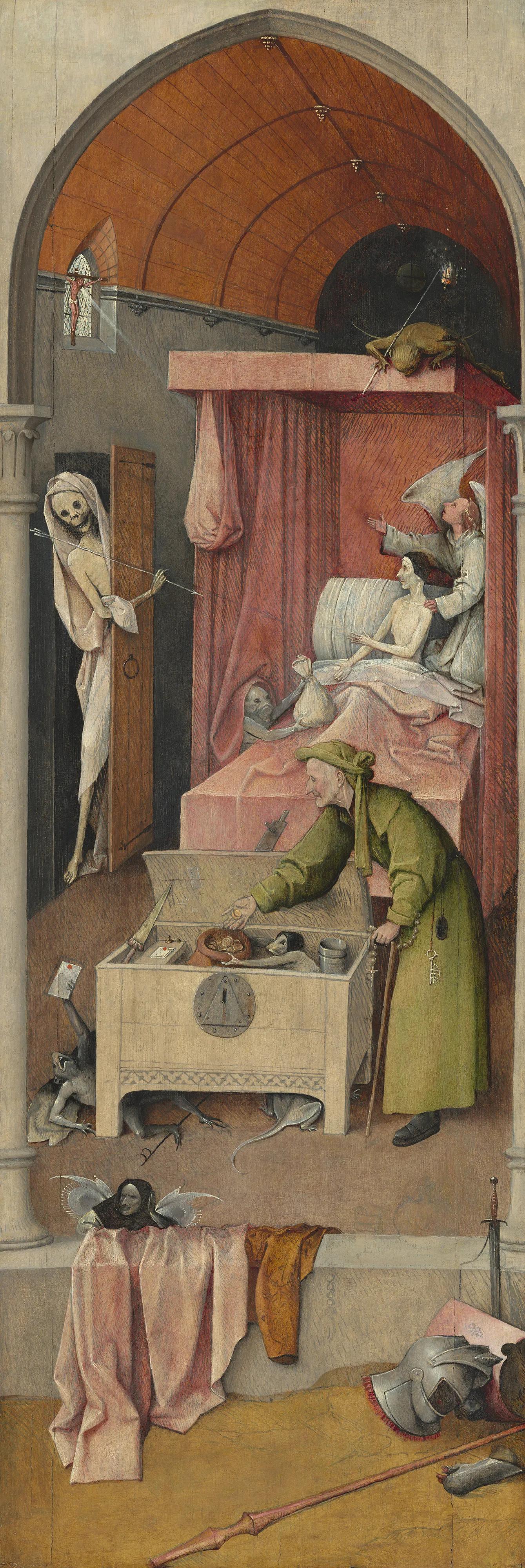
Death comes through a low door on the left, a skeleton in a white shroud, holding an arrow already aimed at the bed. An angel kneels behind the man, one hand on his shoulder and the other raised towards the crucifix. From under the bed curtain a small demon pushes up a tied bag of money. On the canopy above, another demon peers down holding a lantern. The man’s right hand is out, palm turned, between the angel’s gesture and the devil’s gift.
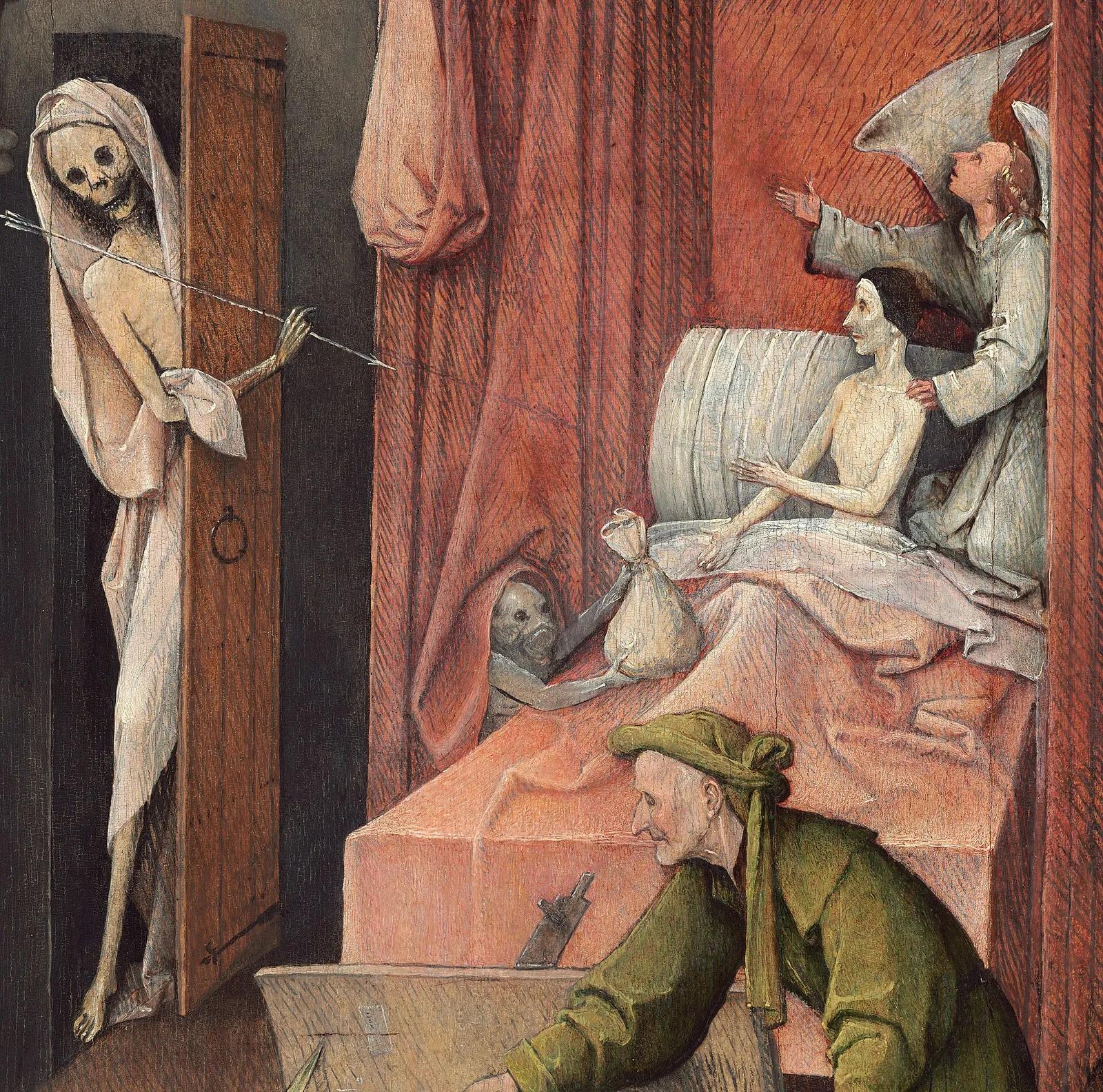
Bosch keeps the room bare and the colours restrained: the red of the bed curtains, the grey stone of the vault, the white of Death’s shroud and of the angel’s robe. The light from the window falls on the crucifix and on the angel, while the demon with the lantern supplies a second, smaller light of its own. Two sources of light, one divine and one false, compete for the same dying man, and the painter places him directly between them.
This is the moment late-medieval Christians feared most: the last hour, when a soul could still be won or lost. The painting asks a plain question and refuses to answer it. Which will he reach for?
The Art of Dying: what Bosch’s audience knew
Bosch’s first viewers would have recognised the set-up. The Ars moriendi, the Art of Dying, was a fifteenth-century manual on how to die well, widely circulated in text and in a famous series of woodcuts from around 1450. The woodcuts show a dying man in bed besieged by devils with five temptations: doubt in the faith, despair, impatience, spiritual pride and avarice, the clinging to worldly goods. Each temptation is followed by an angel’s good inspiration that defeats it.
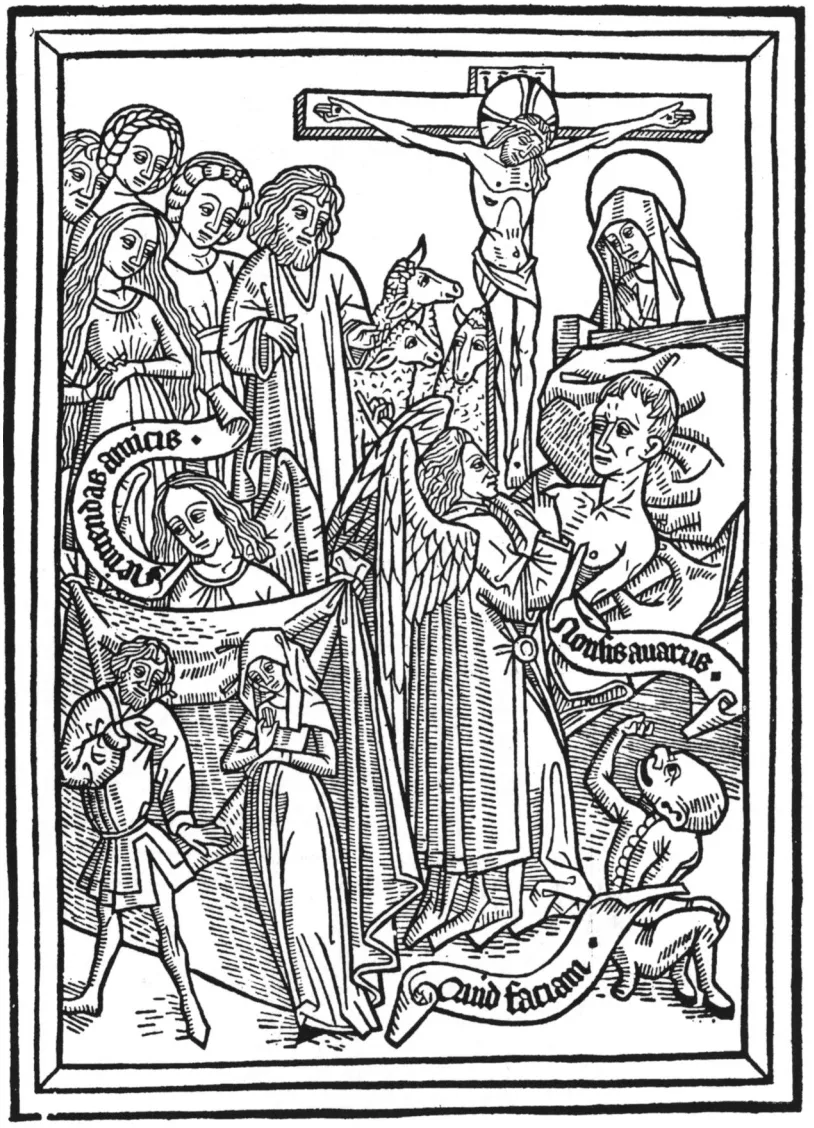
Bosch borrowed the cast: the bed, the angel, the demons, the attentive spectators of the soul’s last struggle. What he removed was the resolution. In the woodcut the angel wins. In Bosch’s panel, the dying man’s eyes and outstretched hand are turned towards the demon’s bag, while the angel points away. The outcome is left to the man, and to us.
Infrared reflectography: what Bosch hid under the paint
Bosch painted thinly. In the National Gallery of Art’s systematic catalogue, John Oliver Hand noted that the paint layer is so thin that the underdrawing, the artist’s preliminary drawing on the white ground, can be seen with the naked eye in many places. Infrared reflectography, which records wavelengths that pass through most paint but are absorbed by carbon-based drawing, reveals much more.
In the underdrawing the dying man is different. Hand reports that he originally held a money purse in his right hand and an ornate covered cup, a pokal, in his left. In other words, Bosch first drew the miser already taking the devil’s money and clutching a precious possession, a man whose answer was obvious. According to the National Gallery of Art’s technical notes, the infrared images also show his mouth open, as if speaking, and Death’s arrow placed nearer to him.
In the painting, the purse is gone from his hand and the cup is gone altogether. The bag hangs between the demon and the man, not yet taken. That single revision changes the picture from a sermon about a damned man to a question about a man who can still choose. Other planned objects were also dropped: the underdrawing of the foreground includes items that were never painted. The changes are documented; why Bosch made them is interpretation, though most scholars read them as a deliberate move towards ambiguity.
The man in green, the chest and the armour
The lower part of the panel is set in front of the room, under the stone arch. An old man in a green robe and hat, leaning on a stick, drops coins into a chest with one hand while a rosary hangs from the other. Most scholars read him as the miser earlier in life, healthy and busy, so that the panel shows two moments of one life at once. The National Gallery of Art describes him as attempting to serve God and Mammon at the same time.
The chest is infested. A rat-faced demon takes coins from it; another, beneath, holds up a paper sealed with red wax, perhaps a letter of indulgence or a record of debts. In the foreground lie a helmet, a lance, a gauntlet and other pieces of armour, with a discarded cloak. Nobody has explained them to universal satisfaction. Proposals include the trappings of worldly power, the miser’s knightly rank, goods pawned with a moneylender, a satire on chivalry, and the “armour of God” from Ephesians 6. A. M. Morganstern and, later, Pierre Vinken and Lucy Schlüter published detailed studies; no reading has settled the question.
- Documented: the subject’s dependence on the Ars moriendi tradition; the changes in the underdrawing; the panel’s size and support.
- Widely accepted: the man in green as the miser earlier in life; the panel as the right wing of a triptych on the deadly sins.
- Debated: the meaning of the armour, the sealed paper and whether the miser is a secret pawnbroker.
A lost Bosch triptych: the Ship of Fools and the Yale fragment
Death and the Miser was not made to stand alone. The Yale University Art Gallery, which owns An Allegory of Intemperance, explains that its fragment and The Ship of Fools in the Musée du Louvre once formed the left wing of a triptych, together symbolising Gluttony, while Death and the Miser was the right wing, representing Avarice. The missing central panel probably showed the remaining deadly sins.
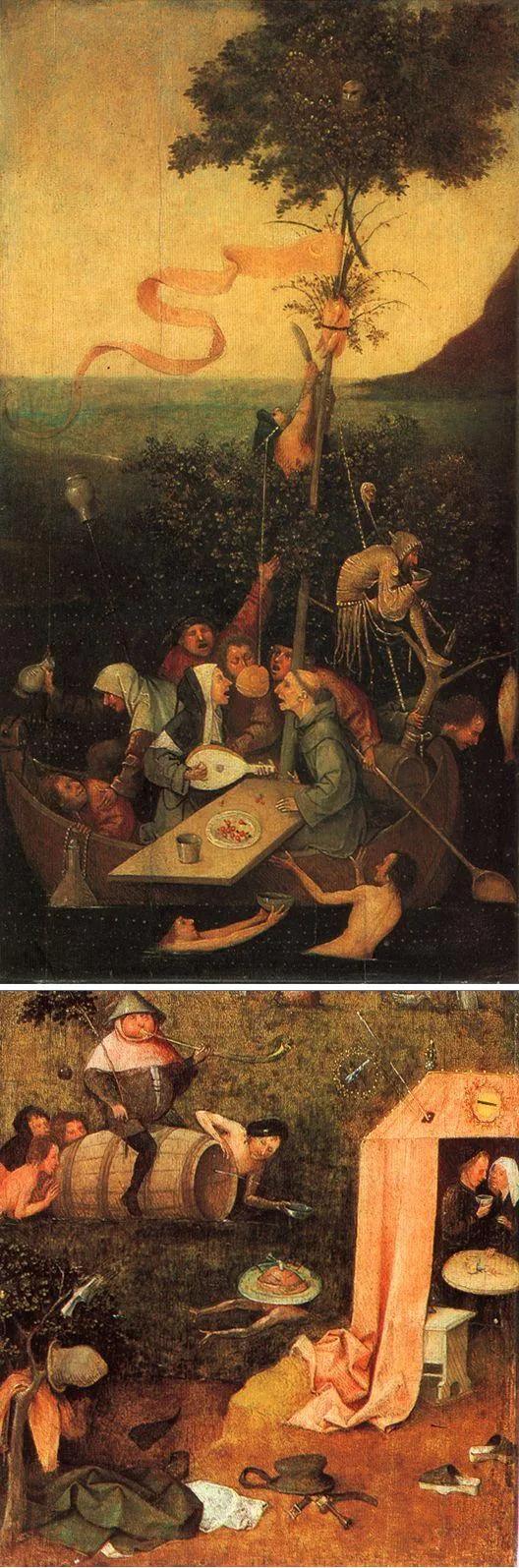
The exterior of the wings is thought to be The Wayfarer, the painting now in the Museum Boijmans Van Beuningen, Rotterdam. Dendrochronology, the dating of the oak boards by their tree rings, found that boards of the Washington panel came from the same tree as the Rotterdam Wayfarer, strong physical evidence for the reconstruction. The same analysis complicates the date: Hand’s catalogue proposed around 1500 on the basis of the wood, the Bosch Research and Conservation Project has favoured about 1500–1510, and the National Gallery of Art now catalogues the panel as about 1485–1490.
When and why the triptych was taken apart is unknown. Its pieces resurfaced separately, centuries later, in Paris, New Haven, Rotterdam and Washington.
No pedigree: how the panel reached Washington
For most of its history the panel is invisible. The first trace is a small pen drawing after it, attributed to the English artist William Henry Brooke and found in a sketchbook of mainly topographical views, which places the painting in a private collection in or near Arundel, Sussex, around 1826. A century later it passed through London dealers. In 1931 the firm of Asscher and Welker offered it to the Louvre, writing that it came from an obscure collection.
out of a small unknown collection, and as such has no pedigree.
The Louvre did not buy it. By about 1932 it belonged to Baron Joseph van der Elst, a Belgian diplomat and collector. In March 1951 the Samuel H. Kress Foundation acquired it, and in 1952 it entered the National Gallery of Art, where Brooke’s drawing, given in 1983, now keeps it company in the collection.
c. 1450
The Ars moriendi woodcuts circulate the scene of the dying man tempted by avarice.
c. 1485–1510
Bosch paints the panel as the right wing of a triptych; datings vary.
1516
Bosch dies in ’s-Hertogenbosch.
c. 1826
A drawing after the panel places it in a private collection near Arundel, Sussex.
1931
Asscher and Welker offer it to the Louvre, admitting it has “no pedigree”.
c. 1932
Owned by Baron Joseph van der Elst.
1951
Acquired by the Samuel H. Kress Foundation.
1952
Enters the National Gallery of Art, Washington.
1986
Hand and Wolff publish the infrared findings in the NGA systematic catalogue.
Source: National Gallery of Art provenance record and open data; Hand and Wolff, Early Netherlandish Painting (1986); Yale University Art Gallery
How to look at Death and the Miser for yourself
In Washington, stand close and look for the places where the drawing shows through: in many passages Bosch’s quick dark lines are visible beneath the thin colour, especially where the paint is lightest. Then step back and follow the diagonal from Death’s arrow to the man’s chest and on to the crucifix in the window. That line is the painting’s argument.
- Look at the man’s right hand. It is open and undecided, which is exactly what the underdrawing shows Bosch removing.
- Find the lantern-bearing demon on the canopy and the single ray from the crucifix: false light and true light.
- Compare the two old men: the busy one in green and the dying one in bed.
- Look into the chest at the coins and the sealed paper, and ask who is really keeping account.
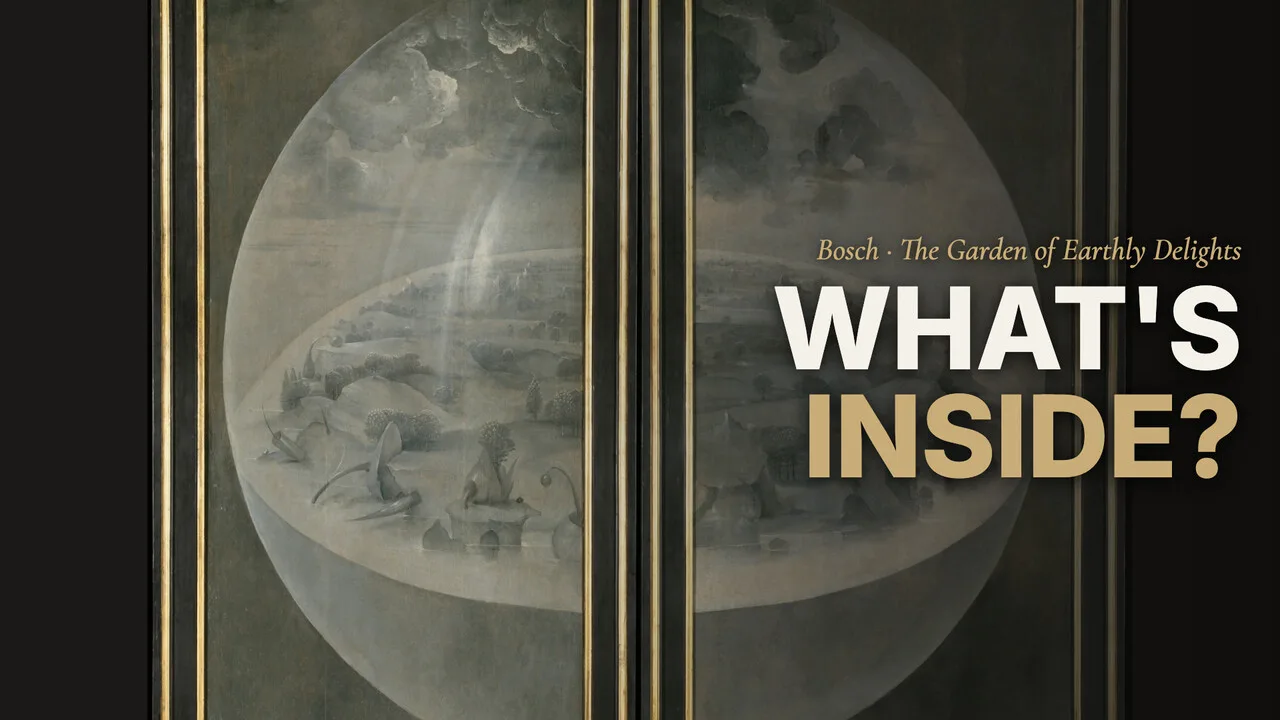
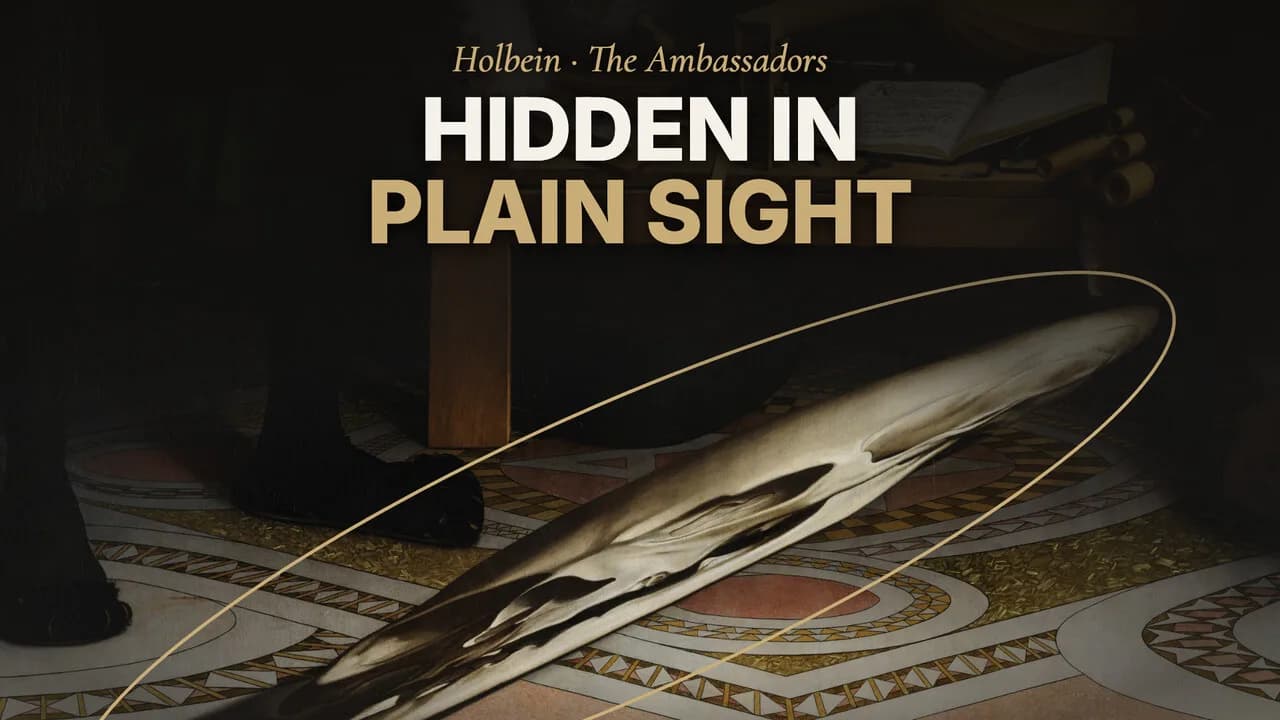
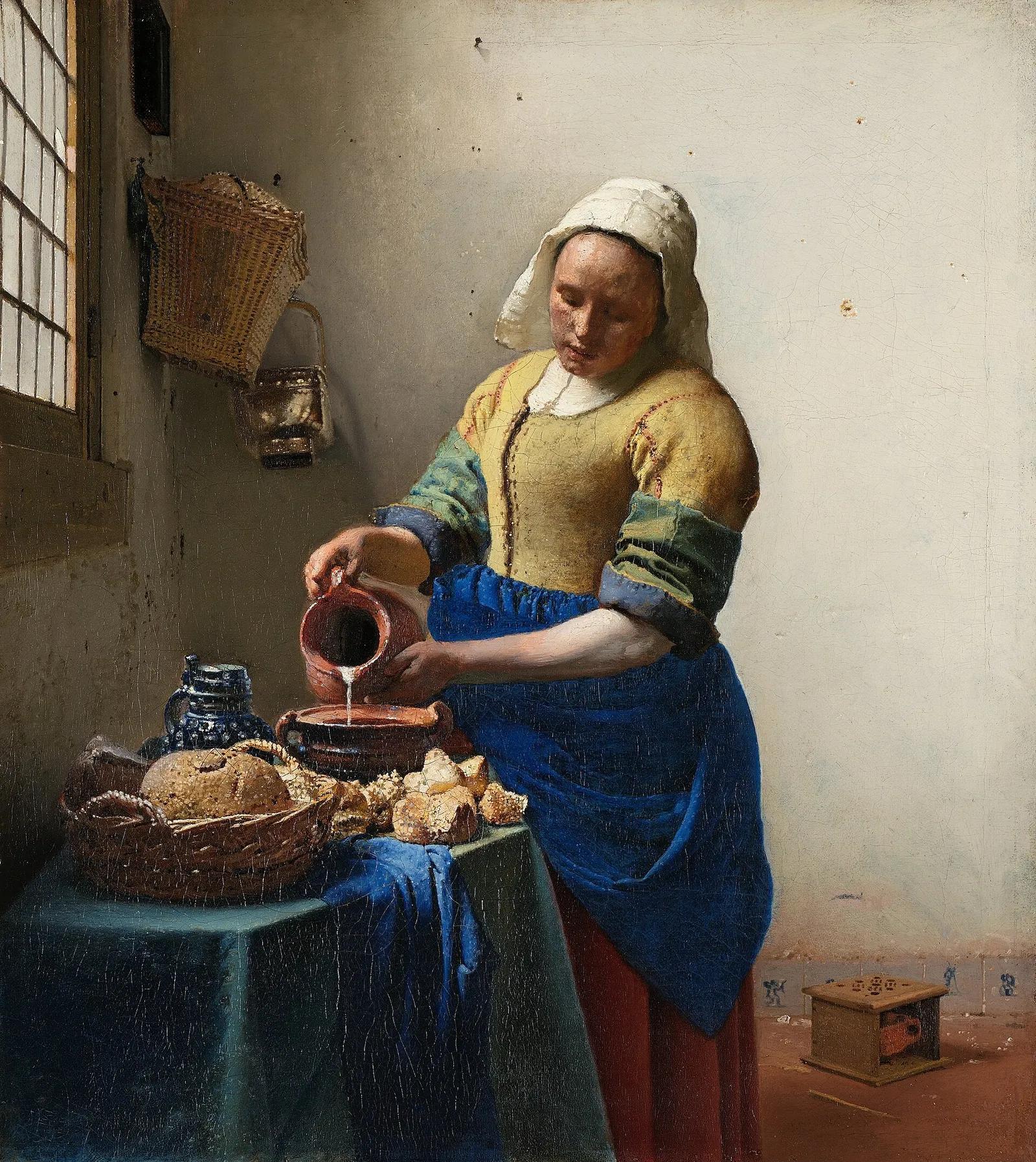
Bosch’s larger visions are explored in our story on The Garden of Earthly Delights. For another painting that confronts its viewers with death, see the skull in Holbein’s Ambassadors; for another change of mind revealed by technical imaging, see Vermeer’s Milkmaid.
Questions people ask
What is the meaning of Bosch’s Death and the Miser?
It shows a dying man’s last choice between salvation and his money. Death enters with an arrow, an angel points him to a crucifix, and a demon offers a bag of gold. Based on the Ars moriendi, the Art of Dying, it warns against avarice, but unlike its sources it leaves the outcome unresolved.
What did infrared reveal in Death and the Miser?
Infrared reflectography shows Bosch’s underdrawing. In it the dying man holds a money purse in one hand and an ornate covered cup in the other, already accepting the devil’s offer. In the finished painting Bosch removed both, leaving the man’s hand open and his choice undecided. Other drawn objects in the foreground were also never painted.
Where is Death and the Miser?
The panel is in the National Gallery of Art in Washington, DC, accession number 1952.5.33, part of the Samuel H. Kress Collection. It measures 93 by 31 centimetres. It once formed the right wing of a triptych whose other surviving parts are The Ship of Fools in the Louvre and An Allegory of Intemperance at Yale.
Who is the old man in green in Death and the Miser?
Most scholars read him as the miser himself earlier in life, shown in the foreground hoarding coins in a chest while holding a rosary, so that two moments of one life appear together. The National Gallery of Art describes him as trying to serve God and Mammon at the same time. The identification is interpretation, not documented.
When did Bosch paint Death and the Miser?
Dates vary. The National Gallery of Art catalogues it as about 1485 to 1490. Earlier dendrochronological study of the oak panel suggested around 1500, and the Bosch Research and Conservation Project has proposed about 1500 to 1510. Bosch died in 1516, so all proposals fall within his mature career.
Sources and further reading
- Death and the Miser (1952.5.33), collection record and provenance, National Gallery of Art
- National Gallery of Art open data (objects.csv), National Gallery of Art, GitHub
- An Allegory of Intemperance (1959.15.22), Yale University Art Gallery
- Review of Hand and Wolff, Early Netherlandish Painting (1986), Jheronimus Bosch Art Center
- Hieronymus Bosch, Death and the Miser: pigments and technique, ColourLex
- Death and the Miser, Wikipedia
- Infrared reflectogram, Death and the Miser, Wikimedia Commons
Images are public-domain or CC0 reproductions from Wikimedia Commons, credited under each figure. Interpretations are attributed to the scholars who hold them.
Keep looking
Know someone who should see this?
Send them the story of Death and the Miser.