
Vinci Stories · Johannes Vermeer
The Milkmaid by Vermeer: What He Painted Out, and Why the Empty Wall Matters
In 2022 the Rijksmuseum's scientists found two things under the surface of Vermeer's most famous kitchen: a rack of jugs behind the maid's head and a willow fire basket at her feet. Both were painted out by the artist. What he removed explains why the picture feels so still.
- Work
- The Milkmaid, c. 1660
- Where to see it
- Rijksmuseum, Amsterdam
- Reading time
- 8 min
- Updated
The Milkmaid by Vermeer at a glance
A kitchen maid stands at a table by a window and pours milk, in a thin white thread, from an earthenware jug into a two-handled bowl. Around her lie bread in a wicker basket, broken rolls, a blue cloth and a stoneware jug with a pewter lid. Behind her there is almost nothing: a whitewashed wall, a nail, a nail hole, a basket and a brass pail hanging by the window. The Milkmaid is small, less than half a metre in each direction, and it has hung in the Rijksmuseum since 1908, and it has become one of the defining images of Dutch painting.
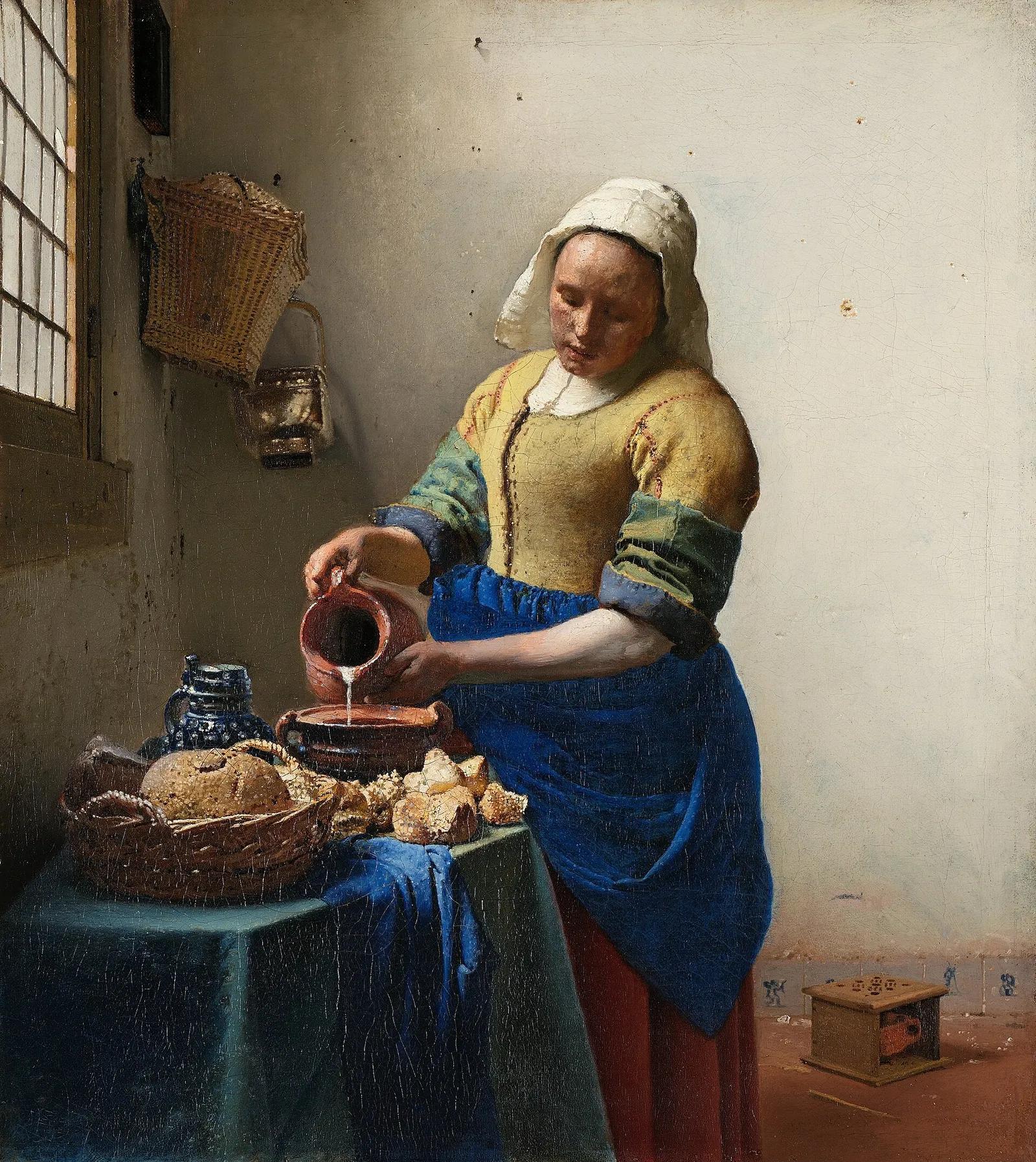
The picture looks simple, which is the point. Almost every decision Vermeer made in it was a decision to leave something out, and since September 2022 we know two of those decisions in detail.
What Vermeer painted out of The Milkmaid: the 2022 scans
Ahead of its 2023 Vermeer exhibition, the Rijksmuseum examined The Milkmaid with a team of conservators and scientists working with colleagues from the Mauritshuis in The Hague. They used macro X-ray fluorescence scanning (which maps chemical elements, and so pigments, across the surface), reflectance imaging spectroscopy and short-wave infrared imaging: the same family of non-invasive tools the museum had used in Operation Night Watch on Rembrandt's cut-down *Night Watch*. The results were announced on 8 September 2022.
- A jug holder. On the wall behind the maid's head, Vermeer sketched in black paint a wooden rack with several jugs hanging from it, then left it undeveloped and covered it with the plaster wall we see. The museum notes that a miniature version of exactly this kitchen fitting survives in Petronella Oortman's dolls' house of about 1690, also in the Rijksmuseum, and that one probably hung in Vermeer's own house.
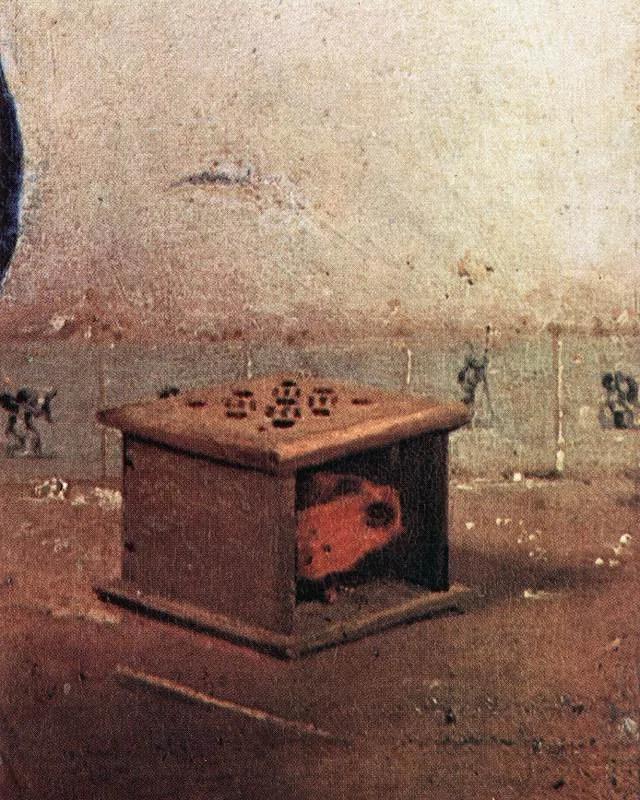
- A fire basket. At lower right, where the foot warmer now stands, was a large object woven from willow. Earlier infrared images had shown it, and it had long been read as a clothes basket. The museum now identifies it as a fire basket: a household item in which a bowl of glowing coals was set to keep newborns warm and dry nappies. Vermeer's estate inventory suggests he owned one. He later covered it with the foot stove, the row of Delft tiles and the floor.
- A fast first lay-in. Beneath the maid's arm the scans found a hasty black underpainting, which shows that Vermeer first blocked out the scene in light and dark before refining it. That sits uneasily with the old image of a painter who worked only slowly and minutely.
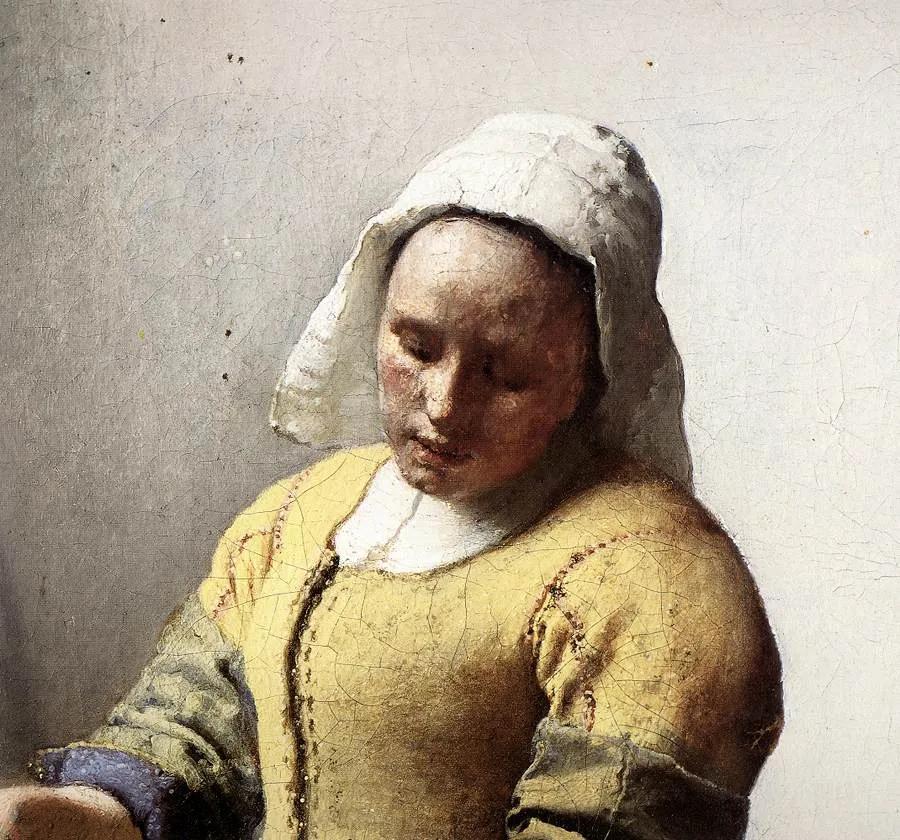
Why remove them? Vermeer left no notes, so any answer is interpretation. But the effect is easy to test with your own eyes. Put a rack of jugs behind her head and the eye would hop from her cap to the crockery; take it away and her head, bent and lit from the left, reads against a calm field of light. Swap a bulky domestic basket for a small foot stove and a band of tiles, and the lower right corner becomes quiet enough to let the stream of milk be the only movement in the room.
How the picture is built: light, bread and the camera obscura question
Light enters from the window at left and falls across the maid's sleeve, cap and the table. The nail on the back wall throws a tiny shadow to the right, a detail that tells you the direction of the light as surely as the window does. Close examination has also found a pinhole in the paint above the maid's right hand, the vanishing point from which Vermeer could stretch strings to lay out his perspective lines.
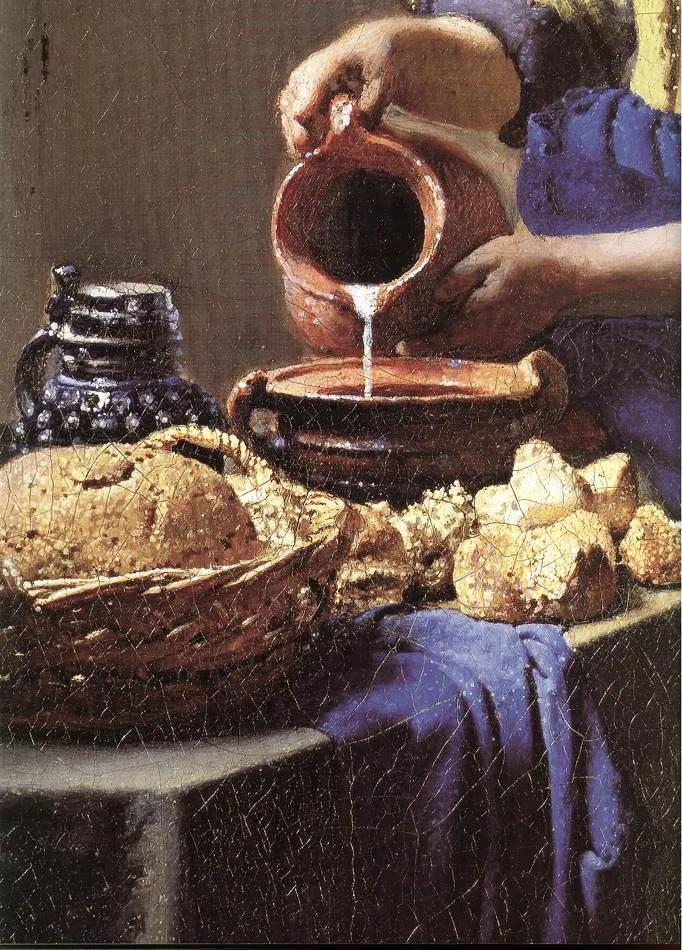
The bread is where the paint surface becomes remarkable. Vermeer covered the crusts and the basket with tiny raised dabs of light paint, often called pointillés, so that the surfaces sparkle. Some scholars connect these globules of light to the out-of-focus highlights produced by a camera obscura, a darkened box or room in which a lens projects an image. Others think he could have arrived at the effect by looking hard and painting thickly. No document shows Vermeer owned or used one, so the camera obscura remains a hypothesis, not a fact; what is certain is that the dots are deliberate and that they make the bread look more lit than it would in daylight.
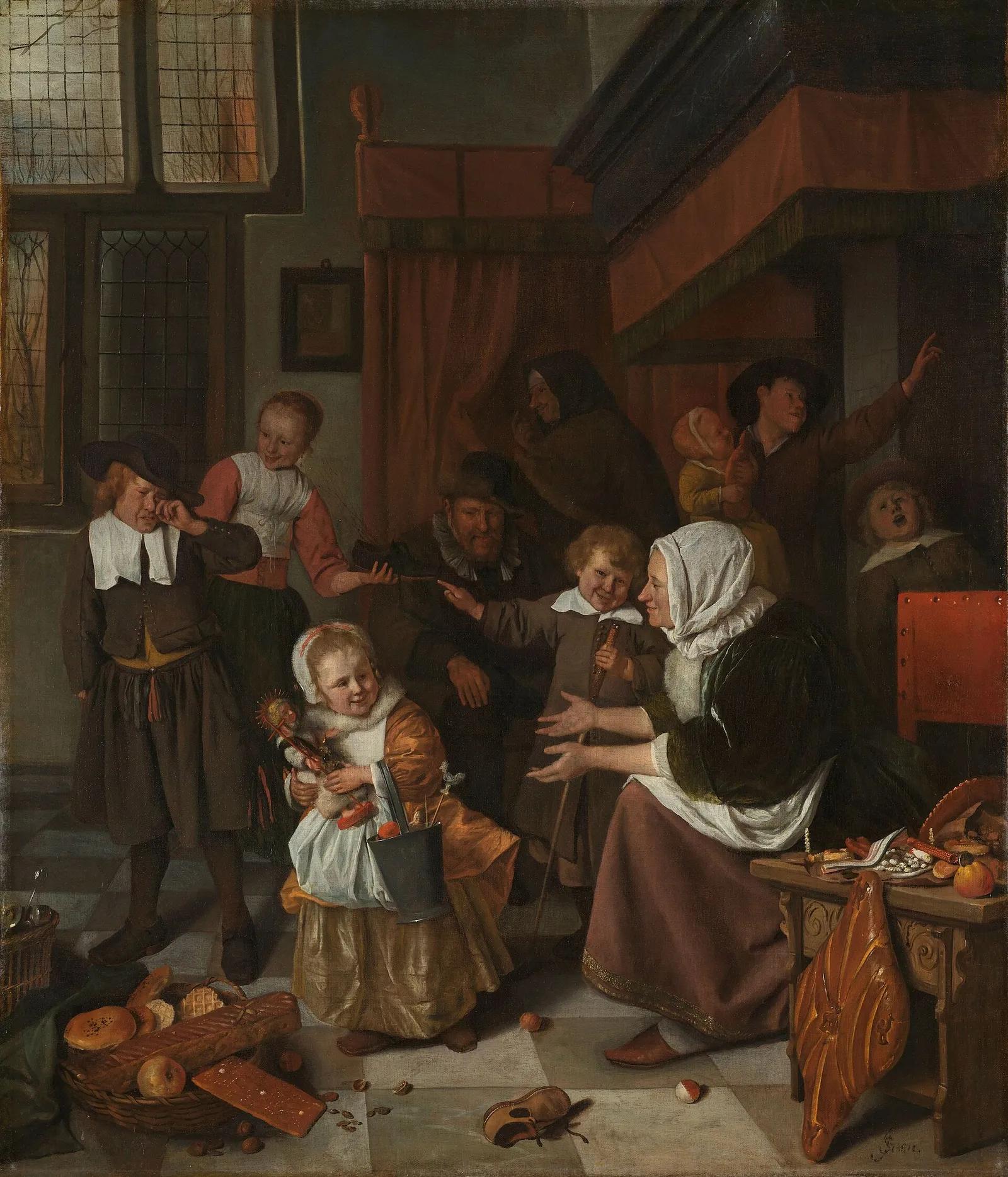
Look also at the lower right. Among the blue and white Delft tiles along the base of the wall is one showing a Cupid, half hidden between the skirt and the foot warmer. Some writers read it as a discreet hint of desire, in a culture where kitchen maids were stock figures of flirtation in prints and paintings; others think it is simply a tile. The foot warmer itself, a wooden box with a perforated lid around a pot of coals, carried similar jokes in Dutch imagery. Vermeer gives none of them the emphasis that Jan Steen would. His maid is absorbed in her work, and the Rijksmuseum's own description puts it just that way.
Vermeer's pigments: a blue from Afghanistan and a forgotten yellow
The apron and the cloth on the table are natural ultramarine, the most expensive blue in Europe, ground from lapis lazuli mined in the Badakhshan region of present-day Afghanistan. Vermeer layered it in glazes over darker underpaint, which is why the apron looks deep rather than flat. The bodice is lead-tin yellow, the brightest yellow available to a seventeenth-century painter. The pigment fell out of use in the eighteenth century, was confused with other yellows, and was identified again only in 1941 by Richard Jacobi at the Doerner Institute in Munich. The red skirt combines vermilion with a red lake glaze, and the wall is lead white mixed with umber and charcoal black.
These are not incidental facts. A small painting that used ultramarine this freely was an expensive object to make, and Vermeer's output was tiny: around 36 or 37 paintings survive. That economy helps explain both his reputation and his debts.
Vermeer in Delft: patrons, debts and a baker's bill
Vermeer was baptised in the Nieuwe Kerk in Delft on 31 October 1632. In April 1653 he married Catharina Bolnes, and in December of that year he registered as a master in the city's Guild of Saint Luke. The couple had eleven children who are recorded. His most important local supporters were probably Pieter van Ruijven and his wife Maria de Knuijt; she left Vermeer 500 guilders in her will of 1665, and many of the 21 Vermeers later owned by their son-in-law Jacob Dissius were probably theirs.
The French invasion of 1672 wrecked the Dutch art market. Vermeer was buried in the Oude Kerk on 15 December 1675, leaving his widow in debt. In January 1676 she handed two of his paintings to the Delft baker Hendrick van Buyten as security for a bread bill of more than 617 guilders. Van Buyten let her repay in instalments. It is one of the plainest documents in art history: a painter whose household ate on credit, settling the account in pictures.
From a 1696 auction to the Rijksmuseum: the Milkmaid's provenance
The painting first appears with certainty at the Dissius sale in Amsterdam on 16 May 1696, as lot 2. It fetched 175 guilders. Over the next century it passed through a run of Amsterdam collections, and its price climbed unevenly, as the Rijksmuseum's provenance record shows.
guilders
| 1696 Dissius sale | 175 |
|---|---|
| 1701 Rooleeuw sale | 320 |
| 1719 Van Hoek sale | 126 |
| 1765 De Neufville sale | 560 |
| 1768 Dulong sale | 925 |
| 1798 De Bruyn sale | 1,550 |
| 1813 Muilman sale | 2,125 |
Source: Rijksmuseum, object record SK-A-2344, provenance
The 1813 buyer, Lucretia Johanna van Winter, brought the picture into the Six family of Amsterdam. When the heirs of Jonkheer Pieter Hendrik Six (1827–1905) put the family collection up for sale, the purchase became a public argument: in parliament, the heritage campaigner Victor de Stuers argued that the painting must stay in the Netherlands at almost any cost, while the socialist leader Pieter Jelles Troelstra opposed the expense and argued for buying modern art instead. In 1908 the Rijksmuseum bought The Milkmaid with 38 other paintings for 550,000 guilders, with support from the Vereniging Rembrandt.
1632
Johannes Vermeer baptised in Delft, 31 October
1653
Marries Catharina Bolnes; joins the Delft Guild of Saint Luke
c. 1660
Paints The Milkmaid, sketching then removing a jug rack and a fire basket
1675
Vermeer buried in the Oude Kerk, Delft, 15 December
1676
His widow pledges two paintings to the baker Hendrick van Buyten against a bread debt
1696
Sold at the Dissius sale in Amsterdam for 175 guilders
1813
Bought for Lucretia Johanna van Winter for 2,125 guilders
1908
Rijksmuseum acquires it from the Six heirs with 38 other paintings
2022
Scans reveal the painted-out jug holder and fire basket (8 September)
2023
Vermeer exhibition at the Rijksmuseum draws 650,000 visitors
Source: Rijksmuseum object record and press releases (2022, 2023); The Leiden Collection, Johannes Vermeer biography
The 2023 exhibition, which ran from 10 February to 4 June, brought together more of Vermeer's paintings than any show before it. The Rijksmuseum reported 650,000 visitors from 113 countries, the most successful exhibition in its history, and The Milkmaid was at its centre.
How to look at The Milkmaid in the Rijksmuseum
Start at the wall, not the woman. Find the nail and its shadow, the empty hole beside it, and imagine the rack of jugs the scans found there. Then drop to the lower right and look at the tiles and the foot warmer, knowing a big willow basket sits underneath. Only then go to the table: the pointillés on the crusts, the jug's rim, the thread of milk that never quite reaches the bowl's surface in your eye. Compare the picture with the crowded, signal-filled room of the Arnolfini portrait and the difference is not skill but intent.
- Stand at an angle to the canvas to catch the raised paint on the bread and basket.
- Look for the pinhole above the maid's right hand, the vanishing point of the perspective.
- Check the colour of the apron in its shadows: the depth comes from ultramarine glazes, not black.
- Notice that she is absorbed in the task and never meets your gaze.
If you cannot travel to Amsterdam, the Rijksmuseum publishes very high-resolution images of the painting online, and the 2022 research images are a useful second layer: they show a busier first idea under the stillness we have come to call Vermeer.
Questions people ask
What was hidden in Vermeer's The Milkmaid?
Research announced by the Rijksmuseum on 8 September 2022 found two objects Vermeer painted out himself: a jug holder with several jugs, sketched in black on the wall behind the maid's head, and a large willow fire basket at lower right, later covered by the foot stove, Delft tiles and floor. The scans also showed a quick dark underpainting beneath her arm.
Where is The Milkmaid by Vermeer now?
The Milkmaid belongs to the Rijksmuseum in Amsterdam, inventory number SK-A-2344. The museum bought it in 1908 from the heirs of Jonkheer Pieter Hendrik Six, together with 38 other paintings, for 550,000 guilders, with support from the Vereniging Rembrandt. It hangs among the museum's seventeenth-century masterpieces, though loans and rehangs can move it, so check before you visit.
Did Vermeer use a camera obscura for The Milkmaid?
Nobody knows. The sparkling dots of light paint on the bread resemble the blurred highlights a camera obscura lens produces, which is why some scholars argue he used one. But no document shows he owned or used the device, and a painter could reach the same effect by observation. Treat the camera obscura as a plausible hypothesis, not an established fact.
How big is The Milkmaid painting?
It is small: 45.5 centimetres high by 41 centimetres wide, painted in oil on canvas. Many visitors are surprised by its size because reproductions make it look monumental. The concentrated composition, with a single figure close to the picture plane and a large empty wall, is what gives it that sense of scale.
What pigments did Vermeer use in The Milkmaid?
The blue apron is natural ultramarine, made from lapis lazuli from Afghanistan and applied in glazes. The yellow bodice is lead-tin yellow, a pigment later forgotten and rediscovered in 1941. The red skirt uses vermilion with a red lake glaze, and the wall is lead white mixed with umber and charcoal black.
Sources and further reading
- Rijksmuseum reveals major discoveries on Vermeer's painting The Milkmaid (8 September 2022), Rijksmuseum
- Johannes Vermeer, The Milkmaid, SK-A-2344: object record and provenance, Rijksmuseum
- Rijksmuseum's Vermeer exhibition most successful in its history (1 June 2023), Rijksmuseum
- Johannes Vermeer: biography, The Leiden Collection
- The Milkmaid: catalogue entry, Essential Vermeer
- Hendrick van Buyten and Vermeer's last years, Essential Vermeer
- Lead-tin yellow, ColourLex
Images are public-domain or CC0 reproductions from Wikimedia Commons, credited under each figure. Interpretations are attributed to the scholars who hold them.
Keep looking

Know someone who should see this?
Send them the story of The Milkmaid.