
Vinci Stories · Jan Havicksz. Steen
Jan Steen’s Feast of Saint Nicholas: Sinterklaas Before Santa Claus
Around 1665–68 Jan Steen painted a Dutch household on the feast of Saint Nicholas, with every child’s present laid out on the canvas. Read closely, it is a comedy of reward and punishment, a record of a contested Catholic feast in a Protestant republic, and a distant ancestor of the American Santa Claus.
- Work
- The Feast of Saint Nicholas, 1665–1668
- Where to see it
- Rijksmuseum, Amsterdam
- Reading time
- 10 min
- Updated
What Jan Steen’s Feast of Saint Nicholas shows
A boy stands at the left edge of the room, rubbing his eye with his knuckles. Beside him an older sister holds up a child’s shoe with a bundle of birch twigs poking out of it. Everyone else in the picture already knows what that means. Jan Steen’s The Feast of Saint Nicholas, painted between 1665 and 1668 and now in the Rijksmuseum in Amsterdam, is built around a single domestic verdict: on the feast of Sinterklaas, good children find sweets and toys in their shoes, and naughty ones find a rod.
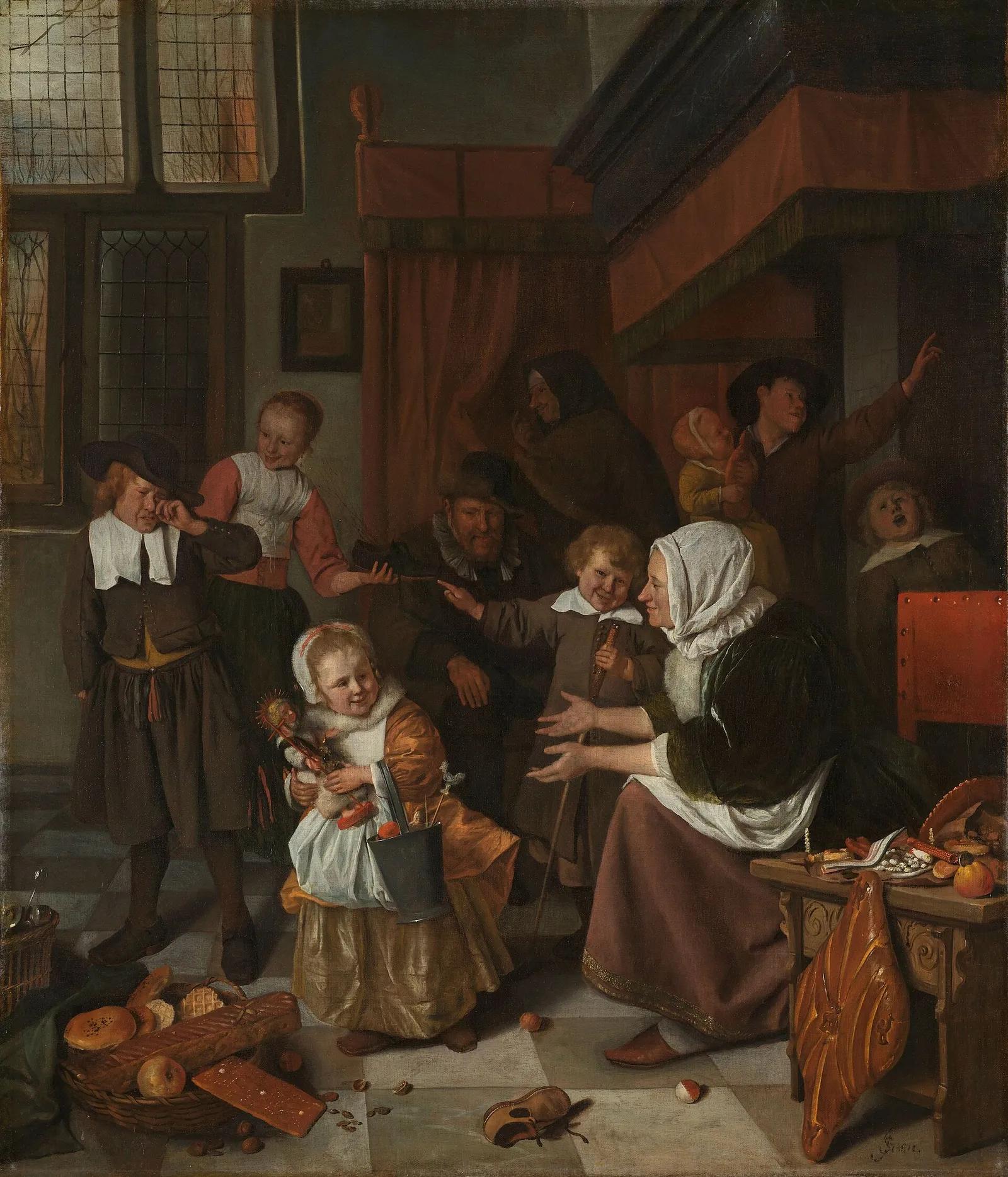
The canvas is modest, 82 by 70.5 centimetres, and almost every square of it is occupied. CODART’s canon of Dutch and Flemish art describes the setting as the living room of a Dutch Catholic family gathered on the evening of 5 December, the eve of Saint Nicholas’s day, with three generations eating sweets, nuts and fruit. The curator Shlomit Steinberg, writing for that canon, calls the scene amusing and convivial, and it is: but it is also unusually precise about objects. The Rijksmuseum’s own catalogue description reads like an inventory, and the painting rewards being read the same way, one present at a time.
The museum counts it among Steen’s most popular works, and CODART calls it the best of three versions of the subject he painted in the 1660s. It entered the national collection by purchase in 1809, when the museum that became the Rijksmuseum was still being assembled, and it has been one of the building’s fixtures ever since.
Every child’s present: the doll, the bucket, the kolf stick
At the centre of the composition is the youngest daughter, in a golden dress with a white apron and a fur-trimmed jacket. She has done well. In one arm she clutches a doll and on the other hangs a tin bucket full of treats. The Rijksmuseum identifies the doll as a figure of Saint John the Baptist, and the close-up bears that out: the little figure wears a rayed halo and carries a red cross-staff. Her mother leans forward with open arms, apparently asking to see or hold the doll; the child turns away and hangs on to it.
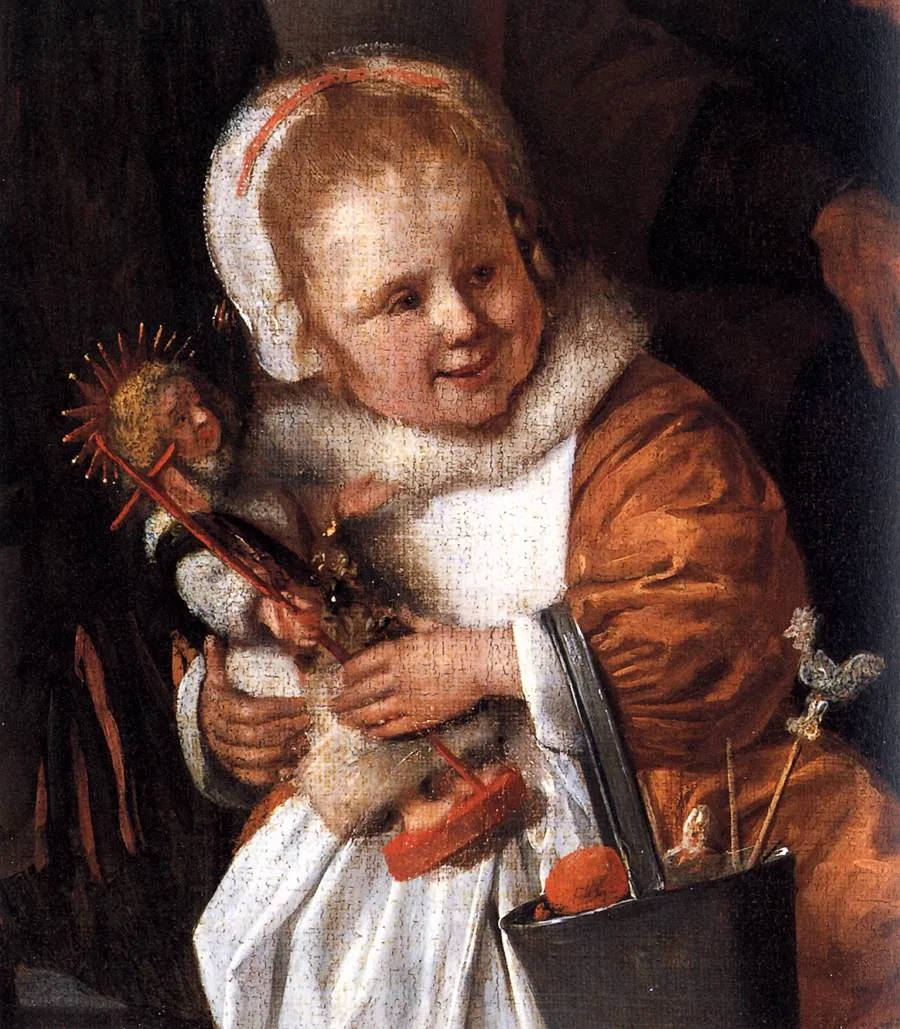
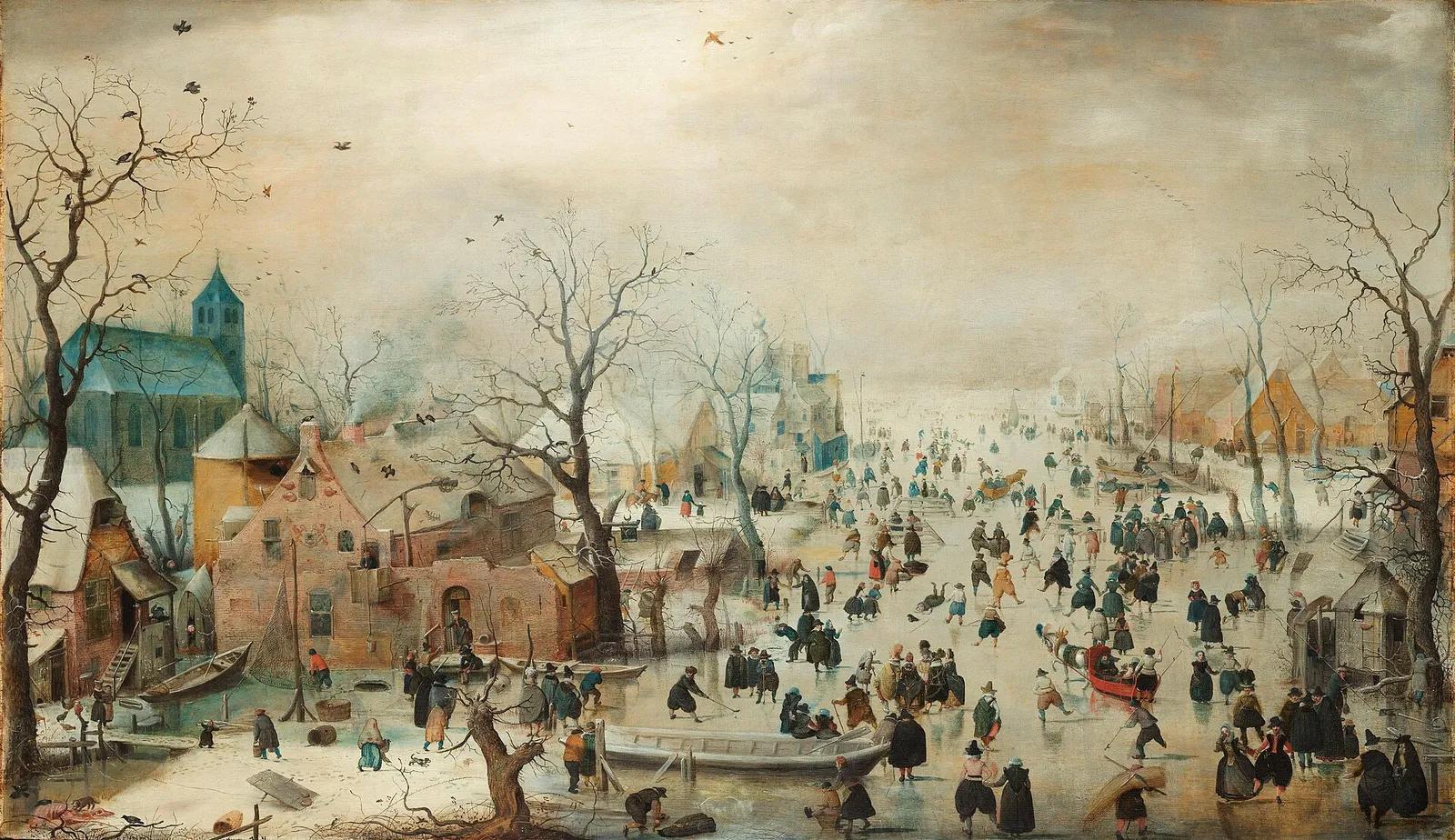
Beside the mother stands a laughing boy holding a long stick with a curved end. This is a kolf club, the stick for the Dutch game of kolf, played on ice in winter and on courts in other seasons; the small ball lies on the floor near the mother’s feet. The same game turns up among the skaters in Hendrick Avercamp’s winter landscape, painted half a century earlier. The boy looks out of the picture at us and gestures towards his brother’s shoe, as if to make sure the lesson is not missed.
The food is painted with the care of a still life. In the lower left corner a basket spills over with breads, a waffle, a long decorated honey cake and an apple; nuts are scattered across the tiles. At lower right, leaning against the table leg, is a large diamond-shaped pastry with curled ends, the festive loaf known as a duivekater. On the table itself are coins, sweets and fruit. The discarded shoe that held the girl’s presents lies empty on the floor in the foreground, which CODART treats as the way into the whole composition: the treats have been taken out of it and moved into her bucket.
- The girl: a Saint John the Baptist doll and a bucket of sweets, including a white sugar bird on a stick.
- The laughing boy: a kolf club, with its ball on the floor by his mother’s feet.
- The toddler at the back: a gingerbread figure of the saint, held up in the arms of an older brother.
- The crying boy: one bundle of birch twigs in his shoe.
- The household: a basket of breads and cakes, a waffle, nuts, fruit, coins and a duivekater loaf.
Be good, or else: the birch rod and the grandmother in the shadows
The Rijksmuseum sums up the moral in a single line on its masterpiece page, and the painting stages it without subtlety. The weeping boy, hat pushed back, is the one family member left out. His sister’s gesture with the shoe is the cruellest thing in the room, and Steen paints her grin with obvious relish.
Sweets for the sweet, birches for the naughty.
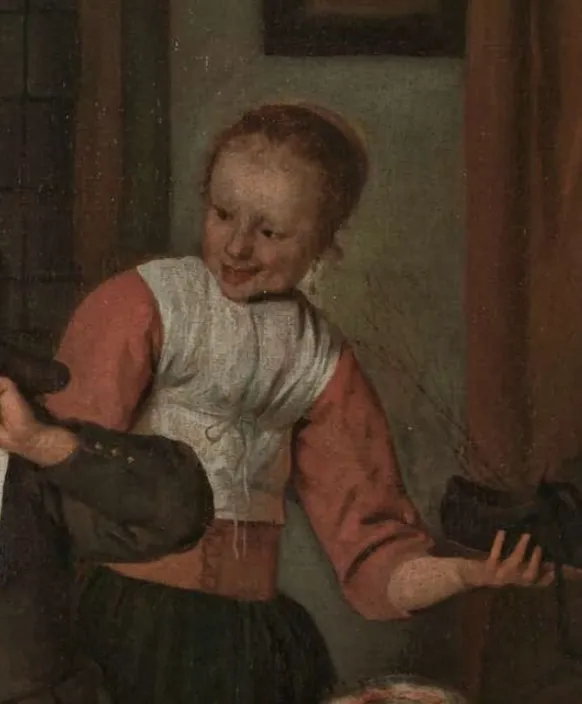
Then look past him into the dim centre of the picture. Behind a pulled-back bed curtain an old woman in a dark hood smiles and crooks a finger towards the crying boy. Many writers read her as the grandmother, quietly signalling that something has been kept back for him, and that the rod is a joke at his expense rather than the end of the story. It is an attractive reading, and it fits Steen’s habit of softening his moral lessons with comedy, but the painting does not show a hidden present. What it does show is that the punishment is public and temporary, and that the adults are in on it.
Some popular accounts identify the children as members of Steen’s own family. That claim cannot be checked against any document, and it is safer to treat the faces as types: Steen reused models, and his genre scenes are not portraits. The point of the picture is the range of reactions to one night’s verdict, from glee to tears, and Steen gives each child a distinct one.
The chimney and the feast of Sinterklaas in the 1660s
At the right, a boy carrying a baby points up into the great hood of the fireplace, where the saint is supposed to have come and gone in the night. Next to him another boy, mouth wide open, is singing; the Rijksmuseum’s catalogue describes young people singing a Sinterklaas song by the fireplace. Saint Nicholas himself does not appear. In Steen’s day, as the Meertens Institute’s research is usually summarised, the saint did not walk into Dutch living rooms or arrive with helpers: he left presents in shoes set by the hearth, and the children found them afterwards. The painting shows the aftermath, not the visit.
That absence matters, because the feast was contested. Saint Nicholas was a Catholic saint, the fourth-century bishop of Myra, and the Dutch Republic was officially Reformed. Protestant ministers and town councils repeatedly tried to restrain the December markets and the baking of saints’ images in dough and gingerbread; the feast survived as a family celebration for children. Steen came from a Catholic family of Leiden brewers, and the Saint John doll in the girl’s arms is a devotional object as well as a toy.
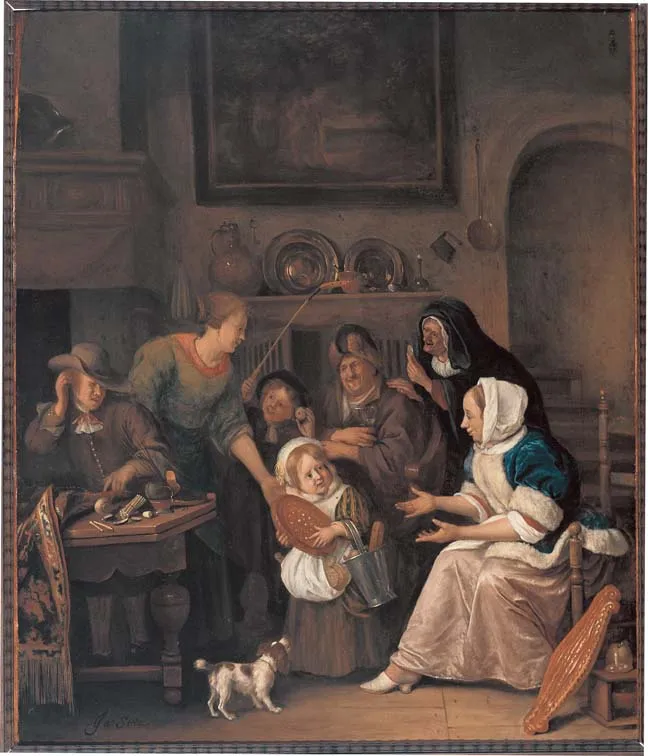
The Museum Catharijneconvent in Utrecht holds another version of the subject associated with Steen in which, according to DutchNews and other published summaries, the girl holds a plain piece of gingerbread rather than a saint. The usual explanation is that the Amsterdam picture was painted for a Catholic buyer and the other for a Protestant one. That is a reasonable inference from the iconography, not a documented fact: no commission records survive for either.
Jan Steen and the ‘Jan Steen household’
Jan Havicksz. Steen was born in Leiden around 1626 and buried there on 3 February 1679. Contemporary sources name three teachers: Nicolaes Knupfer in Utrecht, Adriaen van Ostade in Haarlem, and the landscape painter Jan van Goyen, whose daughter Margriet he married in 1649. He ran a brewery in Delft from 1654, without much success, lived in Warmond and then in Haarlem from 1660 to 1670, where this picture was painted, and returned to Leiden, where he opened a tavern after the art market collapsed in the disaster year of 1672. He was president of the Leiden painters’ guild in 1674.
He was prolific: estimates of his output run to several hundred paintings, of which around 350 are generally accepted today. His scenes of noisy, untidy households gave Dutch a proverb. A ‘huishouden van Jan Steen’, a Jan Steen household, still means a cheerful mess. The Feast of Saint Nicholas is a good example of what the phrase leaves out: the clutter is composed. The empty shoe, the scattered nuts and the toppled basket are all placed to lead the eye, and each object carries a meaning in the story.
Steen’s comedy has a moral spine. His tavern scenes warn against drink and idleness while visibly enjoying both, and here the lesson about behaviour is delivered by children to children. The painter’s sympathy, though, is spread around the room. The crying boy is ridiculous but not wicked, and the grandmother’s beckoning finger suggests that the family will make room for him by the end of the evening.
From Sinterklaas to Santa Claus: how much came from the Dutch?
The English name Santa Claus is a phonetic borrowing of the Dutch Sinterklaas, and the name is recorded in the American press from 1773. Dutch settlers had brought the saint to New Amsterdam in the seventeenth century. But the American Santa was largely assembled in New York in the early nineteenth century by a small circle of antiquarians and writers who liked the idea of a Dutch colonial past. Washington Irving’s comic History of New York (1809) recast the bishop as a stout, pipe-smoking Dutch burgher; much of that portrait was Irving’s invention.
In December 1810 John Pintard, a founder of the New-York Historical Society, commissioned a broadside from the engraver Alexander Anderson for the society’s first Saint Nicholas dinner on 6 December. The St. Nicholas Center describes it as the first American illustration of the saint. It shows him with a birch rod and a purse, and beside the hearth two stockings: one full of toys and sweets, the other holding only rods. A small picture on the mantelpiece contrasts a happy daughter with a sulky son. Steen would have recognised the arrangement at once.
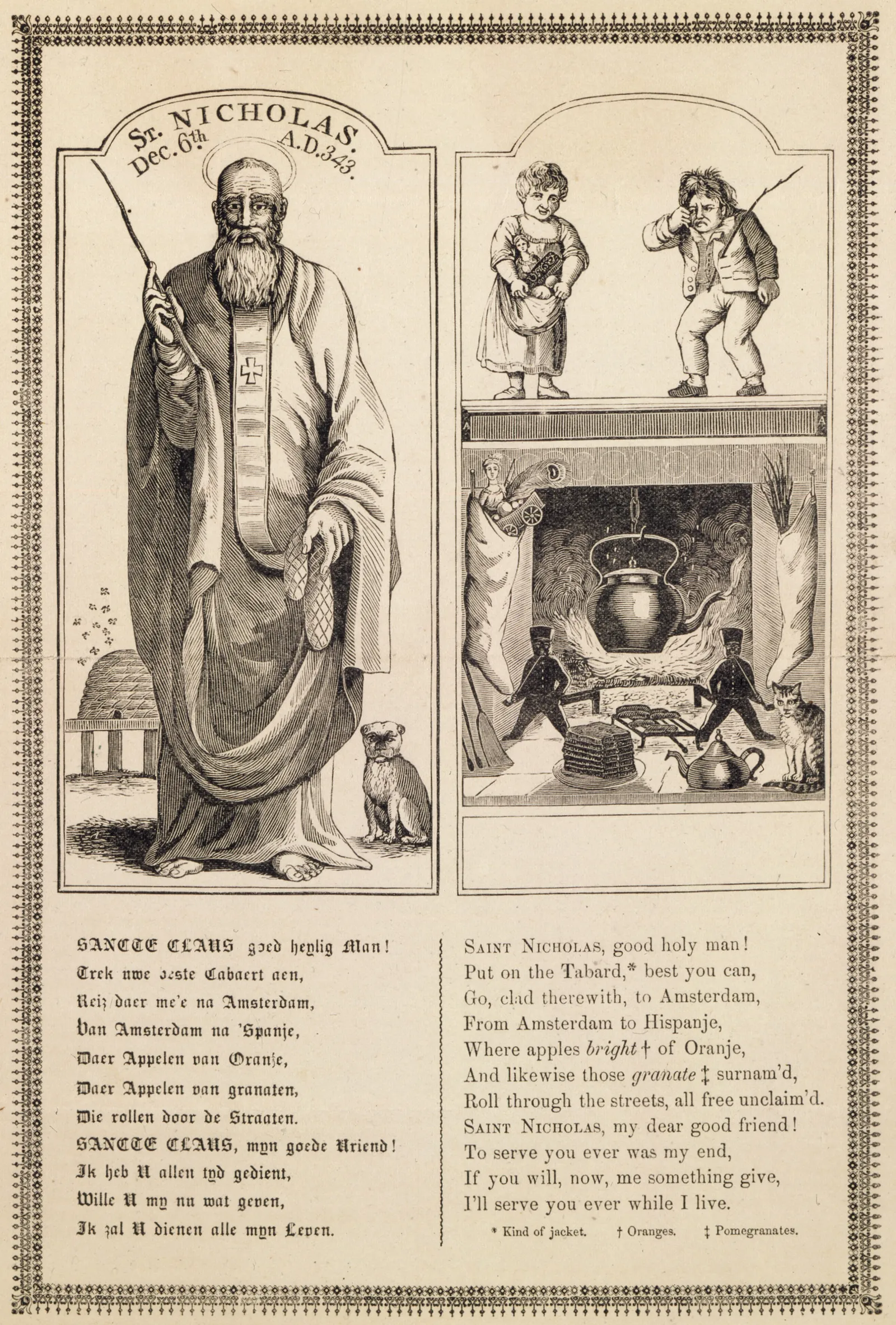
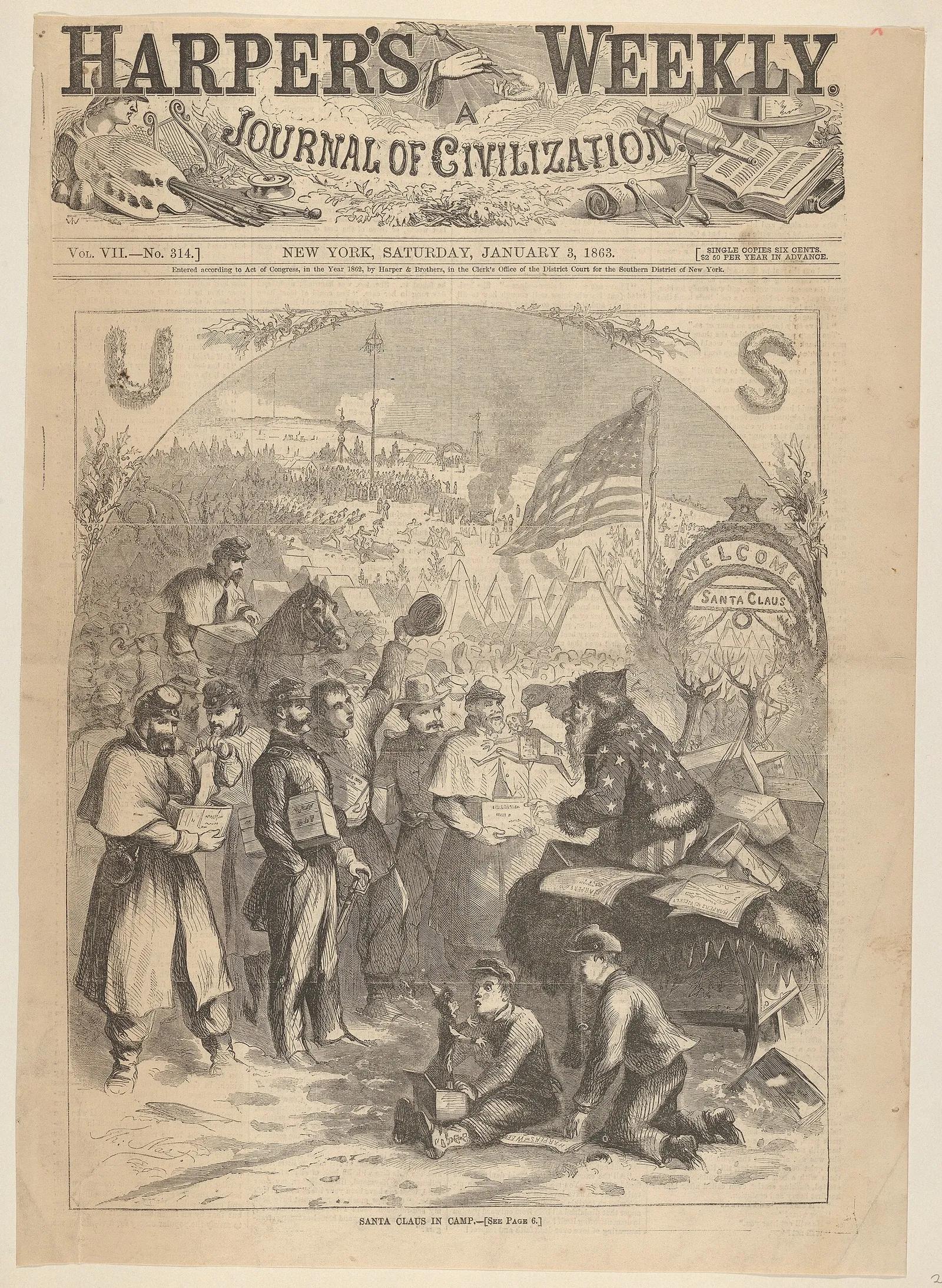
Historians are cautious about how direct the line is. The historian Charles W. Jones, whose research the St. Nicholas Center draws on, showed that Pintard reconstructed the Dutch verse printed on the broadside from the memory of an elderly woman, and argued that the New Yorkers cared little about the saint’s religious meaning. The shoes became stockings; the bishop became, by the 1820s, a jolly figure with reindeer. The poem ‘A Visit from St. Nicholas’, published anonymously in the Troy Sentinel on 23 December 1823, fixed the night-time visit by chimney, and in January 1863 Thomas Nast’s first Santa for Harper’s Weekly put him in a Union camp, a story told in Thomas Nast’s Santa Claus. What survived from the Dutch feast, recognisably, is Steen’s central bargain: gifts for the good, a rod for the rest, delivered down the chimney while the children are not looking.
c. 1626
Jan Steen born in Leiden into a Catholic family of brewers.
1649
Steen marries Margriet van Goyen, daughter of the landscape painter Jan van Goyen.
1660–70
Steen lives and works in Haarlem.
1665–68
Steen paints The Feast of Saint Nicholas, now Rijksmuseum SK-A-385.
1679
Steen buried in Leiden on 3 February.
1773
The name ‘Santa Claus’ appears in the American press.
1809
The painting enters the Dutch national collection by purchase; Washington Irving publishes his History of New York.
1810
Pintard’s Saint Nicholas broadside, engraved by Alexander Anderson, for the New-York Historical Society dinner on 6 December.
1823
‘A Visit from St. Nicholas’ published in the Troy Sentinel on 23 December.
1863
Thomas Nast’s first Santa Claus appears in Harper’s Weekly on 3 January.
Source: Rijksmuseum collection record SK-A-385; St. Nicholas Center; Wikipedia, ‘Jan Steen’ and ‘Santa Claus’
The Feast of Saint Nicholas at a glance
How to look at The Feast of Saint Nicholas yourself
Start where Steen starts you, at the bottom edge: the empty shoe on the tiles, then the basket of bread at left and the duivekater at right. Those three objects frame the floor like props on a stage. Then move up to the faces and try to name each child’s reaction in one word. Steen gives you glee, tears, mockery, wonder and song within a few centimetres of one another.
Next, find the three things that are hard to see in reproduction: the grandmother’s finger in the shadow of the bed curtain, the kolf ball near the mother’s slipper, and Steen’s signature on the far right near the bottom of the table. In the gallery, stand close enough to see the brushwork on the girl’s golden dress, which is looser and faster than the careful still life of the breads.
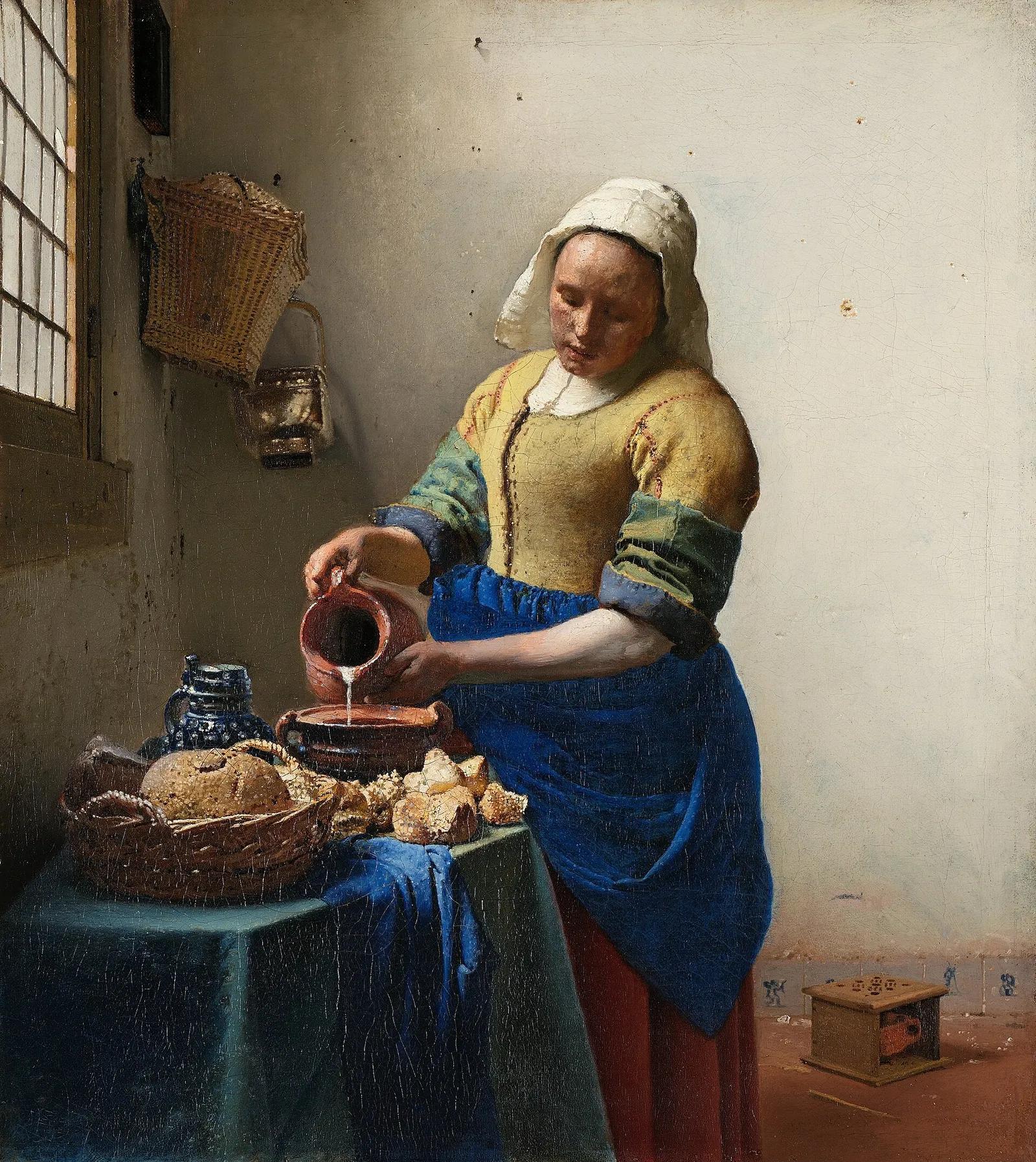
Finally, compare the room with other Dutch interiors in the same museum. Vermeer’s Milkmaid is silent, ordered and almost empty; Steen’s room is full of noise. Both painters were selling the same thing to the same market, a picture of Dutch domestic life, and the difference between them shows how wide that market’s taste could be.
Questions people ask
Where is Jan Steen’s The Feast of Saint Nicholas?
The painting is in the Rijksmuseum in Amsterdam, inventory number SK-A-385. It is oil on canvas, 82 by 70.5 centimetres, and dates from 1665 to 1668. The museum’s record lists it as purchased in 1809, so it has been in the Dutch national collection for more than two centuries.
Why is the boy crying in The Feast of Saint Nicholas?
He has found a birch switch in his shoe instead of presents. On the feast of Saint Nicholas, Dutch children left shoes by the hearth; good children found sweets and toys, naughty ones a rod. His sister holds the shoe up for everyone to see, while an old woman behind the bed curtain beckons to him, which many writers read as a hint that a present has been kept back.
What is the doll the girl is holding?
The Rijksmuseum identifies it as a doll of Saint John the Baptist. The figure has a rayed halo and a cross-staff, the Baptist’s usual attribute. In a Protestant republic, a saint’s image in a child’s arms was pointed, and another version associated with Steen, in the Museum Catharijneconvent in Utrecht, shows the girl with gingerbread instead, which is often explained as a version for a Protestant buyer.
Is Sinterklaas the origin of Santa Claus?
Partly. The name Santa Claus comes from the Dutch Sinterklaas and is recorded in America from 1773, and the rod-or-reward bargain survived. But much of the American figure was invented in New York after 1809 by Washington Irving, John Pintard and their circle, then shaped by the 1823 poem ‘A Visit from St. Nicholas’ and Thomas Nast’s drawings from 1863.
What does ‘a Jan Steen household’ mean?
In Dutch, ‘een huishouden van Jan Steen’ means a noisy, untidy, cheerful household, after the crowded family and tavern scenes Steen painted in the 1660s and 1670s. The phrase can be misleading about his pictures, though. The disorder in The Feast of Saint Nicholas is carefully arranged: each dropped shoe, cake and nut is placed to lead the eye through the story.
Sources and further reading
- The Feast of St Nicholas, Jan Havicksz. Steen, 1665–1668 (SK-A-385), Rijksmuseum
- The Feast of St Nicholas — One Hundred Masterpieces, Rijksmuseum
- The Feast of Saint Nicholas (CODART Canon, Shlomit Steinberg), CODART
- St. Nicholas in New York—1810, St. Nicholas Center
- Eight things about Jan Steen’s The Feast of St Nicholaas, DutchNews.nl
- Jan Steen, Wikipedia
- Santa Claus, Wikipedia
Images are public-domain or CC0 reproductions from Wikimedia Commons, credited under each figure. Interpretations are attributed to the scholars who hold them.
Keep looking
Know someone who should see this?
Send them the story of The Feast of Saint Nicholas.