
Vinci Stories · Hendrick Avercamp
Hendrick Avercamp’s Winter Landscape with Ice Skaters, Explained
Around 1608 Hendrick Avercamp, known as ‘de Stomme’, the mute, painted his largest winter scene: a frozen river crowded with people of every class. Look closely and it is full of jokes, hazards and hidden things, including his own name scratched on a shed, and it raises a careful question about how cold the Little Ice Age really was.
- Work
- Winter Landscape with Ice Skaters, c. 1608
- Where to see it
- Rijksmuseum, Amsterdam
- Reading time
- 9 min
- Updated
What Avercamp’s Winter Landscape with Ice Skaters shows
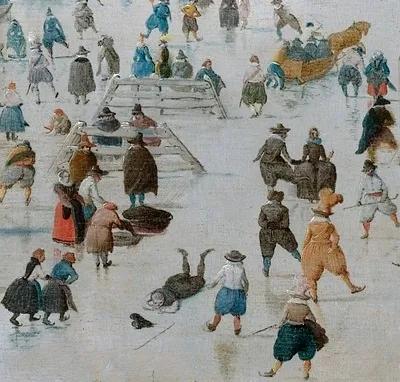
Somewhere near the middle of the ice a man has fallen flat on his back, his legs in the air. Nobody stops for him. Around him skate, stroll, slide and work almost two hundred people: gentlemen in black capes, women with their hands in muffs, children pushing sledges, a couple holding hands, a beggar, a fisherman, a man with a load of reeds on his back. Hendrick Avercamp’s Winter Landscape with Ice Skaters, painted around 1608 and in the Rijksmuseum since 1898, has become one of the images through which people picture the Dutch seventeenth century.
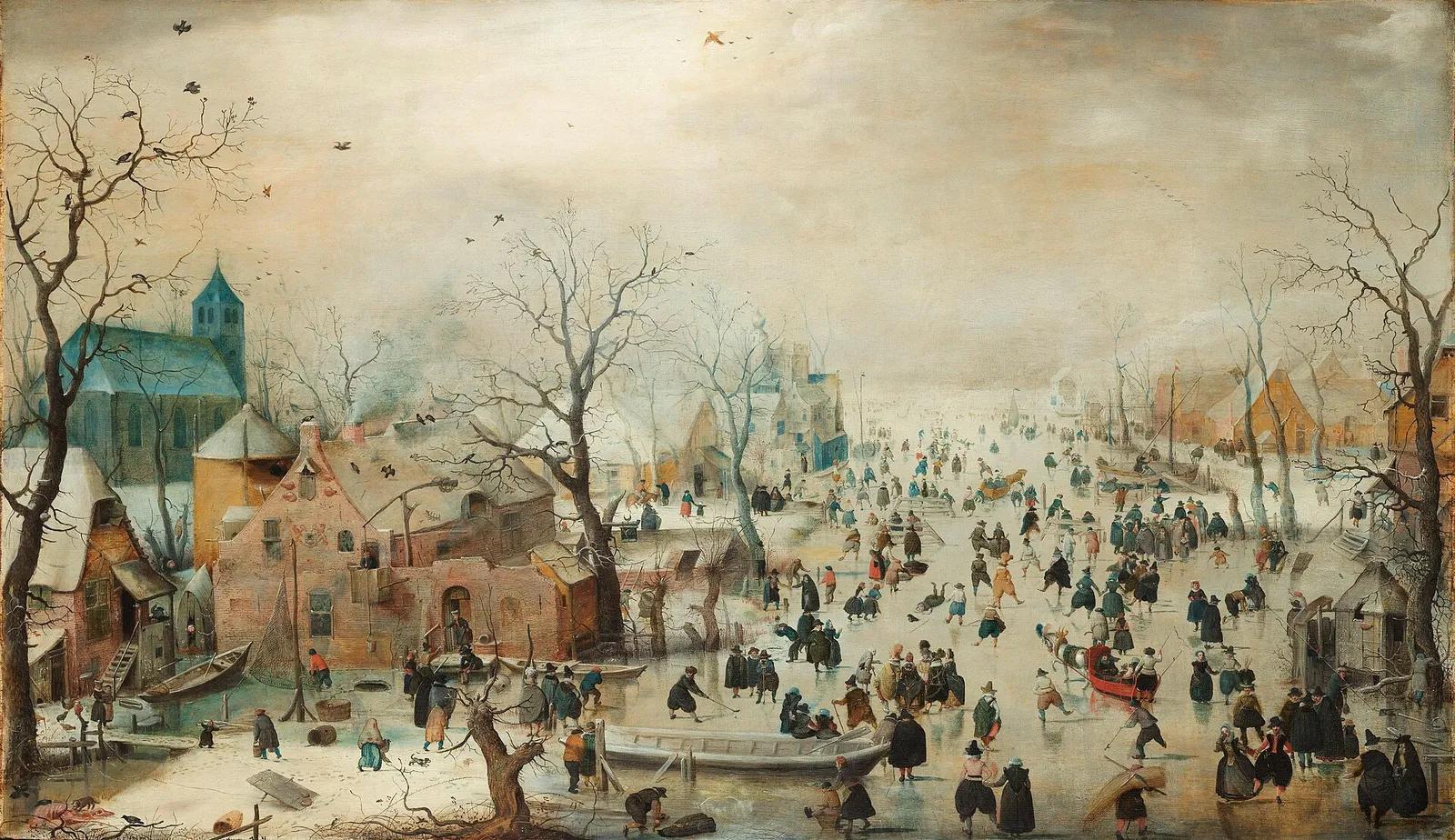
The panel measures 77.3 by 131.9 centimetres, and the Rijksmuseum’s catalogue calls it Avercamp’s largest and most ambitious winter landscape. It is made of three horizontally grained oak planks. Dendrochronology dates the youngest heartwood ring to 1582, which means the panel could have been ready from 1593 but more probably from 1599 or later, consistent with a date around 1608. The high horizon and the Flemish manner of the buildings place it among his early works, alongside winter scenes in Bergen and Schwerin.
CODART’s canon entry lists what the figures are doing: skating, flirting, chatting, working, begging, falling, playing kolf, pushing sleds, riding in sleighs and watching others. It is a survey of a society rather than a portrait of a place. Avercamp rarely painted identifiable towns; the church, the brewery and the farmhouses here are composed, not recorded, and the result is an idealised picture of the young Dutch Republic at leisure on its frozen water.
Avercamp’s signature, scratched among the graffiti
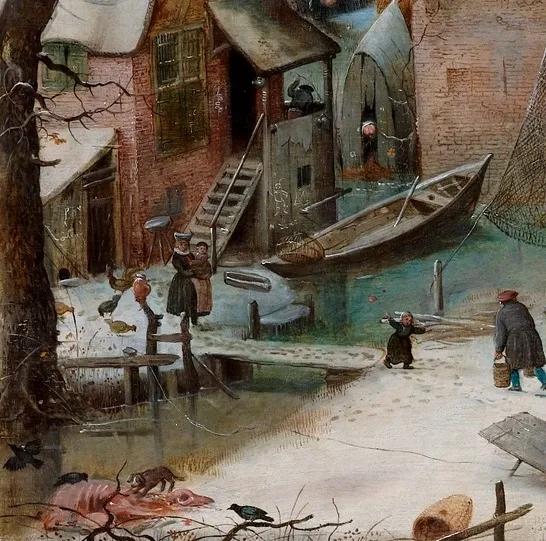
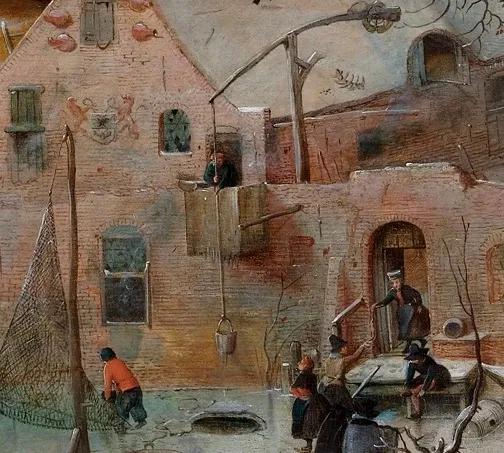
The painting is signed, but not where you would expect. On the right, on the wall of a wooden shed, the Rijksmuseum records the signature ‘HAenricus / Av’, with the H and A joined in a ligature. The shed wall is covered with scrawled graffiti, and the name is written among them as if a passer-by had scratched it there. On the far side of the composition, on a building at left, another graffito of a figure and a boat seems to answer it. The joke is characteristic: the painter puts himself into the picture as one more mark left by the people on the ice.
The museum’s technical notes describe a similar playfulness in the painting process. Some details, such as the small tree in the foreground, were scratched into the wet paint with the end of a brush. The skaters’ shadows are made of fine horizontal strokes laid on the ice, so that the figures seem to glide rather than stand.
Who was Hendrick Avercamp, ‘de Stomme van Kampen’?
Hendrick Avercamp was baptised in Amsterdam on 27 January 1585 and grew up in Kampen, in the province of Overijssel. He was unable to speak and probably deaf, and his contemporaries called him ‘de Stomme’, the mute; he is still known as de Stomme van Kampen. He trained in Amsterdam, where he studied with the Danish-born painter Pieter Isaacsz, and the Rijksmuseum points to the Antwerp landscape painter Gillis van Coninxloo, one of many Flemish artists who had settled in the north, as a likely teacher or model. He later returned to Kampen, where he was buried in May 1634.
The Rijksmuseum describes him as the first Dutch painter to specialise in winter scenes. He made many drawings from life, often tinted with watercolour and sold to collectors for their albums, and he built up a stock of figures that he reused for decades, sometimes without updating their clothes. Around 1620 his compositions changed: horizons dropped, the views widened over flooded fields and canals, and the figures became larger and more individual. Winter Landscape with Ice Skaters belongs to the earlier, crowded manner, with the viewpoint high above the ice.
Bruegel and the first Dutch winter landscapes
Avercamp did not invent the winter landscape. Pieter Bruegel the Elder had painted skaters on a frozen river below a village in 1565, with a bird trap set in the snow at lower right, and that composition was copied and reproduced so often that it became a pattern for the genre. The Rijksmuseum notes that Avercamp knew Bruegel’s winter scenes through prints, and the bird trap in the Amsterdam panel is taken directly from Bruegel.
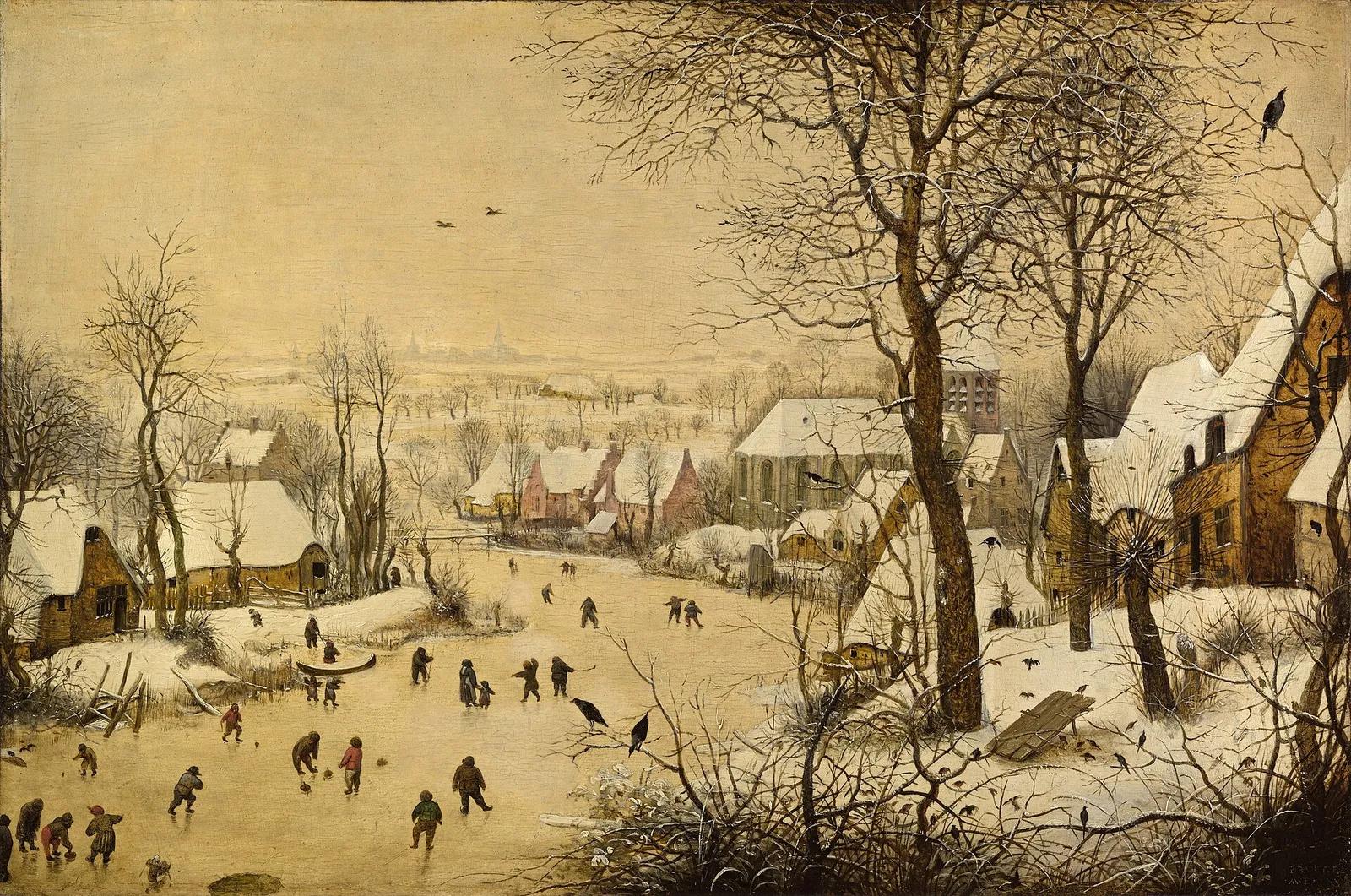
What Avercamp changed was scale and mood. Bruegel’s scene is small and dark, with a sense of menace in the trap waiting for the birds. Avercamp opens the view, lightens the sky to a pearly haze, and turns the ice into a crowded public square where every class meets. Where Bruegel’s skaters are a few dozen, Avercamp’s are a population. That shift, from a Flemish village moral to a Dutch panorama of social life, is the reason the painting sits at the start of the Dutch winter landscape tradition.
Was it really this cold? Avercamp and the Little Ice Age
The painting is often used to illustrate the Little Ice Age, the period of cooler climate between the late Middle Ages and the nineteenth century. That connection is real but needs care. The winter of 1607–08 was exceptionally severe in the Low Countries: the Rijksmuseum notes that waterways and parts of the Wadden Sea froze, and Avercamp’s first winter pictures date from just after it. Frozen rivers and canals were common enough in his lifetime that skating was the most popular winter pastime.
But the Little Ice Age was not one long, uniform freeze, nor did it happen everywhere at once. In 2019 a study in Nature by Raphael Neukom and colleagues, using palaeoclimate reconstructions for the past 2,000 years, found no evidence for a globally synchronous cold epoch. The coldest part of the last millennium most likely came in the fifteenth century in the central and eastern Pacific, in the seventeenth century in north-western Europe and south-eastern North America, and in the mid-nineteenth century over most other regions. Avercamp’s Netherlands, in other words, sat in the right place at the right time for hard winters; his paintings record a regional climate, not a planetary one.
Even so, the paintings are not weather reports. Avercamp worked in the studio from drawings and memory, combining figures and buildings from different sources; DutchNews, summarising the Rijksmuseum’s view, points out that the brewery is seen from above while the rest of the scene is at eye level. The haze, the light and the crowd are composed. What the picture does record accurately is what people did when the water froze: they went out on it, all of them, to work and to play.
How the painting reached the Rijksmuseum
Little is known of the panel’s early history. The Rijksmuseum’s catalogue tentatively connects it with ‘Een ijsvermaak, met vele beelden’, a scene of ice amusements with many figures, in a Rotterdam sale of 19 July 1748, but that catalogue has not been located. The first secure record is the sale of the Gijsbert de Clercq collection in Amsterdam on 1 June 1897, where the dealer C. S. Roos bought it for 345 guilders. He sold it to the museum for 550 guilders, with support from the Vereniging Rembrandt, and the Rijksmuseum records the acquisition in January 1898.
1565
Pieter Bruegel the Elder paints his Winter Landscape with Skaters and a Bird Trap.
1585
Hendrick Avercamp baptised in Amsterdam on 27 January.
1599+
Earliest probable date for use of the oak panel, from dendrochronology.
1607–08
An exceptionally severe winter freezes Dutch waterways.
c. 1608
Avercamp paints Winter Landscape with Ice Skaters.
1634
Avercamp buried in Kampen in May.
1897
Bought by the dealer C. S. Roos at the Gijsbert de Clercq sale in Amsterdam on 1 June, for fl. 345.
1898
Acquired by the Rijksmuseum for fl. 550 with support from the Vereniging Rembrandt.
2019
Neukom et al. in Nature show the Little Ice Age’s coldest phase came at different times in different regions.
Source: Rijksmuseum catalogue entry SK-A-1718 (J. P. Filedt Kok, 2007); Rijksmuseum, ‘Hendrick Avercamp’; Neukom et al., Nature 571 (2019)
How to look at the Winter Landscape yourself
Begin at the lower left corner with the dead horse, where Avercamp starts the eye, then follow the bank to the right along the frozen boat, the kolf players and the fallen skater in the centre. From there, move to the red sleigh, then up to the graffiti shed on the right edge to find the signature. Only then let your eye go into the distance, where the figures become specks and the sky and ice merge.
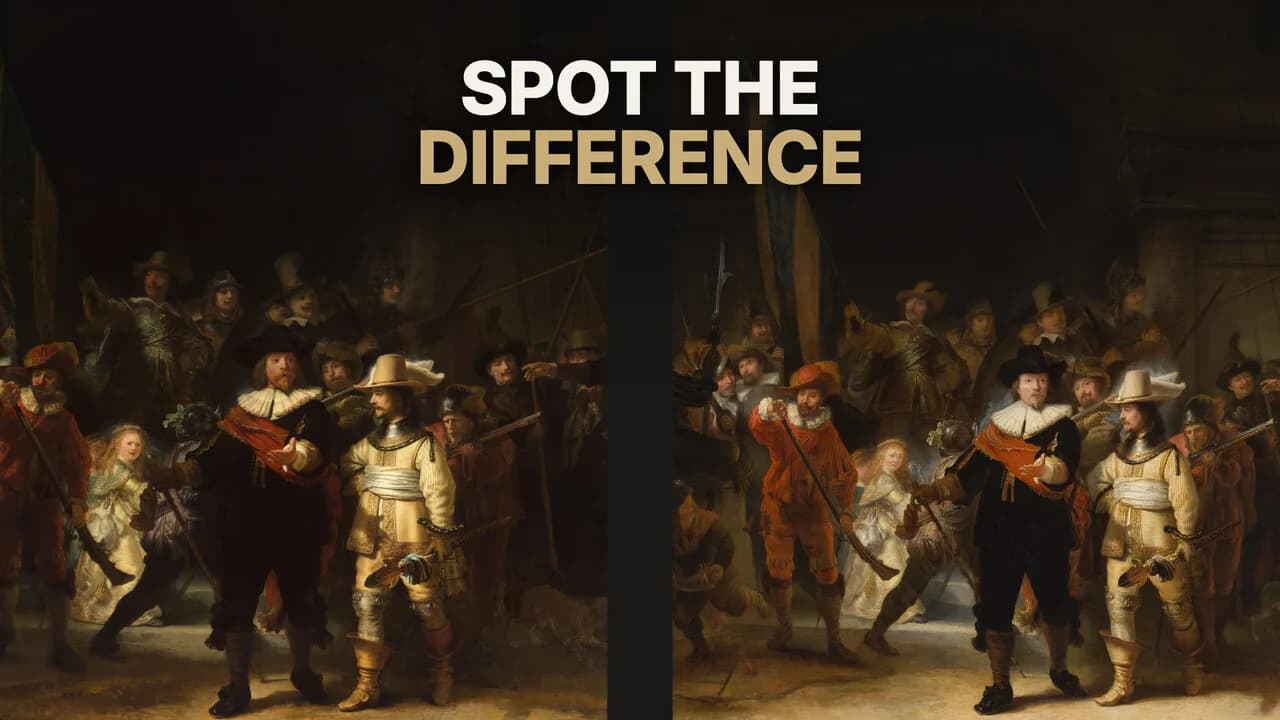
In the gallery, stand back first. The high viewpoint only works at a distance: close up, the panel breaks into hundreds of separate scenes. Then go close and look at the shadows on the ice and at the faint lines scratched into the paint. Compare the picture with the later winter scene by Avercamp in the same museum, Ice-skating in a Village, which has a noticeably lower horizon. And if you are in the Rijksmuseum for the Golden Age galleries, the same building holds The Night Watch, another crowd of Dutch citizens painted a generation later, organised in a very different way.
Nothing in this painting marks a holiday. There is no Christmas tree, no saint and no feast, only a winter afternoon. Its place on seasonal cards is a modern habit. What makes it feel festive is the crowd: a whole society out on the ice together, rich and poor, upright and flat on its back.
Questions people ask
Where is Avercamp’s Winter Landscape with Ice Skaters?
It is in the Rijksmuseum in Amsterdam, inventory number SK-A-1718. The museum bought it after the Gijsbert de Clercq sale of 1897 with support from the Vereniging Rembrandt and registered the acquisition in January 1898. It is oil on an oak panel, 77.3 by 131.9 centimetres, painted around 1608, and the catalogue calls it Avercamp’s largest and most ambitious winter landscape.
Why was Hendrick Avercamp called ‘de Stomme’?
Avercamp could not speak and was probably deaf, so his contemporaries called him ‘de Stomme’, the mute; he is often called de Stomme van Kampen after the town where he grew up and later lived. His deafness did not prevent a successful career. He made many drawings from life and sold finished, watercolour-tinted drawings to collectors as well as paintings.
Does the painting show the Little Ice Age?
It shows a winter of the kind that was common in the Netherlands during the Little Ice Age, and it follows the severe winter of 1607–08. But research published in Nature in 2019 found that the coldest phase came at different times in different regions: in north-western Europe it was the seventeenth century, elsewhere often earlier or later. Avercamp also composed his scenes in the studio from drawings.
Where is Avercamp’s signature in the painting?
On the right, on the wall of a wooden shed covered with graffiti. The Rijksmuseum records it as ‘HAenricus / Av’, with the H and A joined. Because it is written among the other scrawls, it looks like one more mark left by someone on the ice, and it is easy to miss without a close view or a high-resolution image.
What is the game with sticks the skaters are playing?
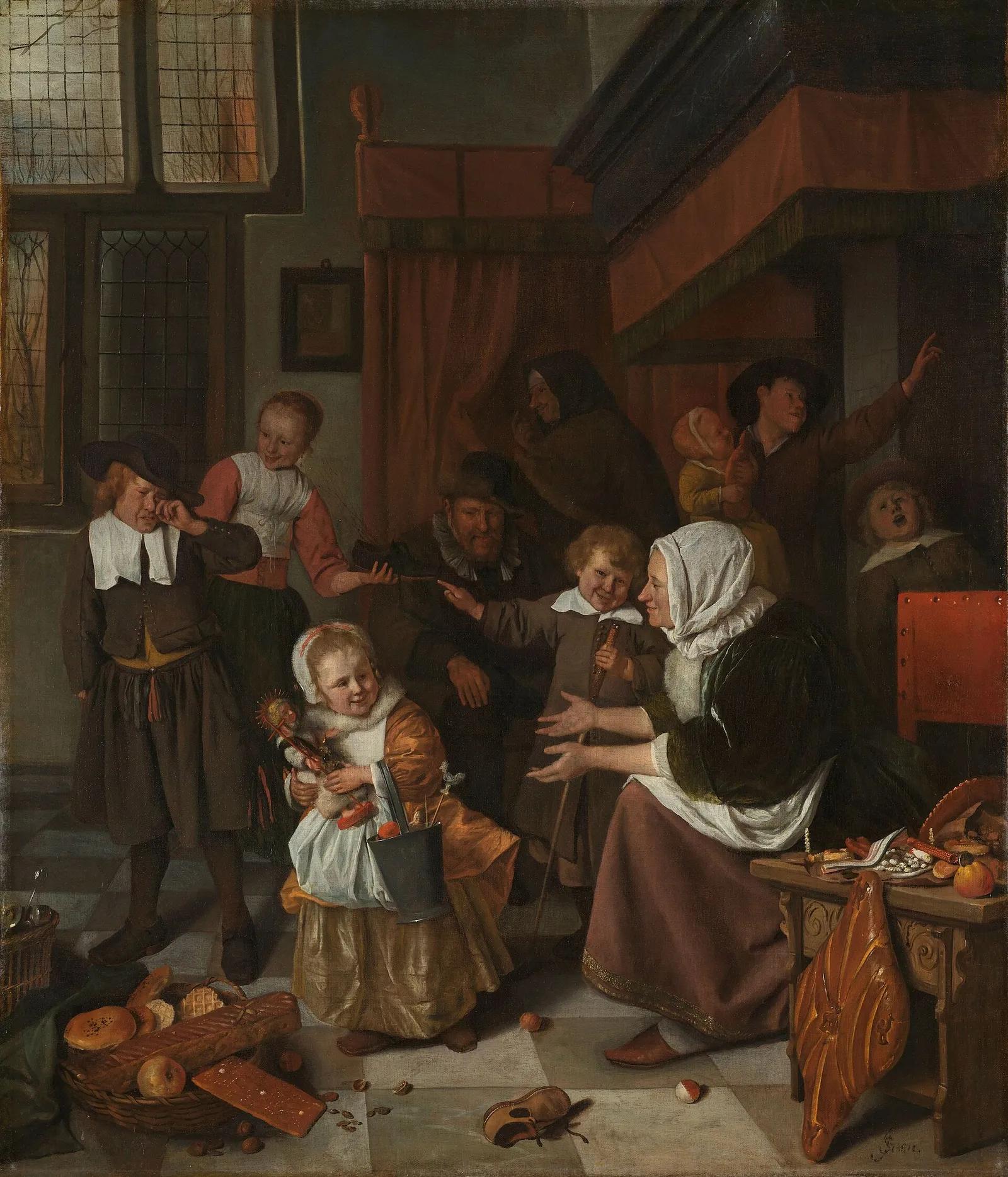
It is kolf, a Dutch game played with a curved club and a ball, on courts and, in winter, on the ice. The players aimed at a target such as a post. It is sometimes described as an ancestor of golf and ice hockey. Kolf players appear in many Dutch winter landscapes, and a kolf club turns up in Jan Steen’s Feast of Saint Nicholas.
Sources and further reading
- Winter Landscape with Ice Skaters, Hendrick Avercamp, c. 1608 (SK-A-1718), Rijksmuseum
- Winter Landscape with Ice Skaters — catalogue entry (J. P. Filedt Kok, 2007), Rijksmuseum
- Hendrick Avercamp, Rijksmuseum
- Winter Landscape with Ice Skaters (CODART Canon), CODART
- No evidence for globally coherent warm and cold periods over the preindustrial Common Era (Neukom et al., Nature 571, 2019), PubMed
- Eight things about Avercamp’s winter wonderland, DutchNews.nl
- Hendrick Avercamp, Wikipedia
Images are public-domain or CC0 reproductions from Wikimedia Commons, credited under each figure. Interpretations are attributed to the scholars who hold them.
Keep looking
Know someone who should see this?
Send them the story of Winter Landscape with Ice Skaters.