
Vinci Stories · Thomas Nast
Thomas Nast's Santa Claus Went to War First: Harper's Weekly, 3 January 1863
On the front page of Harper's Weekly for 3 January 1863, Santa Claus arrives by reindeer sleigh in a Union army camp, dressed in the Stars and Stripes. The artist, the 22-year-old Thomas Nast, would draw him for the next quarter-century and fix the look the world still recognises.
- Work
- Santa Claus in Camp (from Harper's Weekly, vol. 7, p. 1), Published 3 January 1863
- Where to see it
- The Metropolitan Museum of Art, New York
- Reading time
- 8 min
- Updated
Santa Claus in Camp: the 1863 Harper's Weekly cover
The issue of Harper's Weekly dated Saturday 3 January 1863 (volume VII, number 314) was the paper's Christmas number. Its whole front page was given to a single wood engraving by Thomas Nast. Santa Claus has driven his reindeer sleigh into a Union army camp. He wears a coat scattered with stars and trousers striped like the flag, and he is handing out parcels to soldiers who crowd round him with their caps in the air. The caption is brief: Santa Claus in Camp. It was Nast's first published Santa, and the first of the 33 Christmas images he drew for the paper between 1863 and 1886.
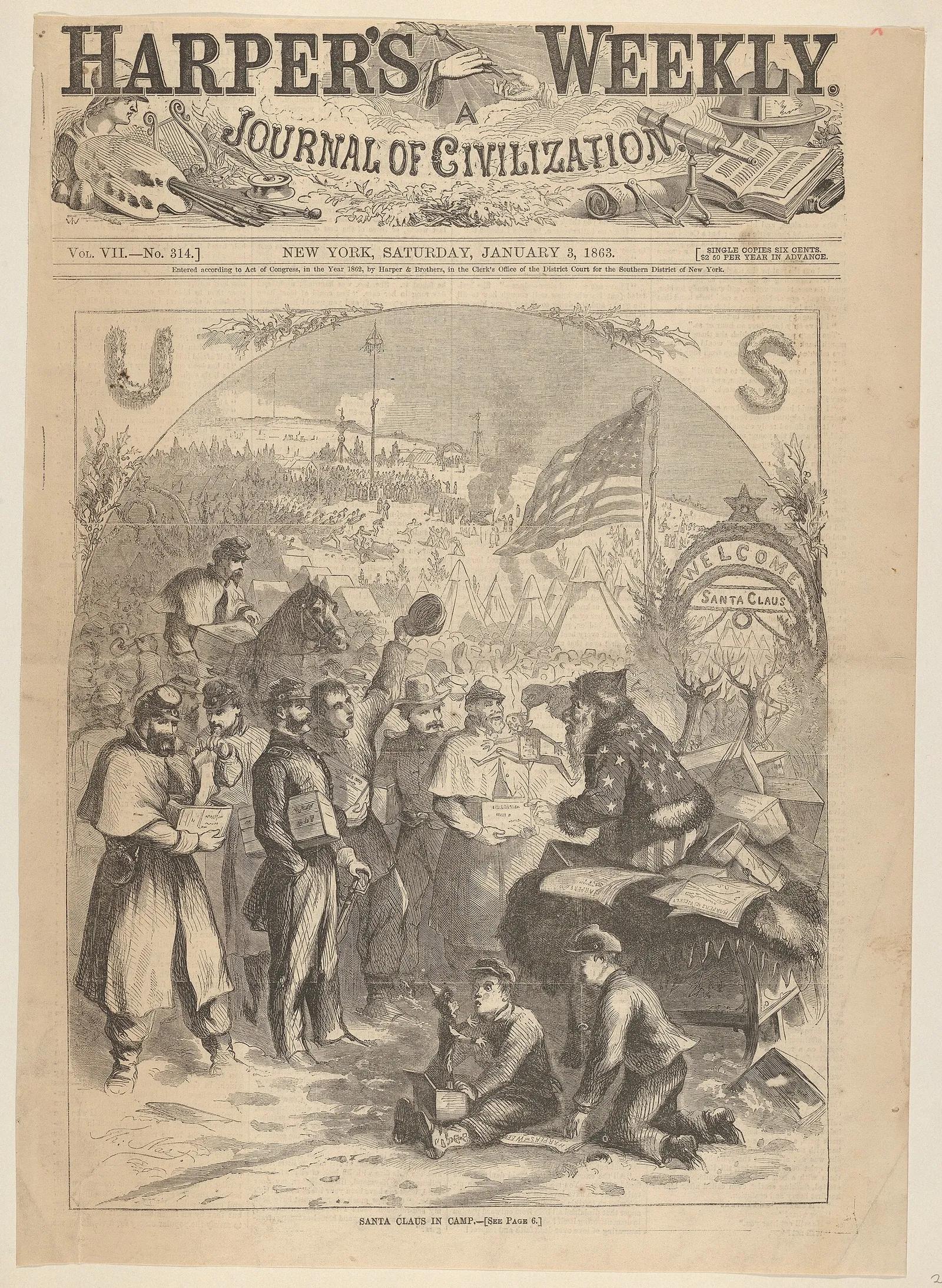
Read the masthead before the picture. Harper's Weekly called itself A Journal of Civilization, and the price box on this page reads Single copies six cents, $2.50 per year in advance. It was a mass-market New York paper, sold to families at home and posted to men in the field, and it was firmly for the Union. A Christmas cover in the second winter of the Civil War was therefore never only about Christmas. It had to cheer readers, flatter soldiers, and keep the war popular in the North at a moment when it was going badly.
Nast was the right artist for that job. He had emigrated from Landau, in the Palatinate, as a six-year-old in 1846, studied drawing in New York, and worked as an illustrator for the city's weeklies while still in his teens. By 1862 he was drawing for Harper's Weekly, where he would stay for a quarter of a century and become its most famous artist.
The puppet with a rope round its neck: what to look for
Start with the toy in Santa's hand. He holds up a jumping jack, a jointed puppet that dances when you pull its string, and it has a cord tied round its neck. The figure is Jefferson Davis, president of the Confederacy, and the joke for a Northern reader in the winter of 1862–63 was obvious: this is the fate Santa is showing the soldiers. The Delaware Art Museum describes it as a puppet labelled Jeff. It is a Christmas present and a political cartoon at once, which is what Nast did best.
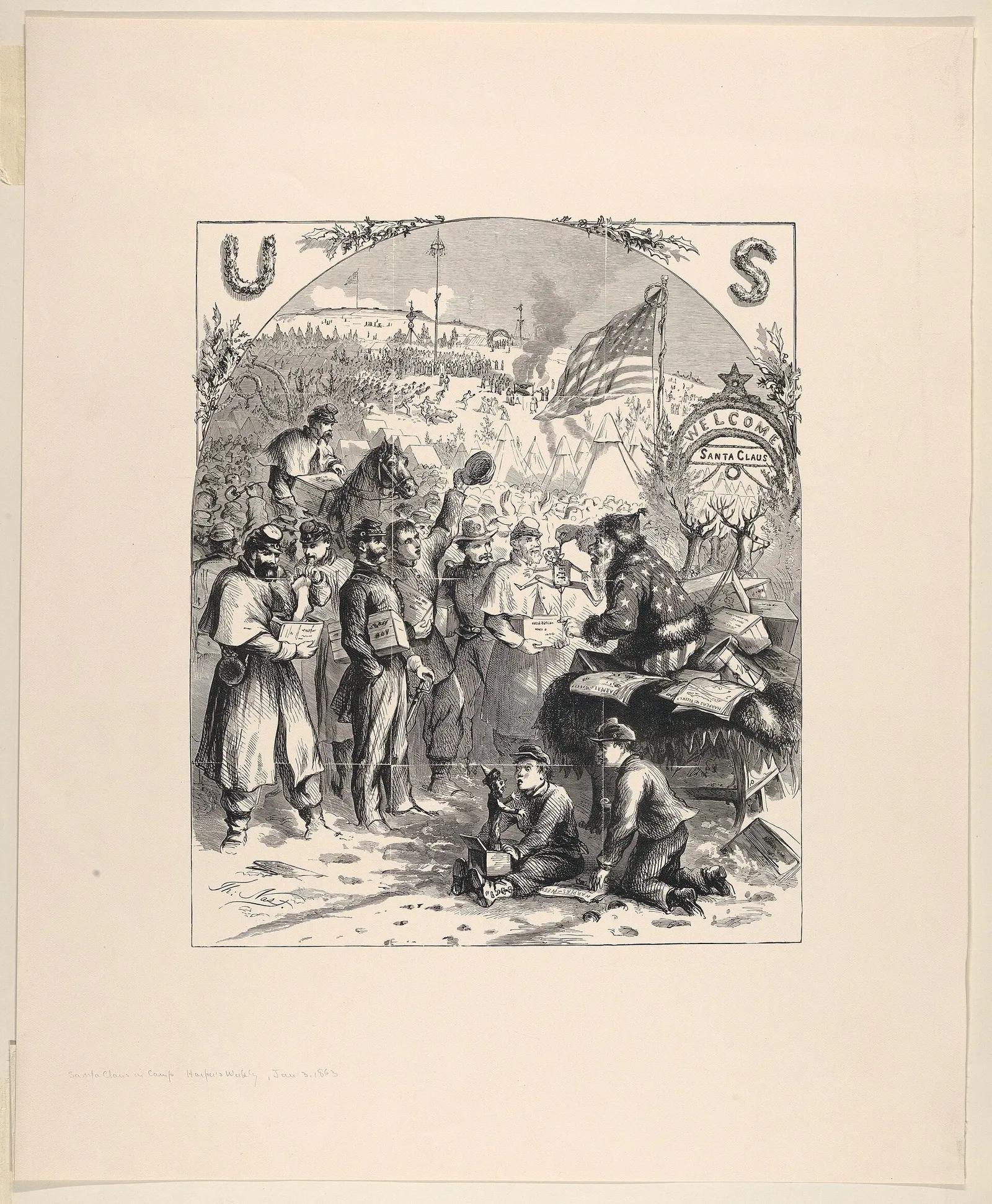
- The corners: a large U at top left and an S at top right, framing the camp as the United States.
- The arch at right, decorated with evergreens, reads Welcome Santa Claus, under a star.
- The sleigh carries crates and boxes and, folded across the furs, copies of Harper's Weekly itself, a neat piece of self-advertisement.
- In the foreground two drummer boys kneel in the snow; one has just opened a jack-in-the-box, and another copy of Harper's Weekly lies on the ground.
- Behind, tents run back to a field of soldiers and a tall flagpole: this is an army settled into winter quarters.
The engraving was drawn on wood and cut by a team of engravers, the standard way of making large pictures for an illustrated weekly in the 1860s: big images were divided into several bolted blocks so that engravers could work in parallel, and on a clean impression you can sometimes see the joins. It printed in black and white on cheap paper, so the colour of Santa's suit was left to the reader's imagination. The stars and stripes were what mattered.
Christmas Eve, 1862: the other picture in the same issue
Turn to the centre of the same number and the tone changes. Christmas Eve, 1862, spread across pages 8 and 9, sets two scenes inside wreaths. On the left a wife kneels at a window and prays, while her children sleep behind her. On the right her husband, a Union soldier, sits alone by a camp fire with his rifle and looks at a picture of his family. Around them Nast placed smaller scenes: Santa on a rooftop and in his sleigh in the sky, and in the lower corners scenes of fighting by land and sea.
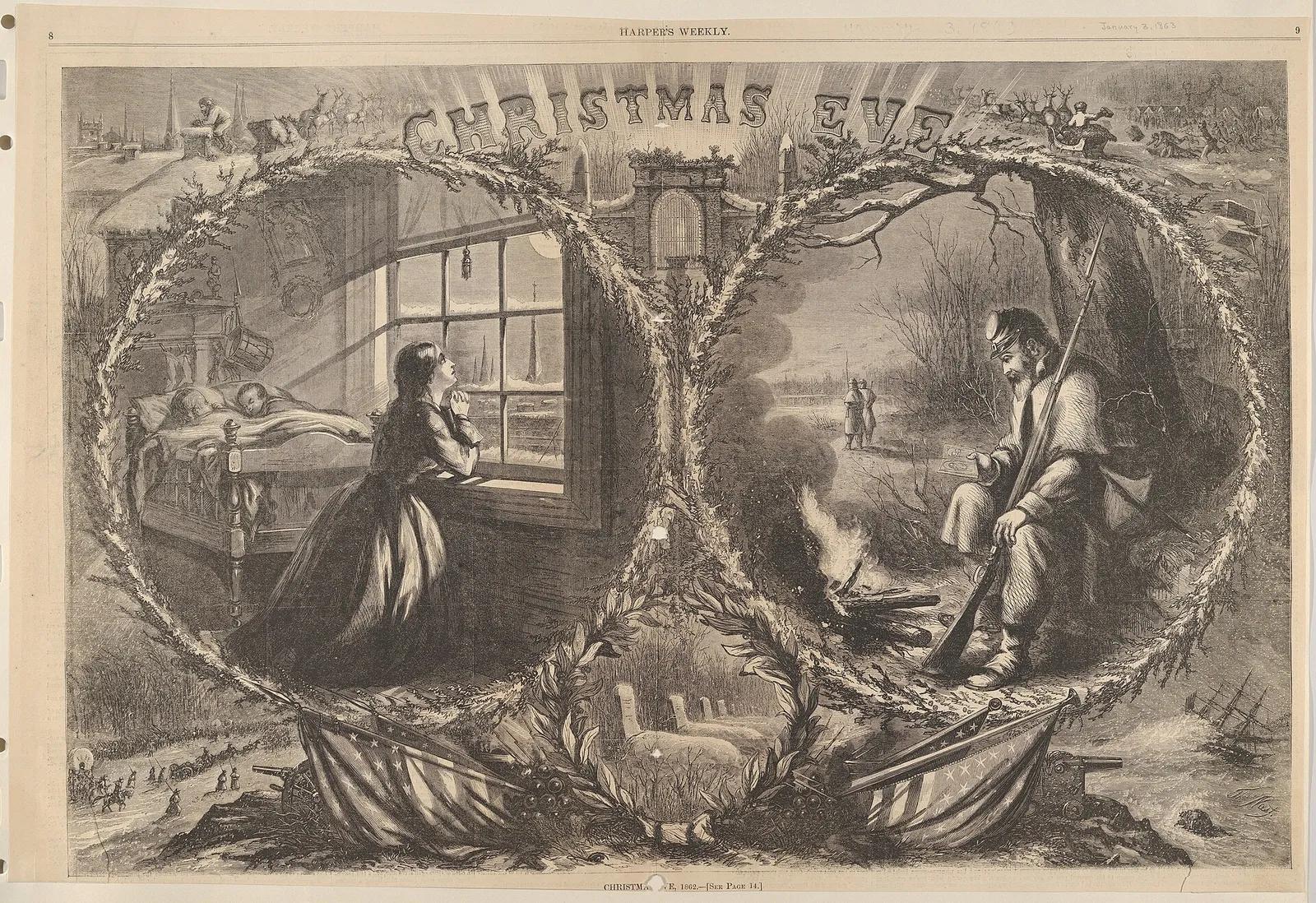
Read together, the two images make the case Harper's wanted to make that Christmas. The cover is cheerful, patriotic and a little cruel to the enemy. The spread is about separation and loss: by late December 1862, after the Union defeat at Fredericksburg on 13 December, a great many Northern households were spending the holiday as the picture shows. Ohio State University's Nast collection describes these images as made to memorialise the sacrifices of Union families.
Where Nast's Santa came from: A Visit from St. Nicholas (1823)
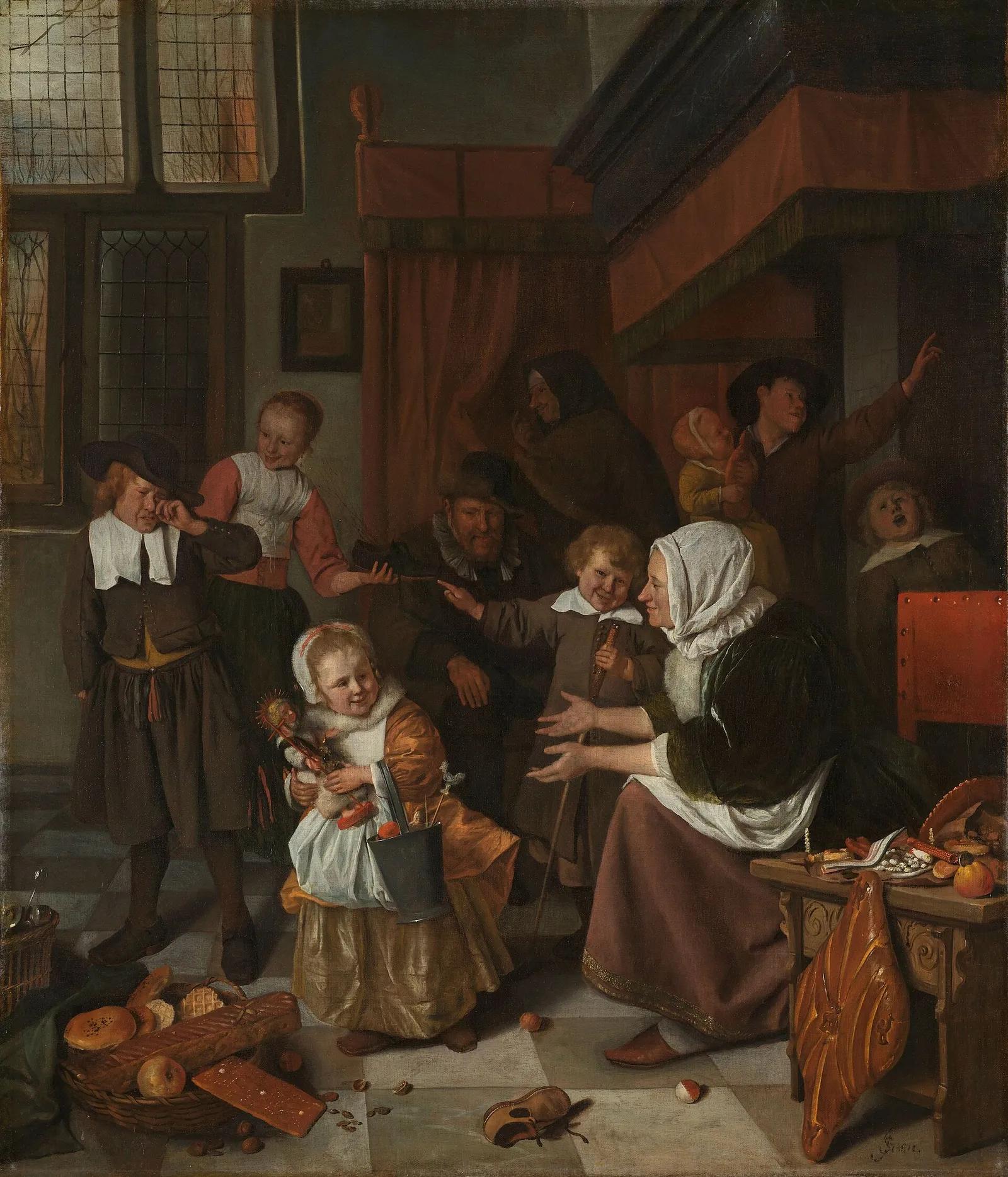
Nast did not invent Santa Claus. The Dutch Sinterklaas tradition, which you can see in a domestic setting in Jan Steen's *Feast of Saint Nicholas*, had been carried to New York and transformed there. The decisive text was a poem published anonymously in the Troy Sentinel, a newspaper in upstate New York, on 23 December 1823, under the title Account of a Visit from St. Nicholas. It was later attributed to Clement Clarke Moore, who included it in his own collection in 1844; some scholars have argued for another author, Henry Livingston Jr., and the question is still debated.
He was dressed all in fur, from his head to his foot, / And his clothes were all tarnished with ashes and soot
The poem gave the figure his sleigh, eight tiny reindeer, the chimney entrance, the pipe, the round belly and the description of him as a right jolly old elf. Nast's 1863 Santa is still small and elfin, in a fur-trimmed outfit, exactly as the poem has him. Over the next two decades Nast made him bigger, older and more human.
Nast's 33 Santas, the North Pole and Merry Old Santa Claus
From 1863 to 1886 Nast produced 33 Christmas images for Harper's Weekly, all but one featuring Santa. Across them he worked out most of what we now take for granted. His illustrations are the first known to place Santa's home at the North Pole and to give him a toy workshop. The most reproduced of them, Merry Old Santa Claus, appeared on 1 January 1881.
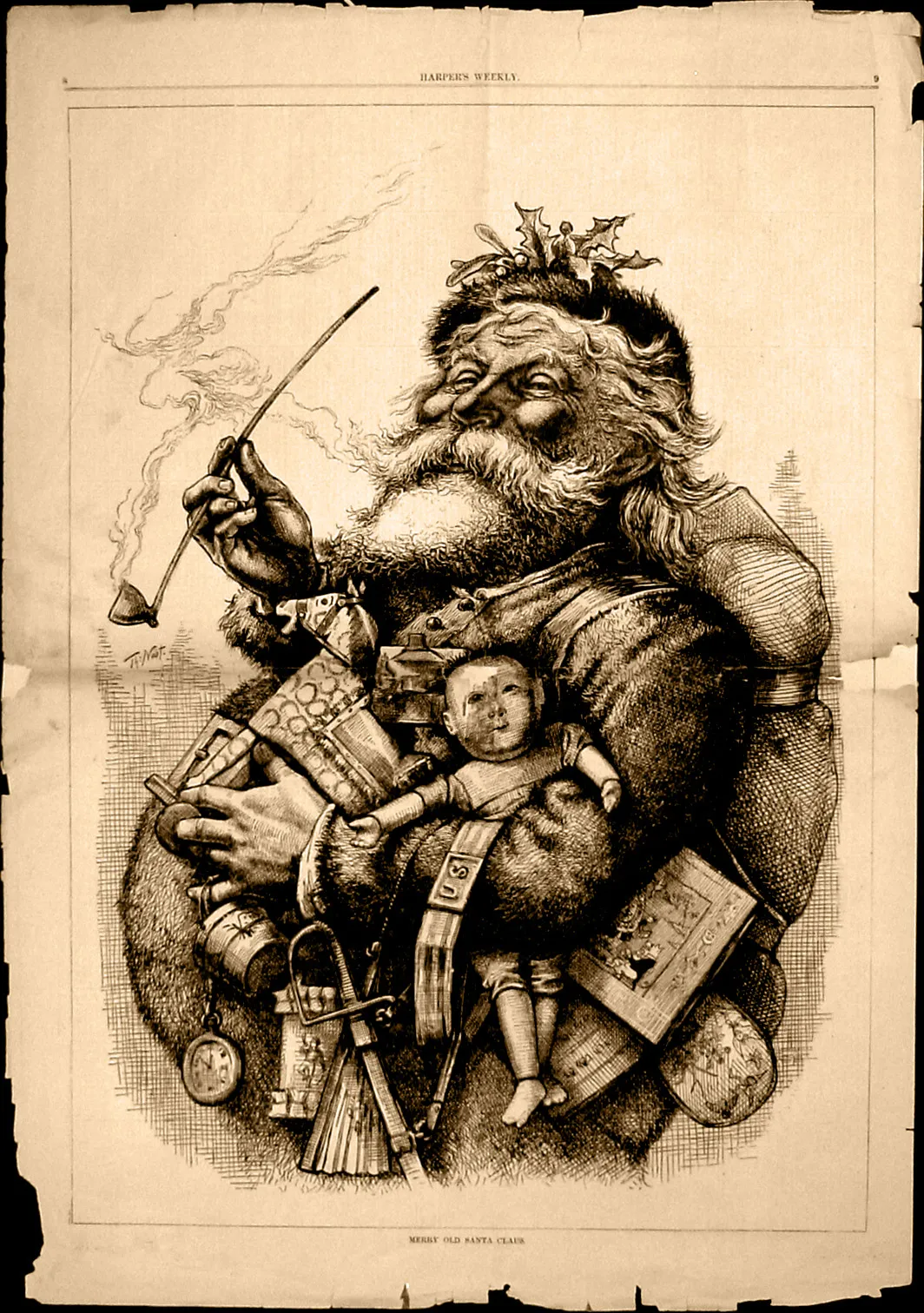
Even this genial figure had not left the war behind. According to the Delaware Art Museum, he carries a soldier's backpack and a dress sword and wears a U.S. belt buckle, and his pocket watch alludes to a congressional debate about pay for soldiers and sailors. Nast, who by then was famous for his campaign against New York's Tammany Hall boss William Tweed and for popularising the Republican elephant, could not resist a political point even at Christmas.
The change in the figure over those eighteen years is worth tracing. The 1863 Santa is small enough to sit comfortably on a sleigh drawn by reindeer, his face wizened and impish, closer to a goblin from a German folk tale than to anyone's grandfather. By 1881 he is portly, rosy and life-size, with a full white beard, a holly sprig in his cap and a long clay pipe. Nast gave him a fixed address, a workshop and a domestic life. Other illustrators, card printers and advertisers then filled in the colour.
1823
Account of a Visit from St. Nicholas published anonymously in the Troy Sentinel, 23 December
1840
Thomas Nast born in Landau, Germany
1846
Nast emigrates to the United States with his mother and sister
1862
Union defeat at Fredericksburg, 13 December, ten days before Christmas
1863
Santa Claus in Camp and Christmas Eve, 1862 published in Harper's Weekly, 3 January
1881
Merry Old Santa Claus published in Harper's Weekly, 1 January
1886
Nast's last Christmas image for Harper's Weekly; 33 in all since 1863
1902
Nast dies in Guayaquil, Ecuador, 7 December
1931
Haddon Sundblom's first Coca-Cola Santa advertisements
Source: Delaware Art Museum; The Metropolitan Museum of Art; Ohio State University Libraries; merrycoz.org (Troy Sentinel transcription); The Ferret
Was Santa red before Coca-Cola?
Yes. The idea that Coca-Cola dressed Santa in red is one of the most persistent myths of Christmas. Nast's Harper's Weekly engravings were black and white, so they settled Santa's shape rather than his colour, but red-suited Santas had already appeared in nineteenth-century prints, cards and advertising: the fact-checkers at The Ferret point to a red Santa used to sell confectionery in 1868. What Coca-Cola did, from the early 1930s, was commission the illustrator Haddon Sundblom to paint a warm, life-size, red-and-white Santa for its seasonal advertising for decades, which fixed one version of the figure across the world.
A popular story also has Abraham Lincoln calling Nast the Union's best recruiting sergeant. The line is widely repeated but no contemporary source for it has been found, so it is best treated as legend.
How to see Nast's Santa Claus for yourself
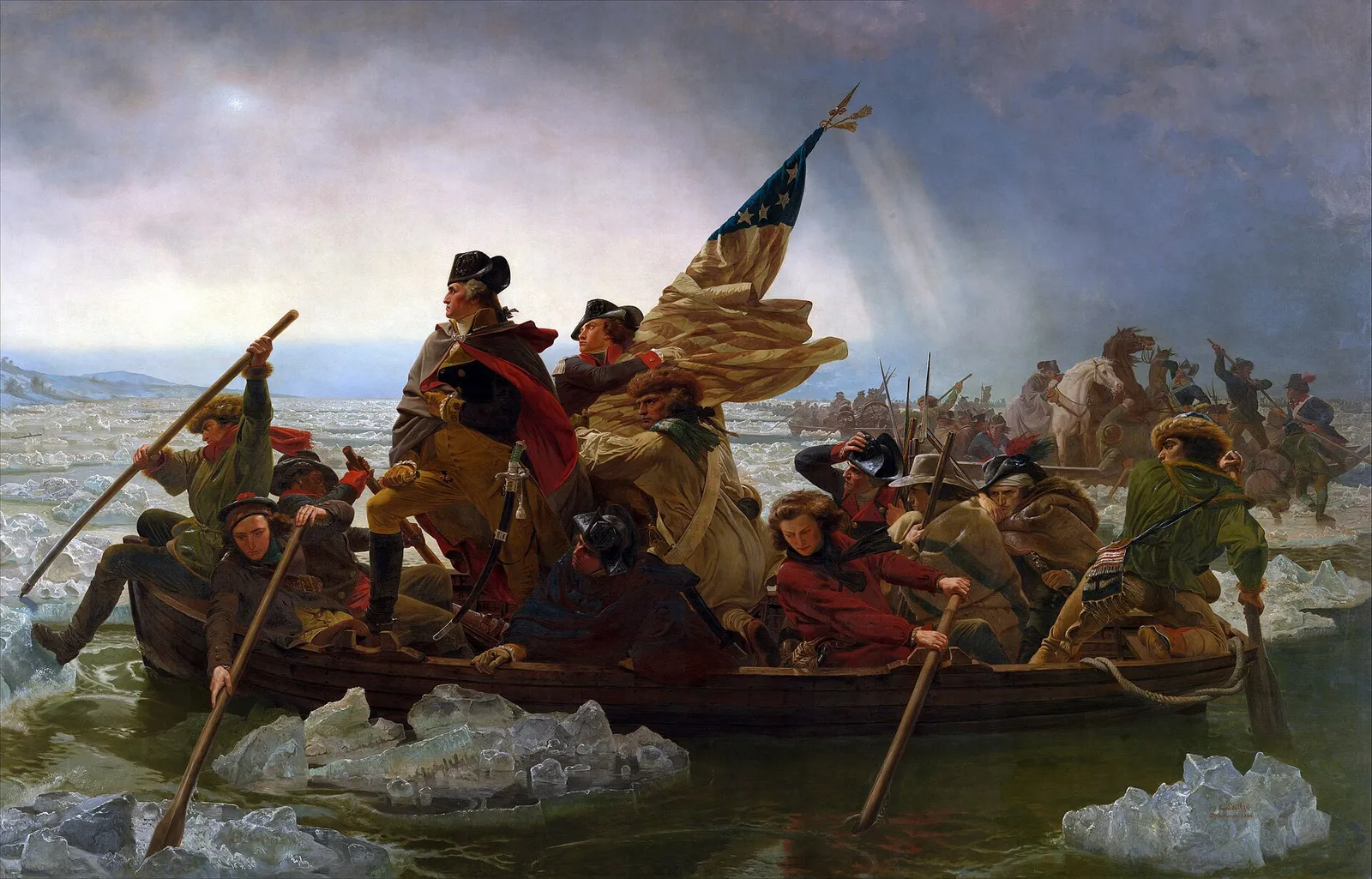
Because Harper's Weekly was printed in large numbers, original pages survive in libraries, historical societies and on the market, and both the cover and the centre spread are in the Metropolitan Museum's collection with high-resolution images online. Look at a full page rather than a cropped Santa: the masthead, the date and the caption are part of the meaning. Then compare the 1863 Santa with the 1881 one, and with the patriotic myth-making of *Washington Crossing the Delaware*, painted a decade earlier for a similar audience.
- Find the puppet, the cord and the name, then ask how a child and a soldier might each have read it.
- Count the copies of Harper's Weekly in the picture.
- Compare Santa's size here with the poem's elf and with Nast's later, life-size grandfather.
- Open the centre spread and read the cover again: the cheerful picture and the anxious one were bought together.
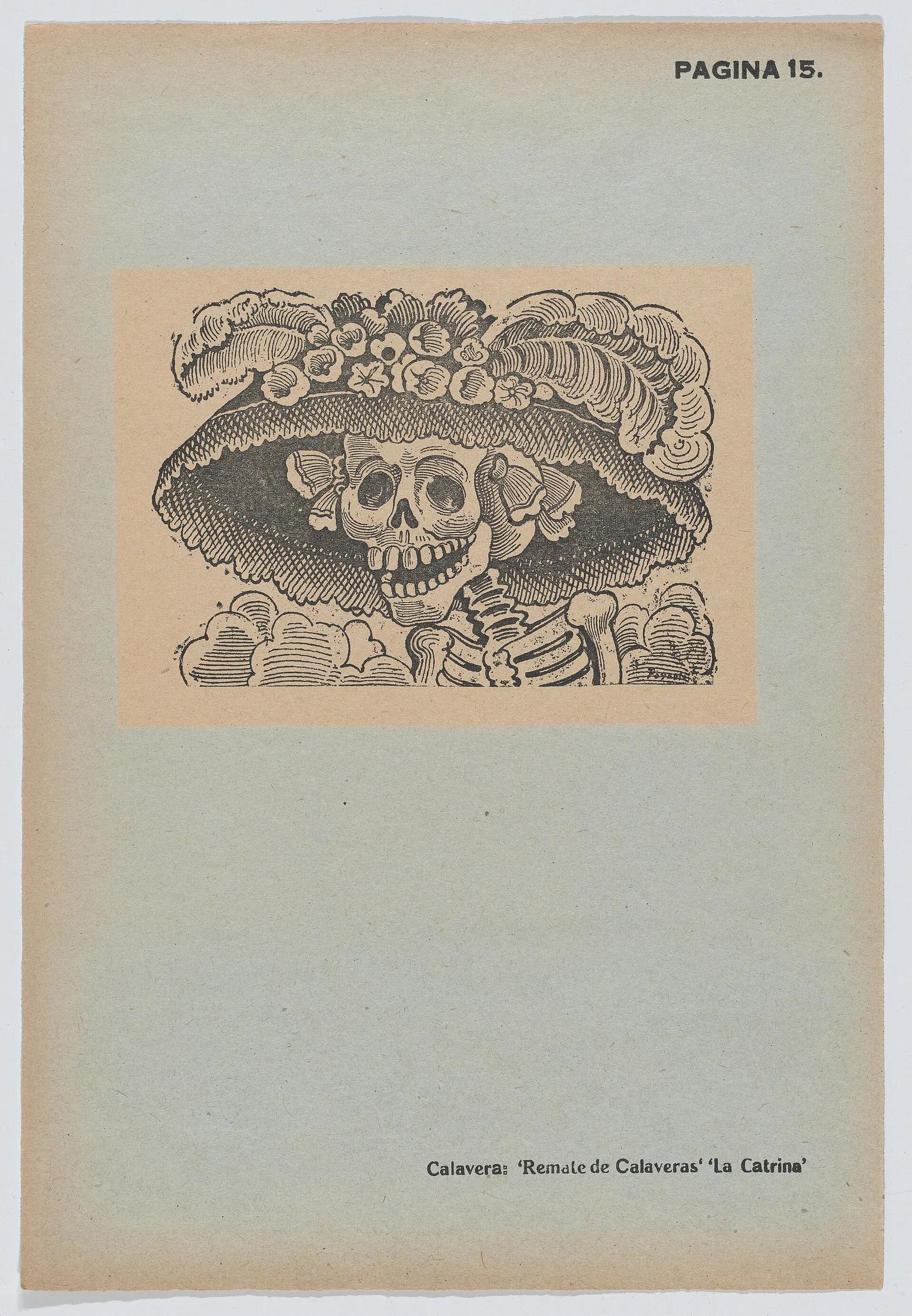
Political printmakers have often borrowed popular figures to make a serious point, from Goya's *Caprichos* to Posada's skeletons. Nast's first Santa belongs in that company: before he came down the chimney, he came to the front.
Questions people ask
When did Thomas Nast first draw Santa Claus?
Nast's first published Santa Claus appeared on the front page of Harper's Weekly dated 3 January 1863, the paper's Christmas issue. Titled Santa Claus in Camp, it shows Santa in a star-spangled coat and striped trousers giving presents to Union soldiers. The same issue carried his double-page Christmas Eve, 1862, with smaller Santa scenes in its margins.
Who is the puppet Santa holds in Santa Claus in Camp?
It is a jumping-jack puppet of Jefferson Davis, president of the Confederate States, with a cord around its neck. For Northern readers in the second winter of the Civil War, the toy was a joke about the fate they hoped awaited him. The Delaware Art Museum describes it as a puppet labelled Jeff.
Did Thomas Nast create the modern image of Santa Claus?
He shaped it more than anyone in the nineteenth century, but he did not invent it. Nast built on the 1823 poem A Visit from St. Nicholas and on Dutch-American Saint Nicholas traditions. Across 33 Christmas images for Harper's Weekly, 1863–1886, he made Santa a bearded, plump figure living at the North Pole with a toy workshop.
Did Coca-Cola make Santa Claus red?
No. Red-suited Santas already appeared in nineteenth-century prints and advertising, including an 1868 confectionery advertisement. Nast's own Harper's Weekly images were printed in black and white. From the 1930s Coca-Cola's advertisements by Haddon Sundblom popularised one red-and-white version of Santa worldwide, but the colour was not their invention.
Who was Thomas Nast?
Thomas Nast (1840–1902) was a German-born American cartoonist and illustrator. He came to New York as a child in 1846 and worked for Harper's Weekly for about twenty-five years from 1862, drawing Civil War scenes, Christmas images and political cartoons, including his campaign against Boss Tweed. He died in Guayaquil, Ecuador, in 1902 while serving as a United States consul.
Sources and further reading
- Santa Claus in Camp (from Harper's Weekly, vol. 7, p. 1), 29.88.4(7), The Metropolitan Museum of Art
- Christmas Eve, 1862 (from Harper's Weekly, vol. 7, pp. 8–9), 29.88.4(8), The Metropolitan Museum of Art
- Santa Claus in Camp (published in Harper's Weekly, January 3, 1863), 33.35.11, The Metropolitan Museum of Art
- Thomas Nast and the Making of the American Santa Claus, Delaware Art Museum
- Account of a Visit from St. Nicholas: the Troy Sentinel text, 1823, merrycoz.org
- 'Twas the Night before Christmas: A Visit from St. Nicholas, Project Gutenberg
- Fact check: No, Santa Claus was not first dressed in red by Coca-Cola, The Ferret
Images are public-domain or CC0 reproductions from Wikimedia Commons, credited under each figure. Interpretations are attributed to the scholars who hold them.
Keep looking
Know someone who should see this?
Send them the story of Santa Claus in Camp (from Harper's Weekly, vol. 7, p. 1).