
Vinci Stories · Emanuel Leutze
Washington Crossing the Delaware: The Flag That Didn't Exist Yet
George Washington crossed the Delaware on Christmas night 1776, in darkness, sleet and ice. Emanuel Leutze painted it seventy-five years later in Düsseldorf, as a bright dawn under the Stars and Stripes. The gap between the two is the story of how a German revolution of 1848 produced America's best-known history painting.
- Work
- Washington Crossing the Delaware, 1851
- Where to see it
- The Metropolitan Museum of Art, Gift of John Stewart Kennedy, 1897, New York
- Reading time
- 9 min
- Updated
Washington Crossing the Delaware: the flag that didn't exist yet
Look just behind George Washington's shoulder in Emanuel Leutze's Washington Crossing the Delaware. A young officer holds a large flag, partly furled by the wind, and in its folds you can read red and white stripes and a blue canton with a circle of white stars. It is the Stars and Stripes. On the night the painting shows, 25–26 December 1776, that flag did not yet exist. The Continental Congress resolved on 14 June 1777 that the flag of the thirteen United States be thirteen stripes, alternate red and white, with a union of thirteen white stars in a blue field, “representing a new constellation”. That was nearly six months after the crossing.
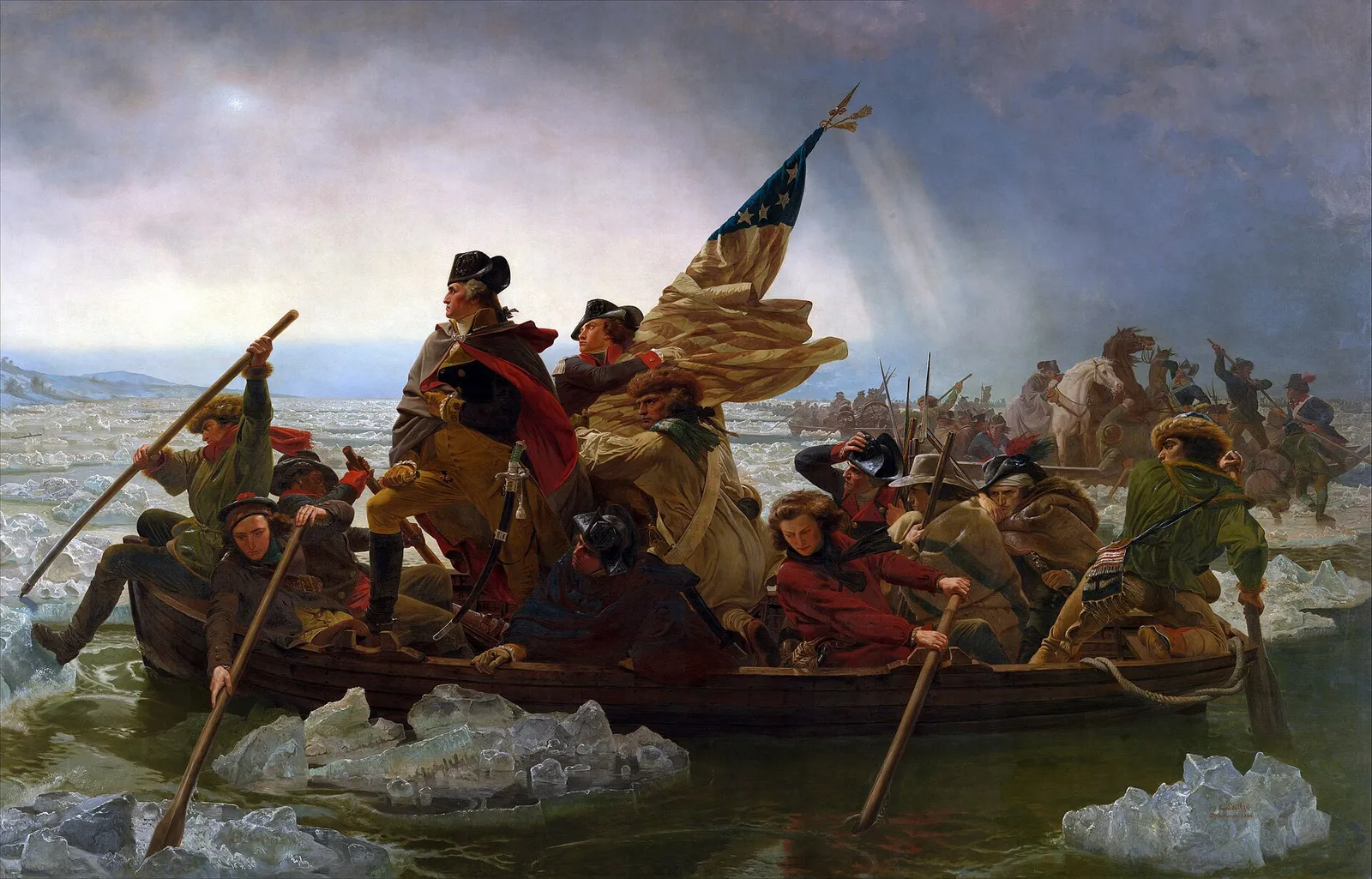
The flag that American troops had used during 1776 was the Continental, or Grand Union, flag: thirteen red and white stripes with the British Union in the canton, first raised outside Boston on 1 January 1776. Leutze, painting in 1850–51, chose the symbol his audience would recognise. It is the first of several departures from what happened, and each has a reason. The painting is not a report of a night in 1776. It is a mid-nineteenth-century argument about liberty, painted in Germany for an American market.
What really happened on Christmas night 1776
By December 1776 the Continental Army had lost New York and retreated across New Jersey into Pennsylvania. Many soldiers' enlistments ran out at the end of the year. Washington planned a surprise attack on the garrison of Hessian troops at Trenton, on the New Jersey bank. On Christmas night about 2,400 men began crossing the Delaware at McConkey's Ferry, some nine miles upstream of the town. Two other planned crossings largely failed because of the ice.
Washington described the conditions to John Hancock, president of Congress, in a letter of 27 December. The ice in the river, he wrote, had made the crossing so slow that it was three o'clock in the morning before the artillery was over, and the march to Trenton was made through a storm of snow and sleet. The army attacked at about eight o'clock on the morning of 26 December and took nearly nine hundred prisoners. It was small as battles go, but it came when the cause seemed close to collapse, and it was remembered accordingly.
25–26 Dec 1776
Washington's army crosses the Delaware at night in ice and sleet.
26 Dec 1776
Victory over the Hessian garrison at Trenton.
14 Jun 1777
Congress adopts the Stars and Stripes, nearly six months after the crossing.
1848
Revolutions across the German states; Leutze, in Düsseldorf, supports the liberal cause.
1849–50
Leutze paints the first version in Düsseldorf.
Nov 1850
A fire in the building damages the first canvas; Leutze starts a second.
Oct 1851
The second version goes on show in New York; Marshall O. Roberts buys it for $10,000.
1897
John Stewart Kennedy gives the painting to the Metropolitan Museum.
5 Sep 1942
The first version, in the Kunsthalle Bremen, is destroyed in an air raid.
16 Jan 2012
Reinstalled in the Met's new American Wing galleries in a replica of its original frame.
Source: George Washington to John Hancock, 27 December 1776 (Founders Online); Journals of the Continental Congress, 14 June 1777; The Metropolitan Museum of Art (97.34); American Heritage; Christie's sale of 12 May 2022 via The Art Wolf
Emanuel Leutze: a German-American painter after 1848
Emanuel Gottlieb Leutze was born in Schwäbisch Gmünd, in Württemberg, on 24 May 1816, and taken to the United States as a child in 1825; he grew up in Philadelphia. He returned to Germany to train at the Düsseldorf academy, the leading school of history painting in the German lands, and from 1845 settled in Düsseldorf for about fourteen years. He was an early promoter of the artists' association Malkasten and a strong supporter of the revolutions of 1848, when liberals across the German states demanded constitutions, a free press and national unity.
The revolutions failed in 1849. Leutze conceived his Washington in that moment. Painting the American Revolution for European eyes, he chose a subject in which a citizen army crossed into enemy territory and won, under a leader who would later give up power rather than keep it. The bright sky, the forward motion and the anachronistic flag all serve that message. Like Rembrandt's *Night Watch* two centuries earlier, it is a large public canvas made to be read across a room as a statement about a citizen militia.
The studio, the models and the fire: why there are two canvases
Leutze worked with the help of the American artists who came to study in Düsseldorf. One of them, the landscape painter Worthington Whittredge, recalled in his memoirs that he was pressed into service twice: once as the steersman with an oar, and once as Washington. To catch the folds of the cloak in a single sitting he stood for two hours without moving, in a replica of Washington's full uniform, a spyglass in one hand and the other on his knee. “I stood and was nearly dead,” he wrote; “They poured champagne down my throat and I lived through it.” Whittredge also recorded that Leutze took Washington's profile from the Houdon bust, and that the Düsseldorf landscapist Andreas Achenbach painted the single star in the sky.
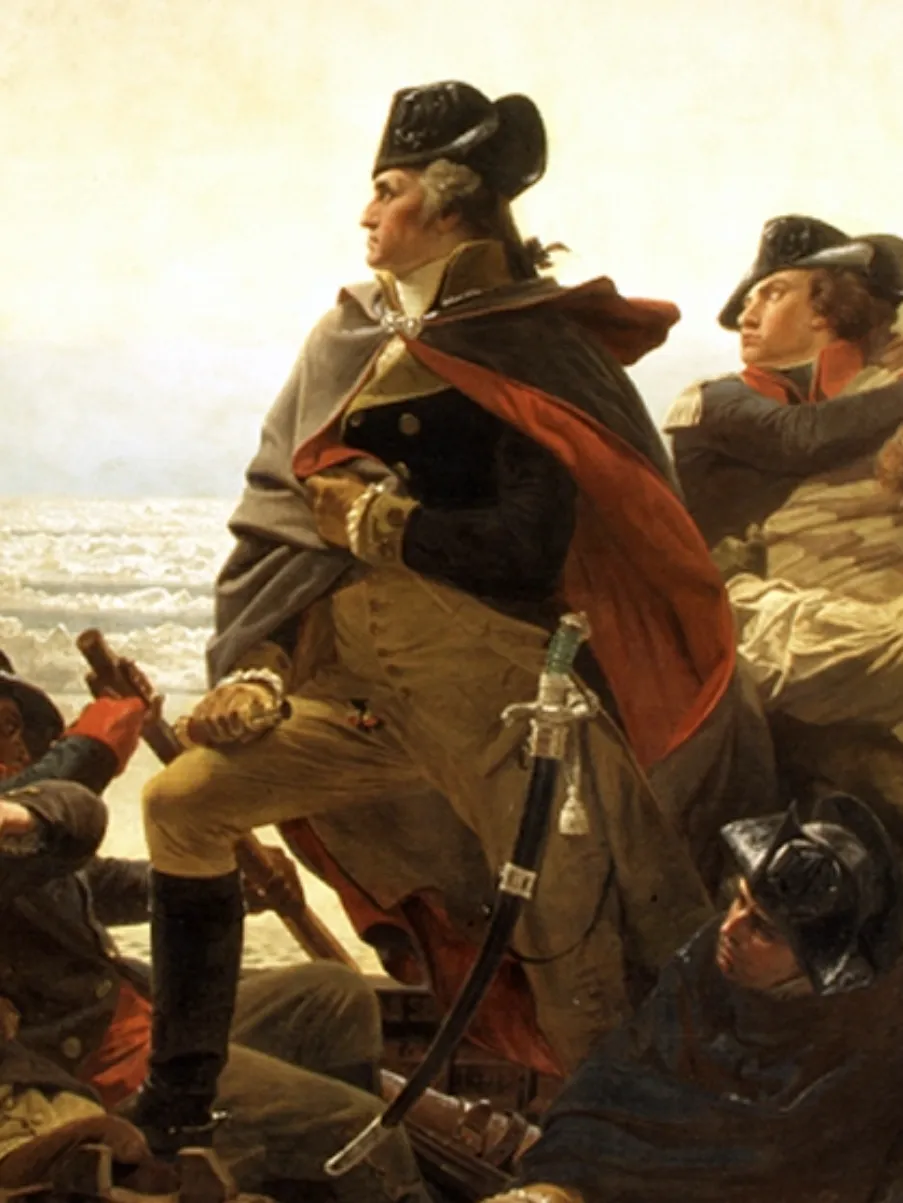
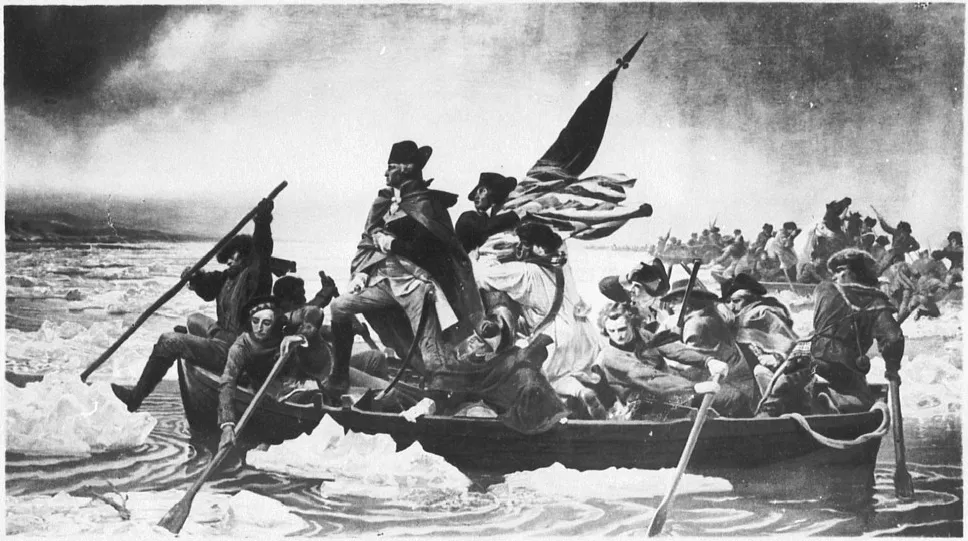
The first canvas was nearly finished in November 1850 when a fire broke out in the building that housed Leutze's studio. The painting was cut from its stretcher and rolled up to save it, and was badly damaged. It was repaired with insurance money, and was later acquired by the Kunsthalle in Bremen. Meanwhile Leutze began a second full-size version, intended for the American market through the print publisher Goupil & Co.; it is the canvas now in New York. The first version stayed in Bremen until 5 September 1942, when it was destroyed in a British bombing raid.
The boat, the ice and the light: what Leutze changed
Besides the flag, three other choices separate the picture from the night. The light is the first. The crossing was made in darkness, in a storm; Leutze shows a cold dawn with a pale yellow band on the horizon and a sky bright enough to silhouette the flag. The single star Achenbach painted is a reminder that it is still meant to be early morning, but the effect is of day breaking on the enterprise, which is the point.
- The flag: the Stars and Stripes, adopted 14 June 1777, in place of the Continental flag of 1776.
- The light: a luminous dawn in place of a night of sleet and snow.
- The boat: a small, low rowing boat, where the troops crossed in large, flat-bottomed Durham boats, cargo craft some 12 to 18 metres long, and the artillery and horses on ferries.
- The river: broad and choked with great slabs of ice, closer to the Rhine than to the narrower Delaware at McConkey's Ferry.
- The pose: Washington standing in the bow of a crowded small boat, a dangerous position on a real river.
The boat matters most to the composition. A Durham boat, long and high-sided, would have hidden the men and flattened the group. A small boat lets Leutze build a pyramid of bodies rising from the oarsmen at the gunwales to Washington and the flag at the apex. The historian David Hackett Fischer has suggested that men did stand in the boats, to keep out of the icy water in the bottom; Washington standing as heroically as he does is still a painter's choice.
cm wide
| Géricault, The Raft of the Medusa (1819) | 716 |
|---|---|
| Leutze, Washington Crossing the Delaware (1851, the Met) | 647.7 |
| Trumbull, Declaration of Independence (Capitol Rotunda) | 548.6 |
| Leutze, smaller version (1851, sold 2022) | 172.7 |
Source: Musée du Louvre (The Raft of the Medusa, 491 × 716 cm); The Metropolitan Museum of Art (97.34, 378.5 × 647.7 cm); Architect of the Capitol (Trumbull, 12 × 18 ft); Christie's New York, 12 May 2022, via The Art Wolf (101.6 × 172.7 cm)
Who is in the boat? Monroe, Washington and the crew
When the painting was shown in 1853, the exhibition catalogue identified the young officer holding the flag as Lieutenant James Monroe, the future fifth president, and named other officers in the boat, among them General Edward Hand, seated with his hat in his hand. Monroe, then eighteen, did cross the Delaware that night and was badly wounded at Trenton; but historians place him with an advance party, not in Washington's own boat.
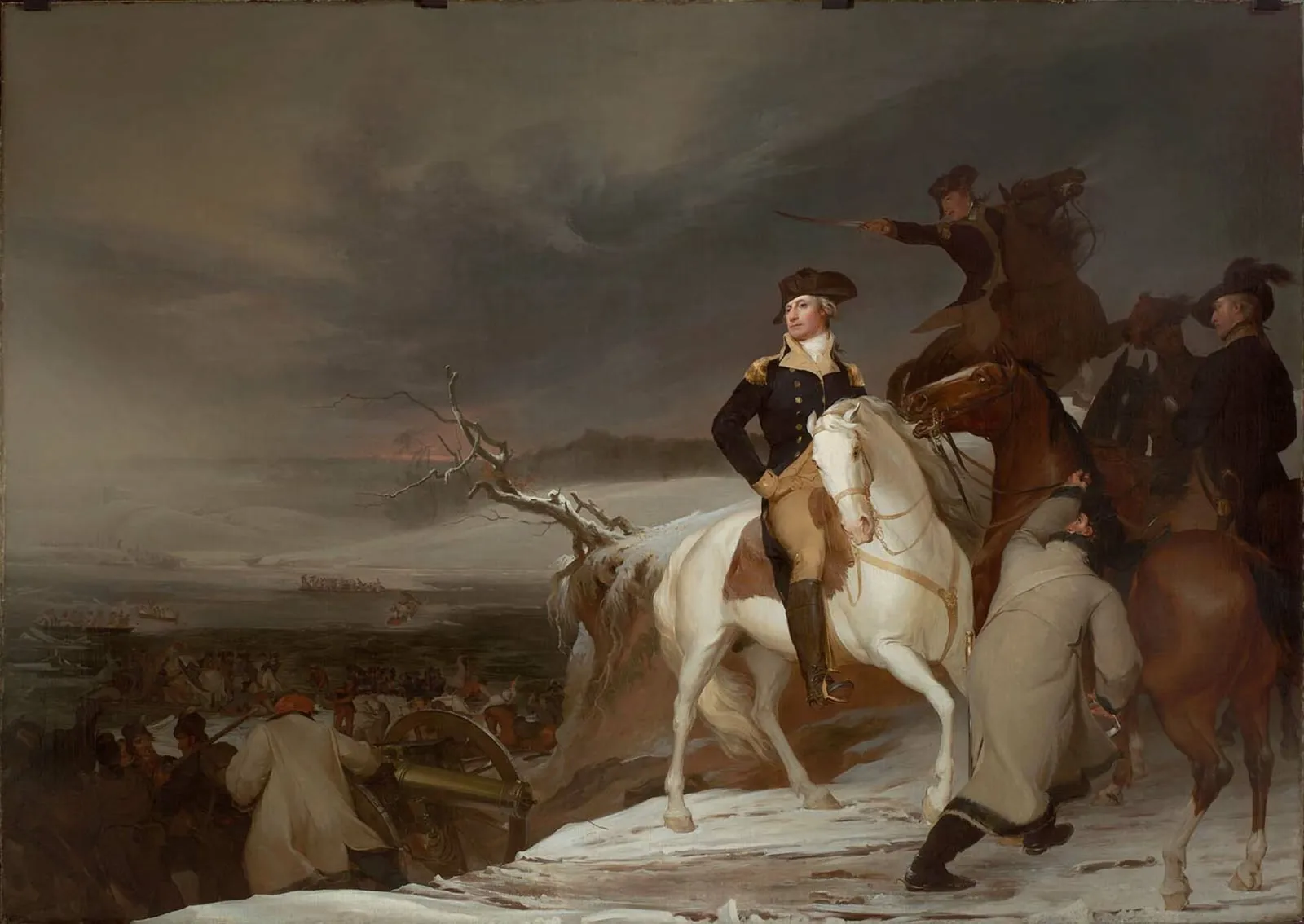
The oarsmen are a deliberate mixture: a man in a Scottish bonnet, men in hunting shirts and buckskin, a figure often read as a Native American or frontiersman, and, near the bow, a Black oarsman. Later writers sometimes named him Prince Whipple, an enslaved man who served in the Revolution, but there is no evidence for the identification. What Leutze shows, in a reading many art historians share, is a cross-section of the American population pulling together. Compare Thomas Sully's Passage of the Delaware of 1819, which shows Washington mounted on the riverbank with his officers: Leutze moved the general into the boat with his men.
From Broadway to the Met: how it became an American icon
The second canvas reached New York in 1851 and was exhibited in October; according to most accounts more than 50,000 people paid to see it. The businessman Marshall O. Roberts bought it for $10,000, then an extraordinary sum for an American picture. Engravings spread it into homes across the country. Thirty years later Mark Twain, describing the typical parlour of a prosperous Mississippi river town in Life on the Mississippi (1883), could count on readers recognising it:
Over middle of mantel, engraving--Washington Crossing the Delaware; on the wall by the door, copy of it done in thunder-and-lightning crewels by one of the young ladies--work of art which would have made Washington hesitate about crossing, if he could have foreseen what advantage was going to be taken of it.
John Stewart Kennedy gave the painting to the Metropolitan Museum in 1897. Its original carved frame was later lost. When the museum reopened its renovated American Wing galleries on 16 January 2012, the painting was rehung in a replica made by Eli Wilner & Company from an April 1864 photograph by Mathew Brady, taken when the picture was exhibited at New York's Metropolitan Fair in aid of Union soldiers; the eagle crest alone is about four metres wide. A smaller version, 101.6 by 172.7 centimetres, reportedly made in 1851 to help the engraver, hung in the White House from 1979 to 2014 and sold at Christie's New York on 12 May 2022 for about $45 million, against an estimate of $15–20 million.
How to see Washington Crossing the Delaware at the Met
The painting fills a wall in Gallery 760 of the American Wing. Start at the far side of the room, where you can take in the whole width, and follow the rising line from the oarsmen bent over the gunwales, through the bodies, to Washington's head and the tip of the flag. Notice the other boats behind, strung out across the river, and how the horizon sits low so that the figures stand against the sky.
Then walk close and look for the details this article has described: the red and white stripes and the ring of stars in the flag behind Washington; the single star high in the sky; the paddles and oars cutting into the ice; the faces of the crew, each a different type. Look at how the brightest part of the sky is placed directly behind the general and the flag. Then remember the letter he actually wrote two days later, about ice that held up the guns until three in the morning, and you will have both the night and the picture.
Questions people ask
Is the flag in Washington Crossing the Delaware accurate?
No. The painting shows the Stars and Stripes, but Congress only adopted that design on 14 June 1777, nearly six months after the crossing of 25–26 December 1776. In 1776 the Continental Army used the Continental, or Grand Union, flag, with thirteen stripes and the British Union in the canton. Leutze chose the flag his audience of 1851 would recognise.
Where was Washington Crossing the Delaware painted?
In Düsseldorf, Germany, by the German-born American painter Emanuel Leutze, in 1849–51. Leutze had grown up in Philadelphia and returned to Germany to work. American artists studying in Düsseldorf, including Worthington Whittredge, posed for him. He conceived the picture after the failure of the German revolutions of 1848.
Why are there two versions of Washington Crossing the Delaware?
The first canvas was badly damaged in a studio fire in November 1850. It was repaired and later bought by the Kunsthalle Bremen, where it was destroyed in a bombing raid on 5 September 1942. Leutze painted a second full-size version, exhibited in New York in 1851 and now in the Metropolitan Museum. A smaller version also exists.
Who is holding the flag in Washington Crossing the Delaware?
The figure was identified when the picture was exhibited as Lieutenant James Monroe, later the fifth president. Monroe did cross the Delaware that night and was wounded at Trenton, but historians place him with an advance party rather than in Washington's boat.
How big is Washington Crossing the Delaware?
The Met's canvas measures 378.5 by 647.7 centimetres, about 12 by 21 feet, and with its replica frame it fills an entire wall of Gallery 760 in the American Wing. A smaller version, about 1 by 1.7 metres, sold at Christie's in May 2022 for about $45 million.
Sources and further reading
- Emanuel Leutze, Washington Crossing the Delaware (97.34), The Metropolitan Museum of Art
- From George Washington to John Hancock, 27 December 1776, Founders Online, National Archives
- Why Washington Stood Up in the Boat (with Worthington Whittredge's recollections), American Heritage
- What's Wrong With 'Washington Crossing the Delaware'?, HistoryNet
- New American Wing Galleries for Paintings, Sculpture, and Decorative Arts (opened 16 January 2012), The Metropolitan Museum of Art
- Christie's 2022 May auctions review, The Art Wolf
- Mark Twain, Life on the Mississippi (1883), Project Gutenberg
- Declaration of Independence (John Trumbull), Architect of the Capitol
- Washington Crossing the Delaware (1851 paintings), Wikipedia
Images are public-domain or CC0 reproductions from Wikimedia Commons, credited under each figure. Interpretations are attributed to the scholars who hold them.
Keep looking
Know someone who should see this?
Send them the story of Washington Crossing the Delaware.