
Vinci Stories · José Guadalupe Posada
La Catrina: The Day of the Dead Icon Began as a Cruel Joke
The skull in the feathered hat now presides over Day of the Dead altars, parades and face paint from Mexico City to Los Angeles. She began as a small zinc plate by José Guadalupe Posada, printed on a penny broadsheet that mocked poor women for dressing above their station. Her famous name came seventeen years after her first printing, from a book, and her body came from a mural.
- Work
- La Calavera Garbancera, known since 1930 as La Calavera Catrina, c. 1910–1913; first securely dated printing 1913. Impression shown: from the portfolio 36 Grabados, Mexico, 1943
- Where to see it
- The Metropolitan Museum of Art, New York. Other impressions in many collections, including the Art Institute of Chicago and the Library of Congress, New York
- Reading time
- 8 min
- Updated
Who created La Catrina? José Guadalupe Posada’s skeleton lady
Look at the original image before you look at any costume, figurine or sugar skull. It is small and it is only a bust. A skull grins out at us, slightly turned, with bare collarbones and no dress at all. On top sits a vast hat in the fashion of the 1900s, its brim loaded with ostrich plumes and silk flowers. The joke depends on the contrast: the most expensive thing in the picture is perched on the one thing nobody can dress up.
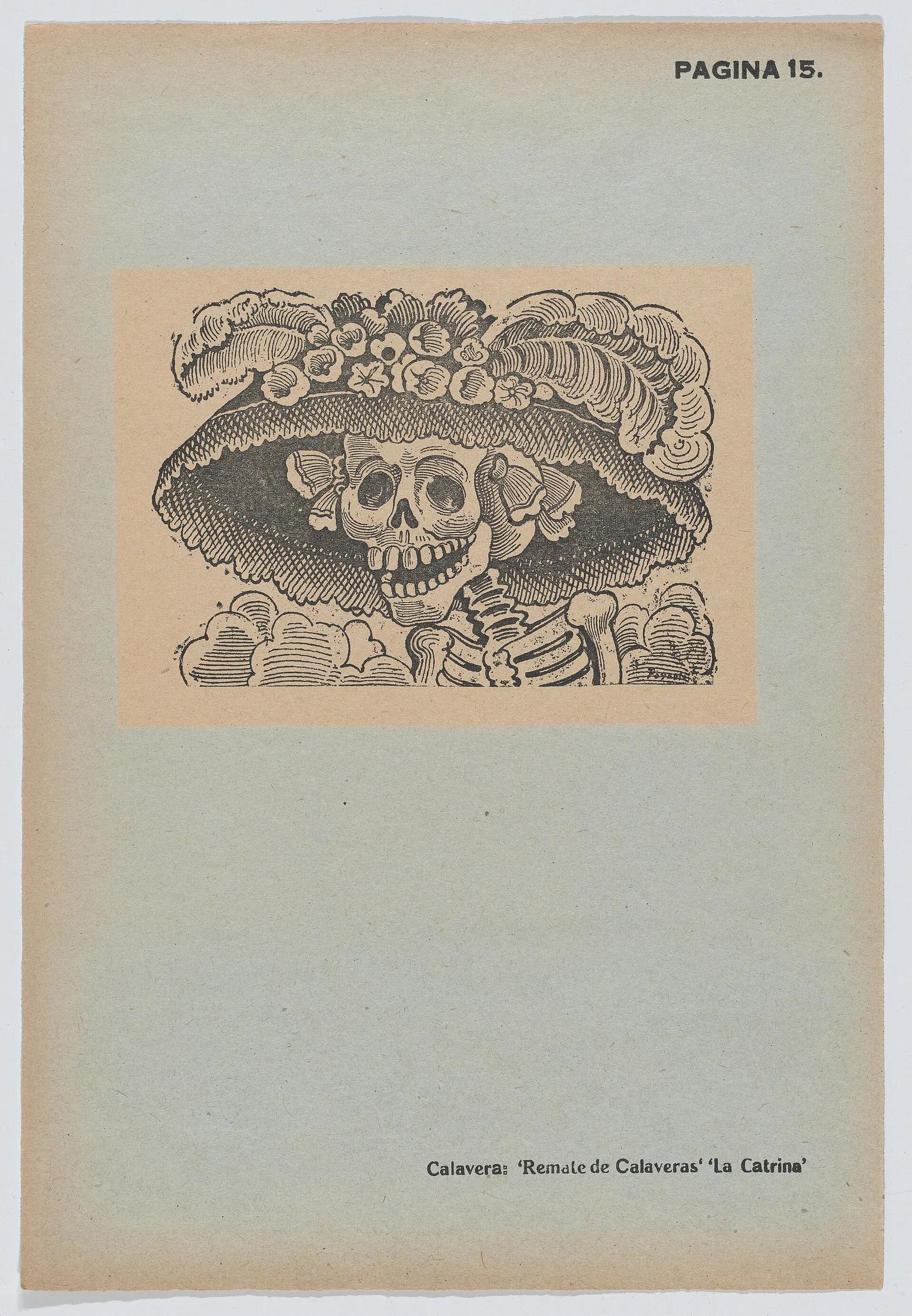
The image is by José Guadalupe Posada, born in Aguascalientes in 1852, who spent the last decades of his life in Mexico City illustrating cheap broadsheets for the publisher Antonio Vanegas Arroyo. He engraved and etched thousands of images: murders, miracles, floods, political scandals and, every autumn, calaveras. The Art Institute of Chicago describes him as the most prolific and influential broadside illustrator of late nineteenth and early twentieth century Mexico. He died on 20 January 1913, poor and largely unrecognised.
The plate was a relief etching on zinc, a quick, cheap technique that let a drawing be printed alongside type. The artist drew on the metal with an acid-resistant ink, and acid ate away the bare areas, leaving the lines standing in relief so they could be inked and printed in the same press as the letterpress verses. Compared with a wood engraving, it was fast, and it kept the swing of a pen line. It also explains why the same plate could be reused for decades: the zinc was durable, and the publisher simply locked it into new pages of type whenever it suited a new set of verses. Posada made it around 1910 to 1913. The Arizona State University scholar Mathew Sandoval dates it to 1912; the earliest securely dated printing is a broadsheet of 1913, published months after his death.
What does Calavera Garbancera mean?
Posada’s skull was not called Catrina. In the broadsheets she is a garbancera. A garbancera was a woman who sold garbanzos, chickpeas, in the street markets. As Sandoval explains, the word was used for Indigenous and mixed-race women of humble origin who powdered their faces and dressed in French-style clothes to pass as ladies. To call someone a garbancera was to say she was ashamed of where she came from.
The joke was already a stock subject before Posada’s famous head. A broadsheet in the Library of Congress, catalogued between 1890 and 1909, carries the headline Gran bola de garbanceras, “a great crowd of garbanceras”, who, “for being so pretentious, will become rotten and stinking skeletons”. Its centre heading reads ¡Garbanceras, al Zanjón! – “Garbanceras, to the ditch!” The Metropolitan Museum owns another impression, on purple paper, and attributes its main image to an artist signing himself J. Cortés.
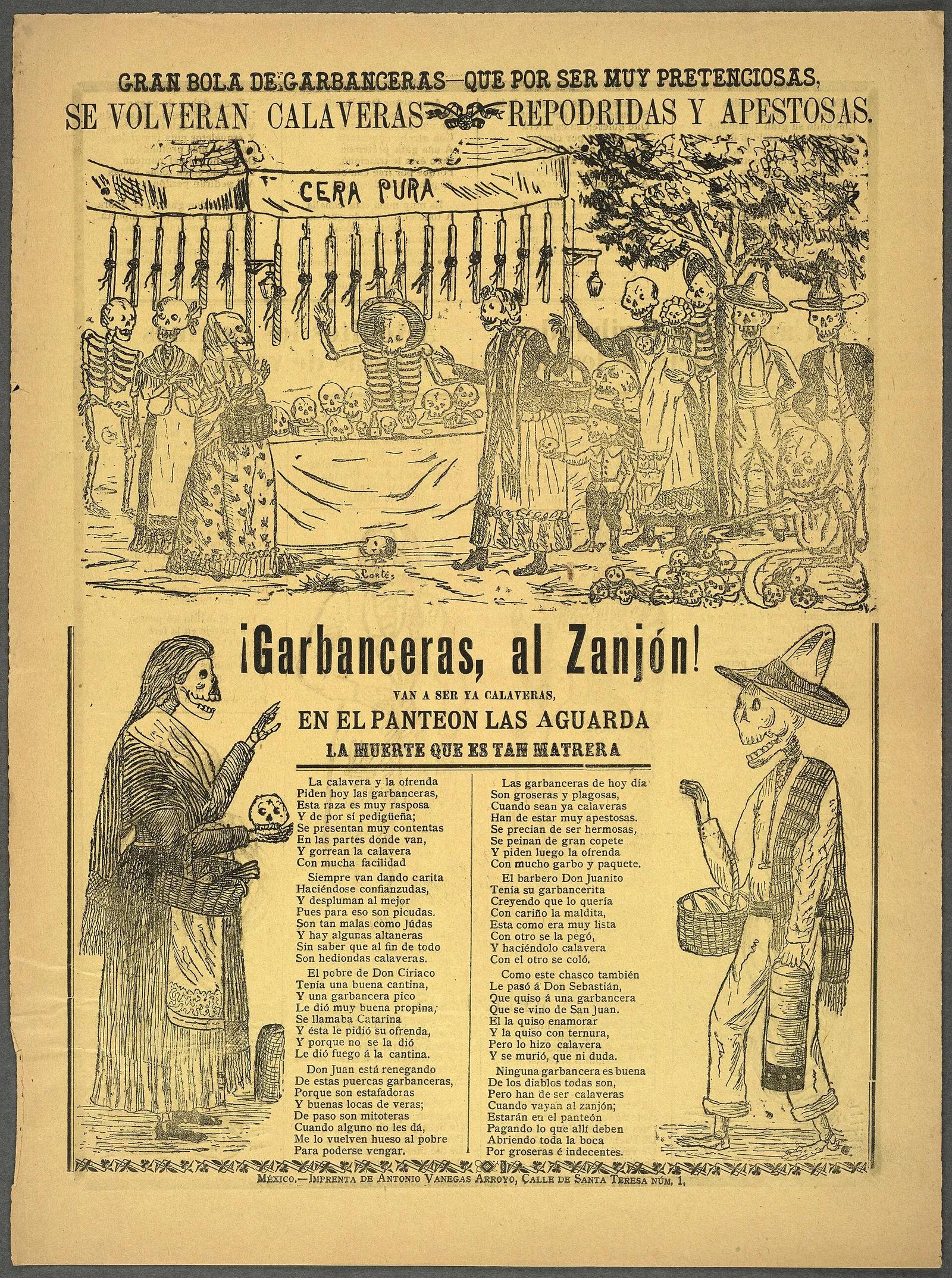
That is the cruelty in the title of this story. The verses do not mock the rich. They mock poor women for wanting to look rich, and promise that death will strip them back to bone. Readings differ on Posada’s own image: some historians argue that his plate satirised pretension in general, including the elite’s taste for everything French, even as the publisher’s verses aimed at working women. The text of the 1913 sheet was written by the Vanegas Arroyo firm, not by Posada, and it is worth keeping the image and the words apart.
The 1913 broadsheet and the calavera tradition
The earliest dated appearance of the head is on a Day of the Dead broadsheet of 1913 titled Remate de calaveras alegres y sandungueras, roughly “a final batch of merry and flirtatious skeletons”. Its subtitle spells out the threat: “those who today are powdered garbanceras will end up as deformed skeletons.” The skull in the hat sits at the centre, surrounded by verses.
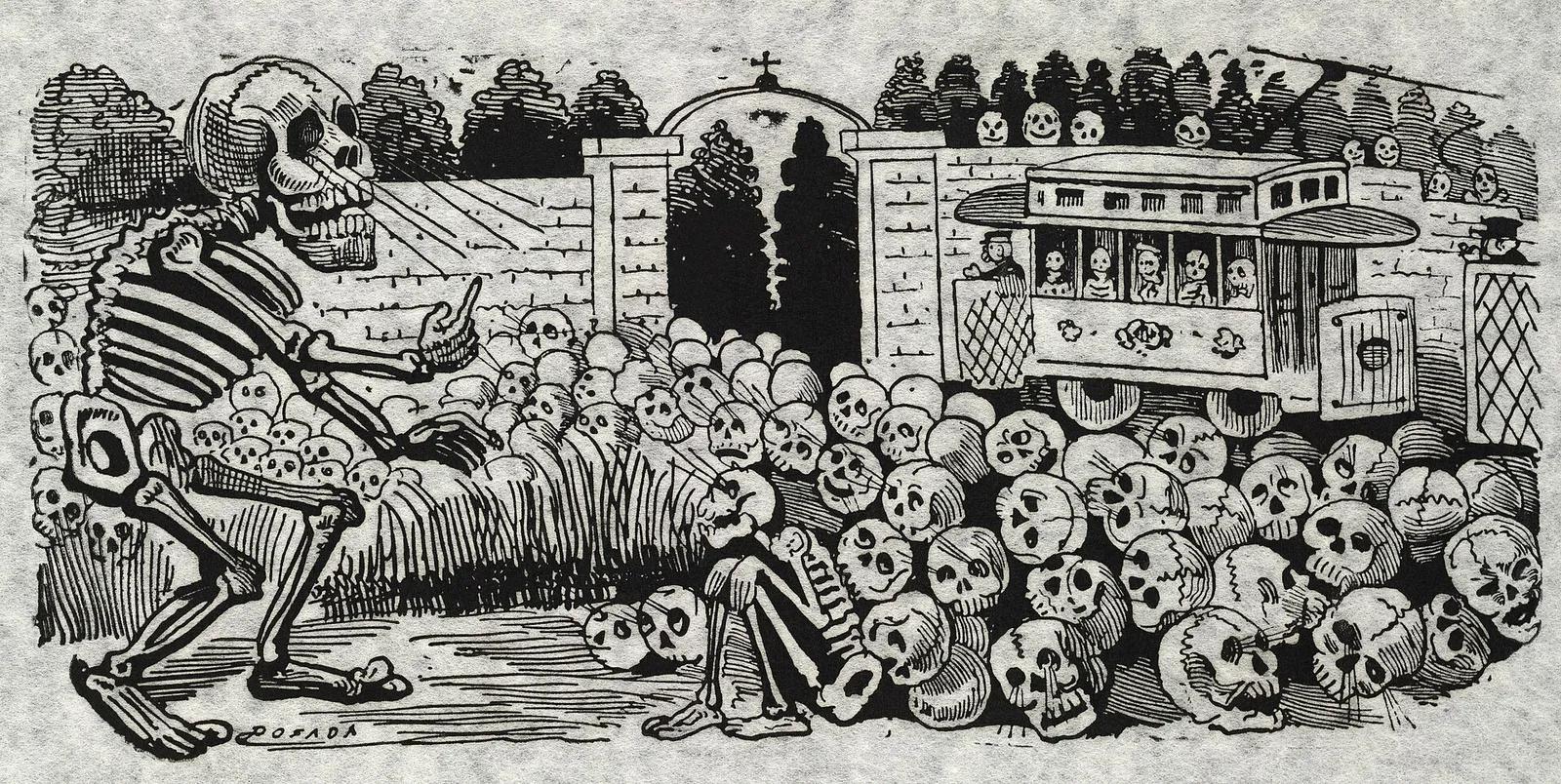
Such sheets were made to be sold for a few centavos and thrown away. Literary calaveras were comic mock-epitaphs, written as if their targets were already dead: politicians, bullfighters, tradesmen, shop girls. Posada supplied the skeletons, dancing, drinking, riding bicycles or, as in his Gran calavera eléctrica, crowding onto the new electric trams. Death was the great leveller, and the satire assumed that everyone, rich or poor, was a skeleton in fancy clothes.
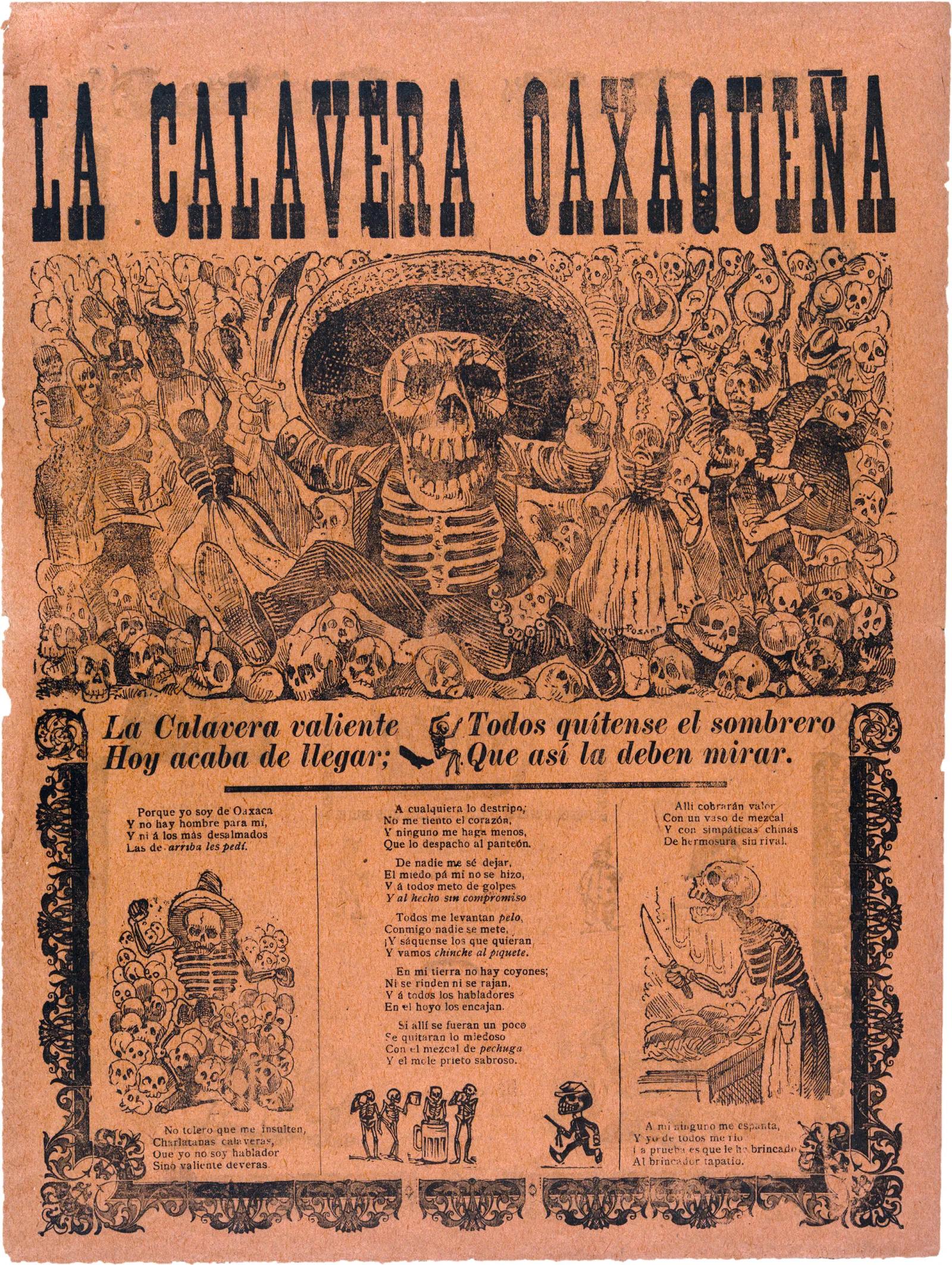
It matters that this tradition belongs to the Day of the Dead, observed on 1 and 2 November, not to Halloween. UNESCO inscribed the Indigenous festivity dedicated to the dead on its list of the Intangible Cultural Heritage of Humanity in 2008. The calavera prints are its comic, urban, printed side: laughter at mortality, not fear of it.
Who named her La Catrina? The 1930 book
Posada was rediscovered in the 1920s by artists. The French-born painter Jean Charlot noticed his prints, tracked down the Vanegas Arroyo shop and introduced the work to Diego Rivera and to the writer and publisher Frances Toor, whose bilingual magazine Mexican Folkways, founded in 1925, had Rivera as art editor.
In 1930 Toor and Rivera published the first book of Posada’s engravings. There the garbancera was given a new caption: Calavera Catrina. A catrín was a dandy, a well-dressed young man about town; catrina is his female counterpart. In Sandoval’s words, “For reasons unknown, Toor and Rivera chose the honorific, which referred to her as a female dandy.” The change softened the joke. A garbancera was a social insult aimed at the poor; a catrina could be anyone with fine clothes.
For reasons unknown, Toor and Rivera chose the honorific, which referred to her as a female dandy.
The next step was American. On 13 April 1944 the Art Institute of Chicago opened Posada: Printmaker to the Mexican People, and crowds overwhelmed the museum. La Catrina was the cover of the catalogue, which was sent to writers and artists in both countries. The Art Institute still holds several of the garbancera broadsheets it acquired at that time.
Diego Rivera’s mural gave La Catrina a body
In 1947 Diego Rivera completed Sueño de una tarde dominical en la Alameda Central (Dream of a Sunday Afternoon in the Alameda Central), a fresco about 15.6 metres long painted for the Hotel del Prado in Mexico City. After the hotel was damaged in the 1985 earthquake, the mural was moved to its own building, now the Museo Mural Diego Rivera. The mural is still in copyright, so it is described here rather than reproduced.
At its centre Rivera placed La Catrina, now at full length and in a long dress. On one side stands Posada, in a bowler hat, linked to her; on the other, holding her hand, is Rivera himself as a boy, with Frida Kahlo standing behind him. Rivera gave the skeleton a feathered boa shaped like a plumed serpent, the emblem of Quetzalcóatl, and other Mesoamerican references. A satire of women who rejected their Indigenous roots became, in his hands, a figure who wore them proudly.
From there the image spread through folk ceramics and papier-mâché, through Chicano murals and posters of the 1960s and 1970s, and finally into costumes, parades and brand campaigns. Sandoval calls her Mexico’s unofficial national totem, perhaps second only to the Virgin of Guadalupe. The irony is hard to miss. A figure invented to ridicule women for abandoning their roots now stands for pride in those roots, and the elaborate hats, dresses and painted faces of modern Catrina parades are exactly the kind of costume the original verses mocked. Knowing the history does not make the modern figure false. It shows how images change meaning as they pass from one audience to another, and how much of that change happened in the decades after Posada’s death.
La Catrina timeline: from broadsheet to icon
1852
José Guadalupe Posada is born in Aguascalientes.
c. 1890–1909
Vanegas Arroyo broadsheets already mock the garbanceras in verse.
c. 1910–1913
Posada makes the zinc plate of the skull in the plumed hat.
1913
Posada dies on 20 January; the head appears that autumn on Remate de calaveras alegres y sandungueras.
1925
Frances Toor founds Mexican Folkways, with Diego Rivera as art editor.
1930
Toor and Rivera’s book of Posada’s prints captions her Calavera Catrina.
1943
Posada’s Catrina plate is printed in the portfolio 36 Grabados, the impression now in the Met.
1944
La Catrina is the catalogue cover of the Art Institute of Chicago’s Posada exhibition.
1947
Rivera completes the Alameda mural with Catrina at its centre.
2008
UNESCO inscribes Mexico’s festivity dedicated to the dead.
Source: Mathew Sandoval, The Conversation (2023); The Metropolitan Museum of Art; Library of Congress; UNESCO
How to look at La Catrina for yourself
When you meet a Posada impression in a museum, look first at the paper. Broadsheets were printed on cheap coloured stock, pink, green, yellow and purple, and the colour was part of the street appeal. Then look at the line. The zinc technique keeps a draughtsman’s quickness; the plumes on the hat are a few curling strokes, the teeth a row of short dashes. The face is a skull but the head is tilted with a society lady’s poise.
- Notice what is not there: no dress, no body, no flowers in the hands. Those came later, from Rivera and from folk artists.
- Find the hat’s size relative to the skull. It is almost twice as wide, and that disproportion is the satire.
- If you can, read the verses on a garbancera broadsheet. They are the clearest evidence of whom the joke was aimed at.
- Compare the 1943 impression with a lifetime broadsheet. Later printings from the same plate can look crisper or heavier depending on paper and ink.
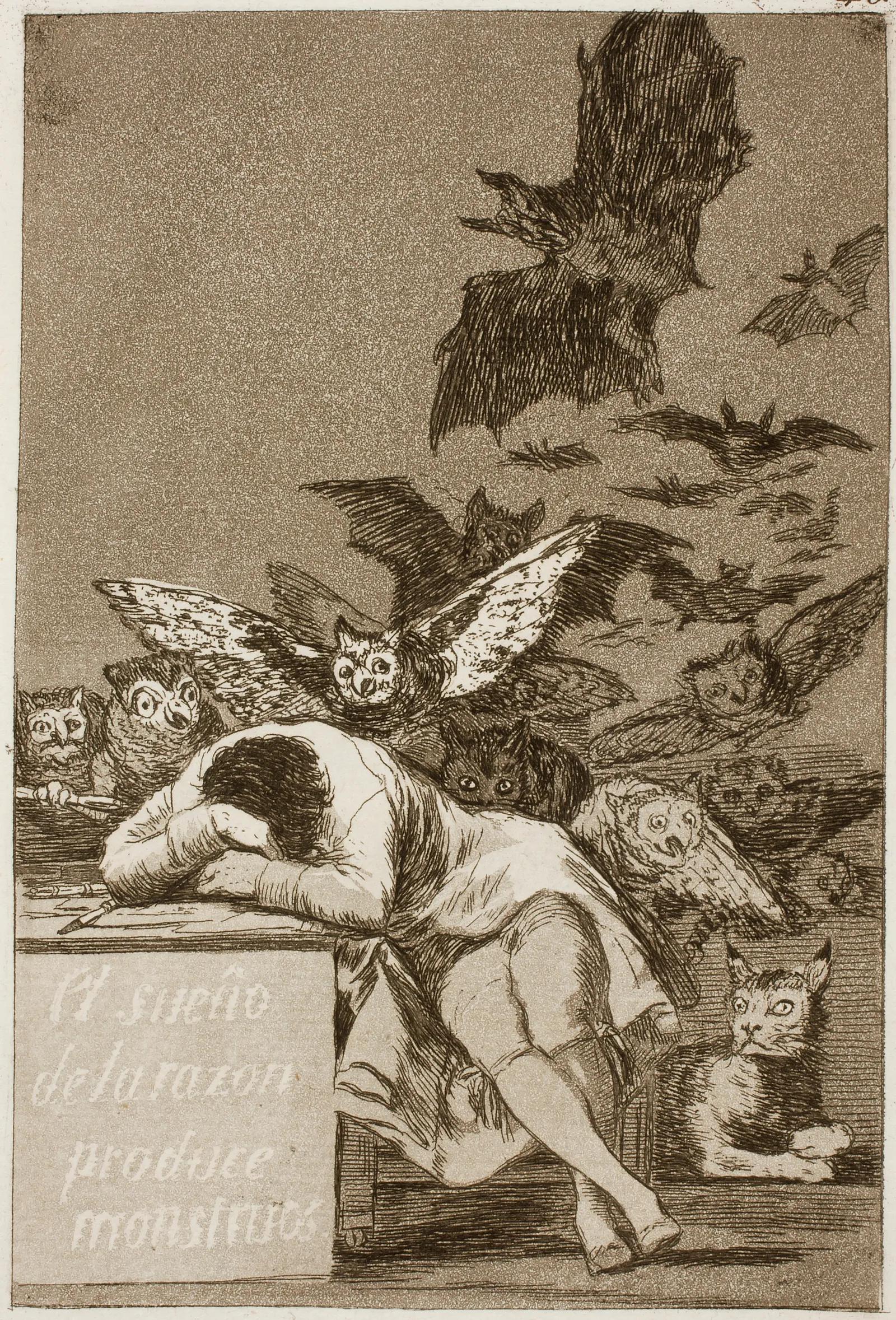
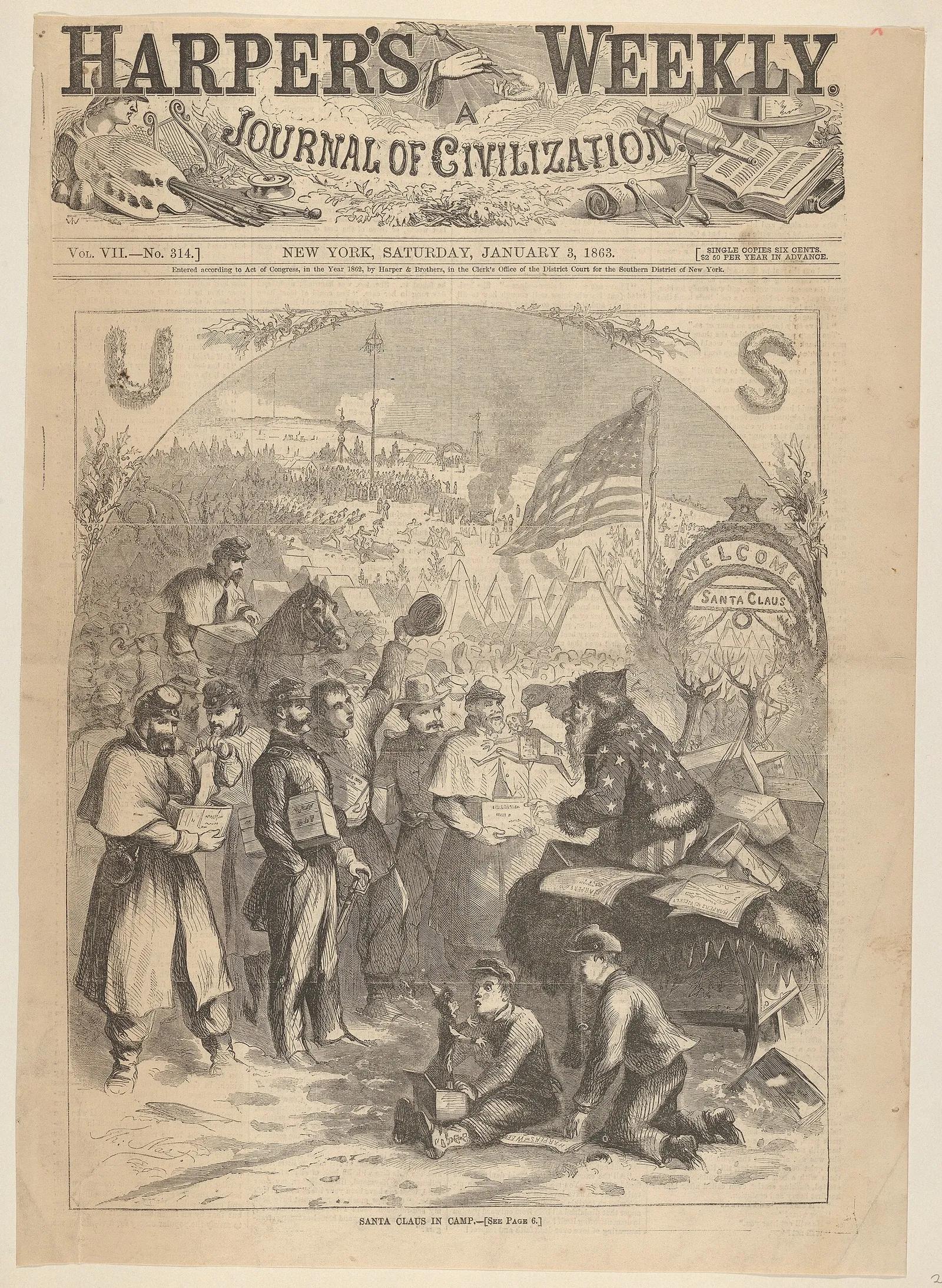
Posada’s calaveras sit in a long line of popular prints that outlived their cheap origins, like Hokusai’s Great Wave or Thomas Nast’s Santa Claus. For a darker satire of human folly, compare Goya’s Sleep of Reason.
Questions people ask
Who created La Catrina?
La Catrina was created by the Mexican printmaker José Guadalupe Posada (1852–1913) as a small relief etching on zinc, made around 1910 to 1913 for broadsheets published by Antonio Vanegas Arroyo in Mexico City. Posada drew only the skull, shoulders and a plumed hat; the full-length figure most people know comes from Diego Rivera’s mural of 1947.
What was La Catrina originally called?
She was originally the Calavera Garbancera. A garbancera was a woman who sold chickpeas in the market, and the word was used to mock women of humble, often Indigenous, origin who dressed in European fashions to pass as upper class. The name Calavera Catrina, meaning a female dandy, first appeared in a 1930 book published by Frances Toor and Diego Rivera.
Is La Catrina a Halloween symbol?
No. La Catrina belongs to Mexico’s Day of the Dead, observed on 1 and 2 November, when families remember and honour their dead. Posada’s calaveras were comic broadsheets sold for the festival, laughing at mortality and at the living. The figure’s use in Halloween costumes is a recent commercial development, not part of her origin.
Why is La Catrina in Diego Rivera’s mural?
Rivera admired Posada as a father of Mexican art and placed him and La Catrina at the centre of Dream of a Sunday Afternoon in the Alameda Central (1947), with himself as a boy holding her hand. He gave her a full body, a long dress and a feathered serpent boa, recasting a satirical figure as a national symbol.
When was La Catrina first published?
The earliest securely dated printing of Posada’s skull in the plumed hat is a 1913 Day of the Dead broadsheet, Remate de calaveras alegres y sandungueras, published by the Vanegas Arroyo firm after Posada’s death in January that year. Some scholars date the plate itself to 1912 or more broadly to about 1910 to 1913.
Sources and further reading
- How ‘La Catrina’ became the iconic symbol of Day of the Dead, Mathew Sandoval, The Conversation
- Page 15: Catrina (calavera), from ‘36 Grabados’ (46.46.102(15)), The Metropolitan Museum of Art
- Broadsheet relating to the elegant and pretentious skeletons that become decayed and fetid (46.46.374), The Metropolitan Museum of Art
- Gran bola de garbanceras (LCCN 99615864), Library of Congress
- Gift of Calaveras, Given to the Chickpea Sellers (1944.949), The Art Institute of Chicago
- The Lovely Garbanzo-Sellers as Calaveras (1944.923), The Art Institute of Chicago
- Revolutionary Calavera (1943.1288), The Art Institute of Chicago
- La Calavera Catrina, Wikipedia
Images are public-domain or CC0 reproductions from Wikimedia Commons, credited under each figure. Interpretations are attributed to the scholars who hold them.
Keep looking
Know someone who should see this?
Send them the story of La Calavera Garbancera, known since 1930 as La Calavera Catrina.