
Vinci Stories · Andrea Mantegna
Mantegna’s Adoration of the Magi and the Chinese Porcelain Cup
Around 1500 Andrea Mantegna painted the Adoration of the Magi as a tight close-up of eight heads and three gifts. One of those gifts arrives in a blue-and-white Chinese porcelain cup, among the earliest pictures of porcelain in European art, and every other detail, from the African king’s earring to the baby’s blanket, was chosen with the same care.
- Work
- Adoration of the Magi, About 1495–1505
- Where to see it
- J. Paul Getty Museum, Los Angeles
- Reading time
- 10 min
- Updated
What Mantegna’s Adoration of the Magi shows
An old, bald king with a long white beard bends low over a cup. He holds it in one hand and lifts its lid with the other to show what is inside: gold coins of different sizes. The cup itself is white and painted with blue flowers. It is Chinese porcelain, and in the Italy of around 1500 it was almost as marvellous as the child he is offering it to. Andrea Mantegna’s Adoration of the Magi, in the J. Paul Getty Museum in Los Angeles, is, in the words of the Getty curator Dawson W. Carr, well known to students of Asian ceramics as one of the earliest representations of Chinese blue-and-white porcelain in European art.
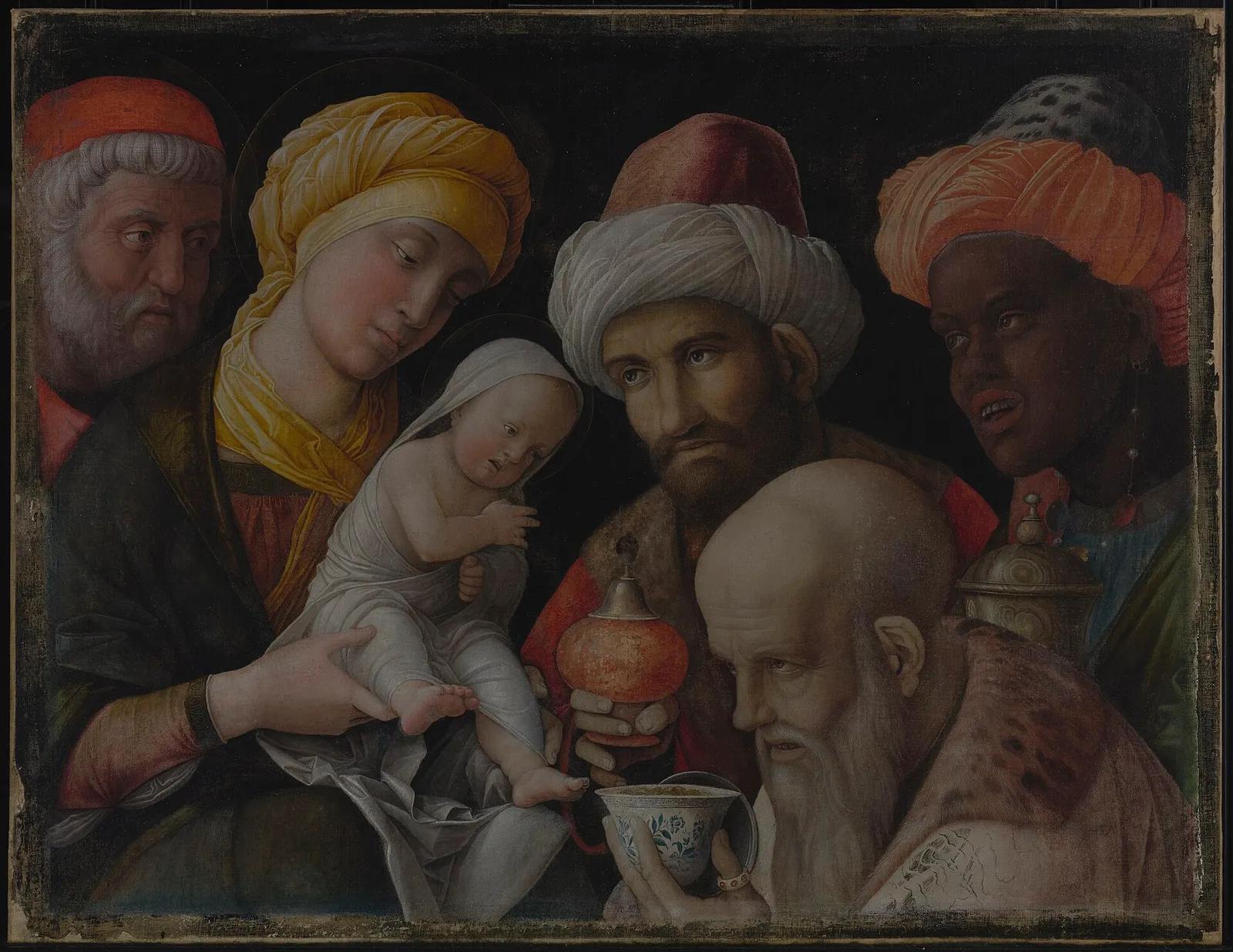
The painting is small, 48.5 by 65.6 centimetres, and painted in distemper, pigment bound in animal glue, on fine linen. The Getty dates it to about 1495–1505, near the end of Mantegna’s long career as court painter to the Gonzaga in Mantua. Eight figures fill it: at left Joseph, bearded and wary, and Mary in a yellow headdress holding the swaddled child; at right the three Magi, each with a gift in an exotic vessel. Everything else has been removed.
Mantegna thrusts the viewer into the scene with his use of the close-up, centuries before it became the familiar technique of motion pictures.
No pageant, no star: Mantegna’s close-up
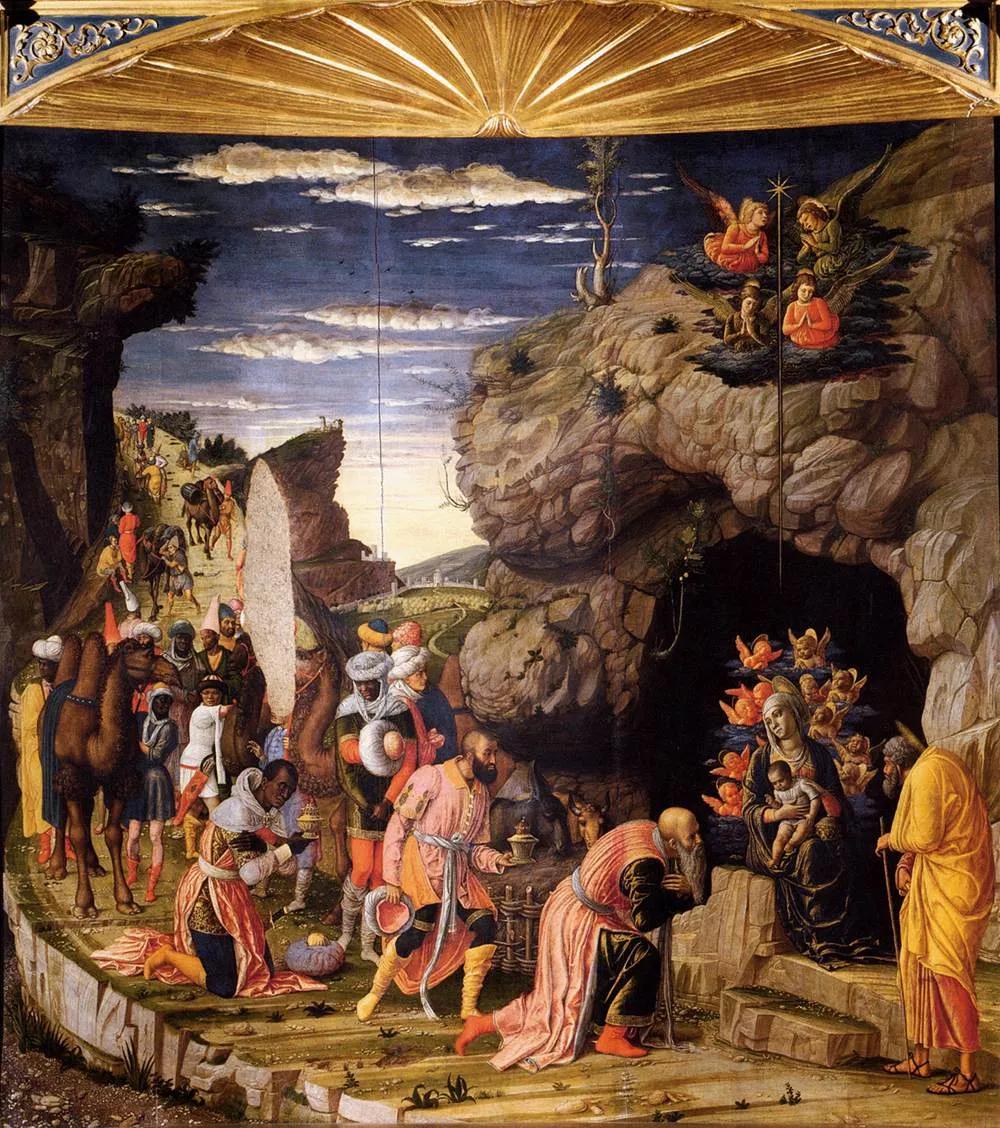
Most Renaissance Adorations are processions. The Magi arrive with horses, camels, servants and banners, often winding down from distant hills; Mantegna had painted that kind of picture himself in the 1460s, in the Adoration now in the Uffizi. Here, as Carr puts it, he deliberately abandons perspective and setting. Even the star, essential to the story, is left out. What remains is a frieze of heads pushed up to the picture surface, an arrangement the Getty’s own catalogue relates to Mantegna’s study of ancient Roman reliefs.
The format belongs to a type of devotional picture that spread in late fifteenth-century Italy: half-length figures, cut off by the frame, brought close to the viewer for private prayer. The point was to make the sacred event immediate. Each of the Magi shows a different state of awe. The oldest bows his head and does not meet the child’s eyes; the middle king is fixed and quiet; the youngest, at far right, has his mouth open in wonder. The viewer is meant to recognise the right response and share it.
Mantegna planned the image thoroughly. X-radiographs examined at the Getty show no major changes to the composition, only refinements: the outline of Mary’s headdress, the child’s head and foot, and one telling correction. A finger that once projected beyond the porcelain cup was painted out, apparently because it looked awkward. No preparatory drawings survive; Carr suggests that Mantegna systematically destroyed them.
The Chinese porcelain cup: Ming blue-and-white in Renaissance Italy
Chinese porcelain reached fifteenth-century Europe in a trickle. Pieces came as diplomatic gifts, sometimes sent by the Mamluk sultans in Cairo to the doges of Venice and other prominent figures, and princely families collected it when they could. The Gonzaga were among them, which may be how Mantegna had a model. Its material was a mystery: European potters could not reproduce it, its composition was not understood, and a popular belief held that porcelain was not entirely made by human hands. Its whiteness, thinness and translucency made it, in Carr’s reading, a fitting present for a divine king.
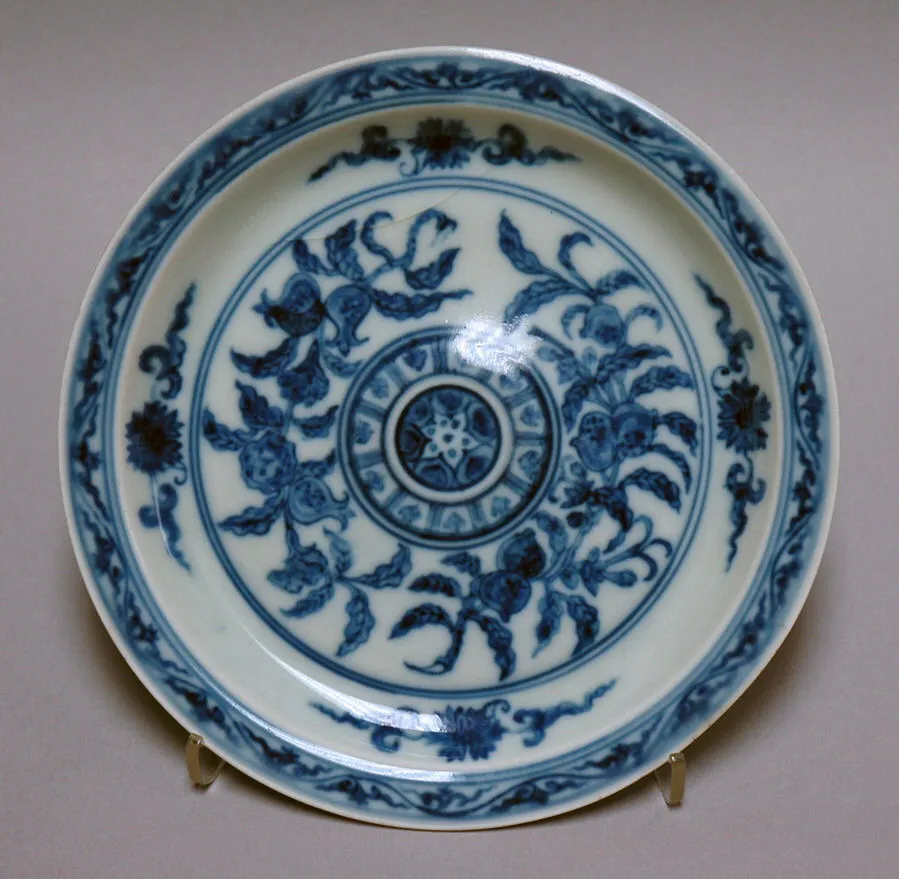
Carr compared Mantegna’s vessel with surviving porcelain and found that it most closely resembles a yashou bei, a type of wine cup made under the Ming emperor Yongle. Only four examples of the type were known when he wrote: three in the Palace Museum in Beijing and one sold at Sotheby’s in London in 1986. The two Beijing cups that match it bear Yongle’s mark and were made between 1420 and the emperor’s death in 1424. If this was Mantegna’s model, he enlarged and elongated it and added a lid. The flower pattern on his cup does not match any known piece and may be his own abstraction of the lotus motif found on the real cups.
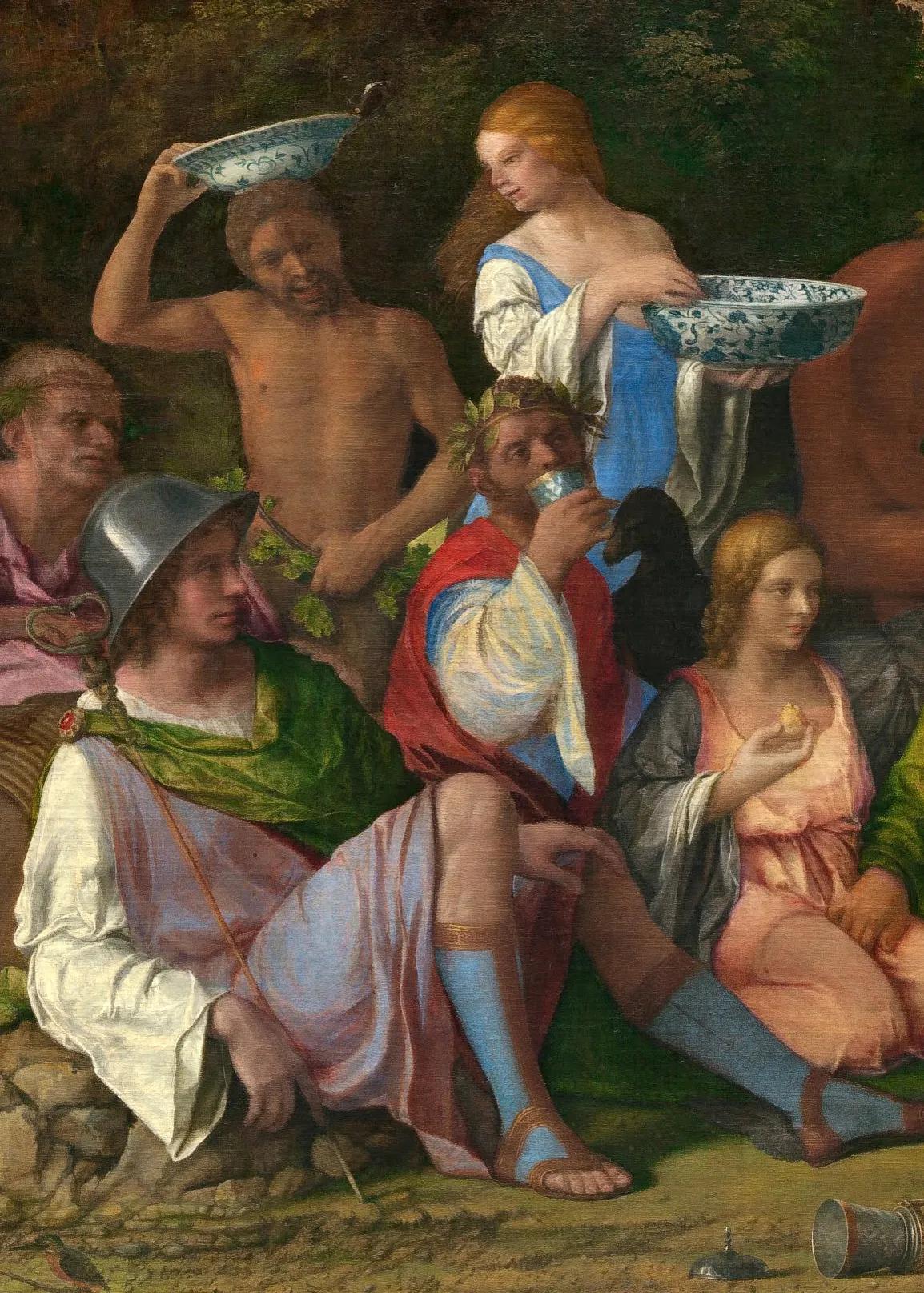
Mantegna’s picture is not alone. The ceramics historian A. I. Spriggs observed that the three earliest depictions of porcelain in European paintings all come from north-eastern Italy: a Madonna and Child attributed to Francesco Benaglio from the 1460s, Mantegna’s Adoration, and Giovanni Bellini’s Feast of the Gods, dated 1514; the Benaglio and the Bellini are both now in the National Gallery of Art in Washington. Bellini was Mantegna’s brother-in-law, and his gods eat from blue-and-white bowls, a painting whose later reworking by Titian is told in Bellini’s Feast of the Gods.
Gold, frankincense and myrrh: the three gifts and their vessels
Matthew’s Gospel names the gifts but not the givers. Over the centuries, Christian writers gave the gifts meanings. Gold, the most precious metal, honoured Christ as king. Frankincense, a gum resin from trees native to east Africa and Arabia and prescribed for incense in the Book of Exodus, honoured his divinity or priesthood. Myrrh, another resin used in embalming, foretold his death and burial. In earlier Adorations, Mantegna’s included, the gifts arrive in similar gold caskets that look like reliquaries. Here each has a different, exotic container.
- Gold: carried in the porcelain cup by the oldest king, the only gift we actually see, with coins of several sizes and types.
- Frankincense: held by the middle king in a vessel of orange-red veined stone with a silver bell-shaped cap. Carr suggested a form of jasper; the Getty’s 2019 label calls it a Turkish incense burner.
- Myrrh: held by the young African king in a covered jar of banded stone, agate or chalcedony in Carr’s description, alabaster or agate in the Getty’s, recalling the containers used in antiquity for precious oils.
Carr notes a finding from studies of Mantegna’s materials: the artist rarely imitated a specific real stone, but invented stones so close to nature that they look real. The vessels may have been based on objects in the Gonzaga collections, where Isabella d’Este was an avid collector of hardstone vases for her rooms. None of the Magi wears a crown. Furs and jewels suggest rank, and Carr wonders whether Mantegna was accommodating a patron who was himself a marquis, not a king.
The African king: Balthazar or Caspar?
The Bible does not name the Magi, and the names that tradition gave them, Caspar, Melchior and Balthazar, were not attached consistently to the same figures. This painting shows the problem neatly. Carr’s 1997 book follows one tradition: the eldest is Melchior, representing Europe; the middle-aged king is Balthasar, representing Asia; the youngest, the African, is Caspar. The Getty’s 2019 exhibition Balthazar: A Black African King in Medieval and Renaissance Art used another: the eldest, holding Chinese porcelain, is Caspar, associated with Asia; the turbaned king in the centre is Melchior; and the African king, in a leopard-skin headdress, is Balthazar. Both readings agree on the idea behind them, that the three kings stood for the three known continents and the three ages of man.
The African king is painted with particular attention. His earring, a chain of pearls and translucent stones on gold thread, is, according to Carr, a jewellery form not known from any culture, Mantegna’s own invention. The head is also one of the most damaged areas of the painting, with many small losses of paint, though its features survive. The Getty’s exhibition placed the picture in a harder history. Its gallery text records that Isabella d’Este, the marchioness of Mantua, bought Black African children to be raised as servants at court, and that Mantegna would have come into regular contact with servants at the Mantuan court in the 1490s.
Could the figure of Balthazar in Mantegna’s painting have been based on an individual in her household?
The Getty frames that as a question, and it should stay one. No document names a model. What the exhibition made clear is that Balthazar’s African origin was meant to show the universal reach of Christianity, while the presence of Black Africans in the retinue of Isabella and her husband Francesco Gonzaga was meant to display the couple’s worldliness, and that many of those people were not free.
The child as priest, and where the painting has been
Look at the baby’s blanket. Carr pointed out that Mantegna wraps it like a Roman toga, slung over the left shoulder and drawn up over the head. In ancient Rome a man shown in a toga with his head covered was performing a religious rite, and Mantegna knew the motif from reliefs of the emperor Marcus Aurelius sacrificing as Pontifex Maximus, high priest. The child is presented as priest as well as king, and he responds to the kings with a blessing, two fingers raised, turned by Mantegna into the jerky gesture of a real infant. His court friend Battista Fiera, physician, poet and student of ancient costume, may have advised him.
Nothing is known of the painting’s whereabouts until 1871, when Louisa, Lady Ashburton lent it to the Royal Academy’s old masters exhibition in London. After her death in 1903 it passed through her grandson to the collection of the Marquess of Northampton at Castle Ashby. In 1901 the critic Charles Yriarte was the first to write about it at length. Some later scholars doubted the attribution, partly through confusion with a weaker copy now in the Philadelphia Museum of Art. In 1985 the seventh marquess sold it at Christie’s in London, and the Getty bought it on 18 April; the Los Angeles Times reported the price the next day as $10.5 million.
Its condition reflects the fragility of distemper. Such paintings were made to be seen unvarnished, with a matte, brilliant surface, but varnish was later applied to this one, darkening some colours. Excess varnish was removed in the Getty’s cleaning, but none of it can be taken off entirely without risk. There is a horizontal crease at the level of Mary’s eyes and a tear running from her cheek across the child’s shoulder, and small losses are concentrated in the central vessel and the African king’s head.
1430–31
Andrea Mantegna born at Isola di Cartura, north of Padua.
1441–42
Apprenticed to the Paduan painter Francesco Squarcione.
1460
Becomes court painter to the Gonzaga in Mantua.
1490
Isabella d’Este joins the Gonzaga court on her marriage to Francesco Gonzaga.
c. 1495–1505
Mantegna paints the Adoration of the Magi in distemper on linen.
1506
Mantegna dies in Mantua.
1514
Giovanni Bellini dates The Feast of the Gods, another early painting of Chinese porcelain.
1871
First recorded exhibition, lent by Louisa, Lady Ashburton, to the Royal Academy, London.
1985
Sold by the Marquess of Northampton at Christie’s, London; bought by the J. Paul Getty Museum.
2019
Shown in the Getty exhibition Balthazar: A Black African King in Medieval and Renaissance Art (to February 2020).
Source: Dawson W. Carr, Andrea Mantegna: The Adoration of the Magi (Getty, 1997); J. Paul Getty Museum, Balthazar gallery text (2019)
Christmas or Epiphany? How to look at the painting
The image appears on Christmas cards, but its feast is Epiphany, 6 January, when the Western Church commemorates the visit of the Magi as Christ’s first revelation to the wider world. In Mantegna’s time, Carr notes, two other manifestations were also celebrated on that day: the baptism of Christ and the miracle at Cana. The painting is about recognition. Three foreign kings see who the child is, and the viewer is invited to see it with them.
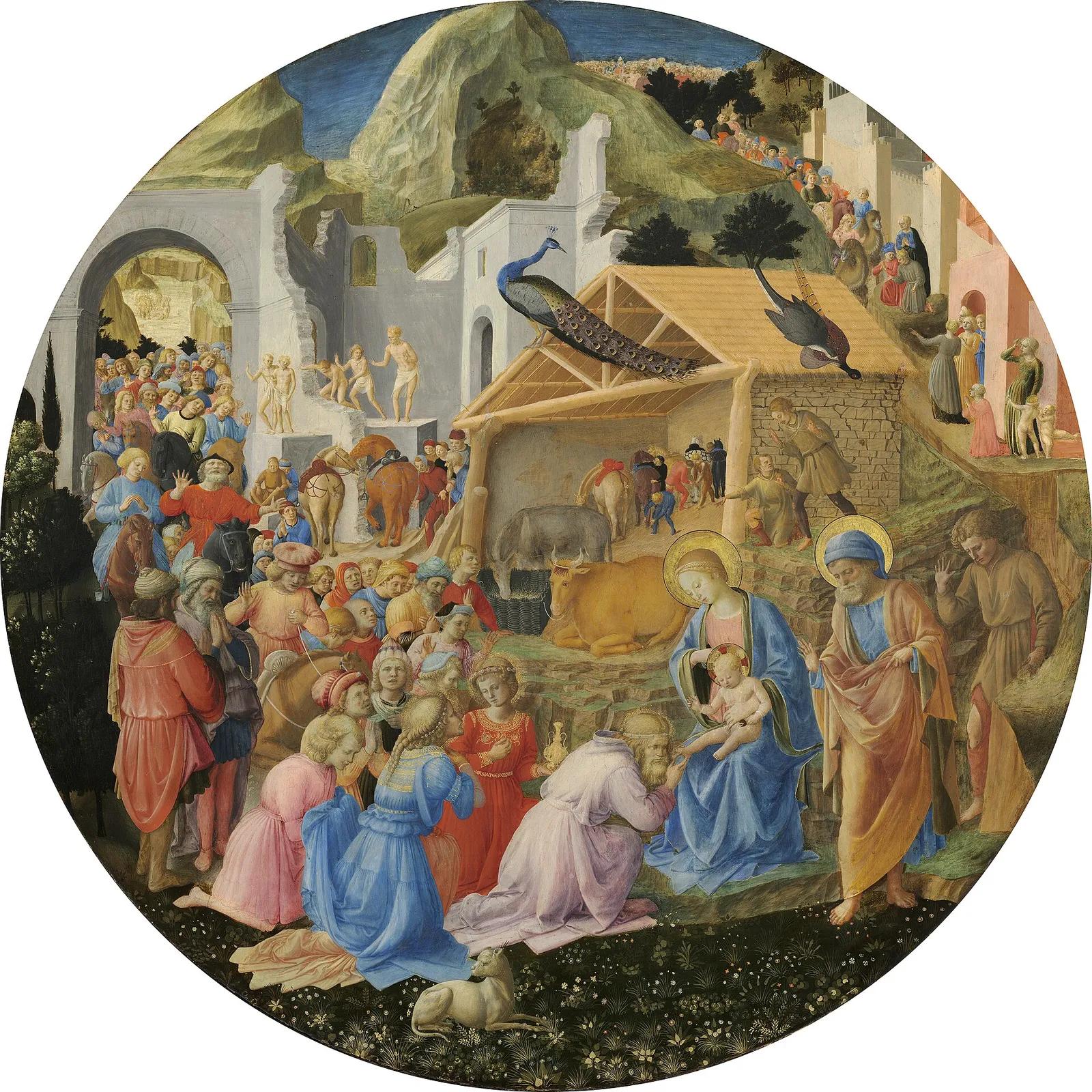
To look at it yourself, begin with the cup, then follow the hands. Mary’s hand supports the child’s foot; the child’s hand blesses; the oldest king’s hand lifts the lid; the middle king grips his vessel by its foot. Then look at the eyes, which tell the story of the scene: Joseph watches the strangers, Mary looks down at the child, the child looks at the gold, and the three kings look at him. Notice what is not there: a crown, a star, a stable, a horizon. Compare the composition with a crowded Adoration like the one in Adoration of the Magi: Why Is There a Peacock? to see how much Mantegna took away.
In front of the original, stand close and look for the shell gold Mantegna used for the coins and haloes, applied in thin strokes, and for the faint brocade pattern on the middle king’s turban. Then step back. From a few metres away the losses disappear, and what remains is the effect Mantegna wanted: eight faces close enough to touch, and one fragile blue-and-white cup at the centre.
Questions people ask
Where is Mantegna’s Adoration of the Magi?
This version is in the J. Paul Getty Museum, Los Angeles (85.PA.417). It is distemper on linen, 48.5 by 65.6 centimetres, dated about 1495–1505. The Getty bought it at Christie’s, London, in April 1985 from the Marquess of Northampton. Mantegna’s other famous Adoration, painted in the 1460s as part of a triptych, is in the Uffizi in Florence.
Why is there a Chinese cup in Mantegna’s Adoration of the Magi?
Porcelain was one of the rarest and most mysterious materials in fifteenth-century Europe, arriving as diplomatic gifts and collected by princes such as the Gonzaga of Mantua. Its whiteness and translucency, and the belief that it was not entirely man-made, made it a fitting container for gold offered to Christ. The cup closely resembles a Ming wine cup of the Yongle period.
Is this the first picture of porcelain in European art?
It is among the earliest. The ceramics historian A. I. Spriggs identified three early examples, all from north-eastern Italy: a Madonna and Child attributed to Francesco Benaglio from the 1460s, Mantegna’s Adoration from about 1500, and Giovanni Bellini’s Feast of the Gods, dated 1514. The Benaglio is probably slightly earlier than Mantegna’s painting.
Who is the Black king in Mantegna’s painting?
He is one of the three Magi, representing Africa and youth. His name varies with the source: Dawson Carr’s 1997 Getty book calls him Caspar, while the Getty’s 2019 exhibition named him Balthazar, the more common modern identification. The Getty raised, as a question rather than a finding, whether he might have been modelled on one of the enslaved African servants at Isabella d’Este’s court.
What is distemper painting?
Distemper is paint made by binding pigments with animal glue rather than egg or oil. Mantegna used it on fine linen for many devotional pictures because it dries to a matte, luminous surface that reads well in low light. It is fragile and water-soluble, and it should not be varnished, which is why many distemper paintings, including this one, have darkened where later restorers applied varnish.
Sources and further reading
- Andrea Mantegna: The Adoration of the Magi (Dawson W. Carr, 1997, Getty Virtual Library), J. Paul Getty Museum
- Balthazar: A Black African King in Medieval and Renaissance Art — gallery text, J. Paul Getty Museum
- Exhibition Explores Balthazar, an African King, in Medieval and Renaissance Art, Getty News
- Adoration of the Magi, Andrea Mantegna, Google Arts & Culture (J. Paul Getty Museum)
- Adoration of the Magi (Mantegna), Wikipedia
Images are public-domain or CC0 reproductions from Wikimedia Commons, credited under each figure. Interpretations are attributed to the scholars who hold them.
Keep looking

Know someone who should see this?
Send them the story of Adoration of the Magi.