
Vinci Stories · Fra Angelico and Fra Filippo Lippi
Adoration of the Magi: Why Is There a Peacock on the Roof?
A round Florentine painting of the Magi, begun by Fra Angelico and probably finished by Fra Filippo Lippi, has a peacock perched on the stable roof, far too big for its surroundings. It was painted over finished areas, late in the work. The reason it is there runs from Saint Augustine’s dinner in Carthage to the bedroom of Lorenzo de’ Medici.
- Work
- The Adoration of the Magi, c. 1440/1460
- Where to see it
- National Gallery of Art, Samuel H. Kress Collection, Washington, DC
- Reading time
- 8 min
- Updated
The peacock in the Adoration of the Magi
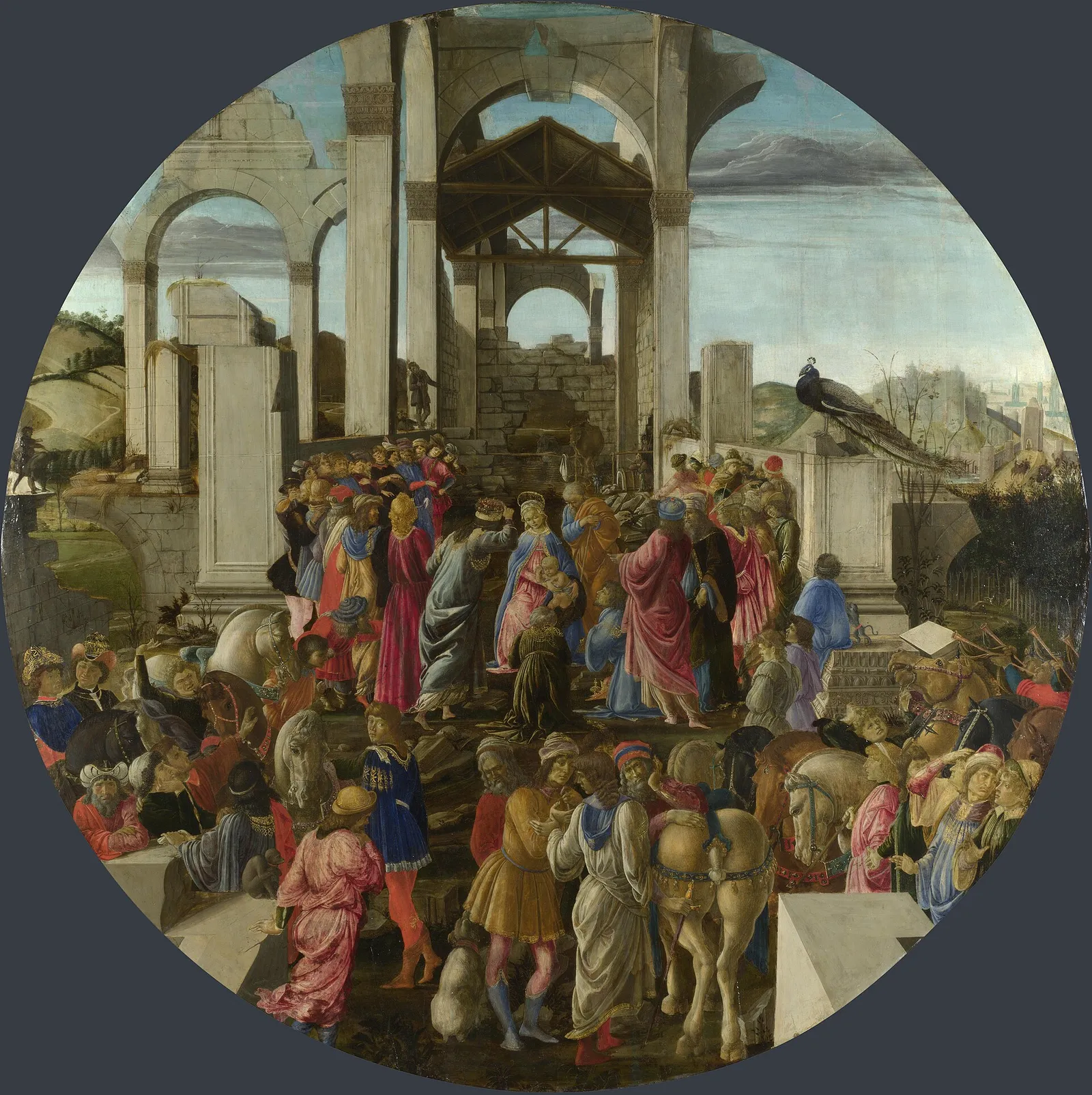
In the middle of the upper half of this round painting, on the ridge of the stable at Bethlehem, sits a peacock. It is enormous. Its blue-green body is as long as one of the figures in the stable below, and its spotted train hangs down over the thatch. It looks back over its shoulder at the hills. Nobody in the painting looks at it.
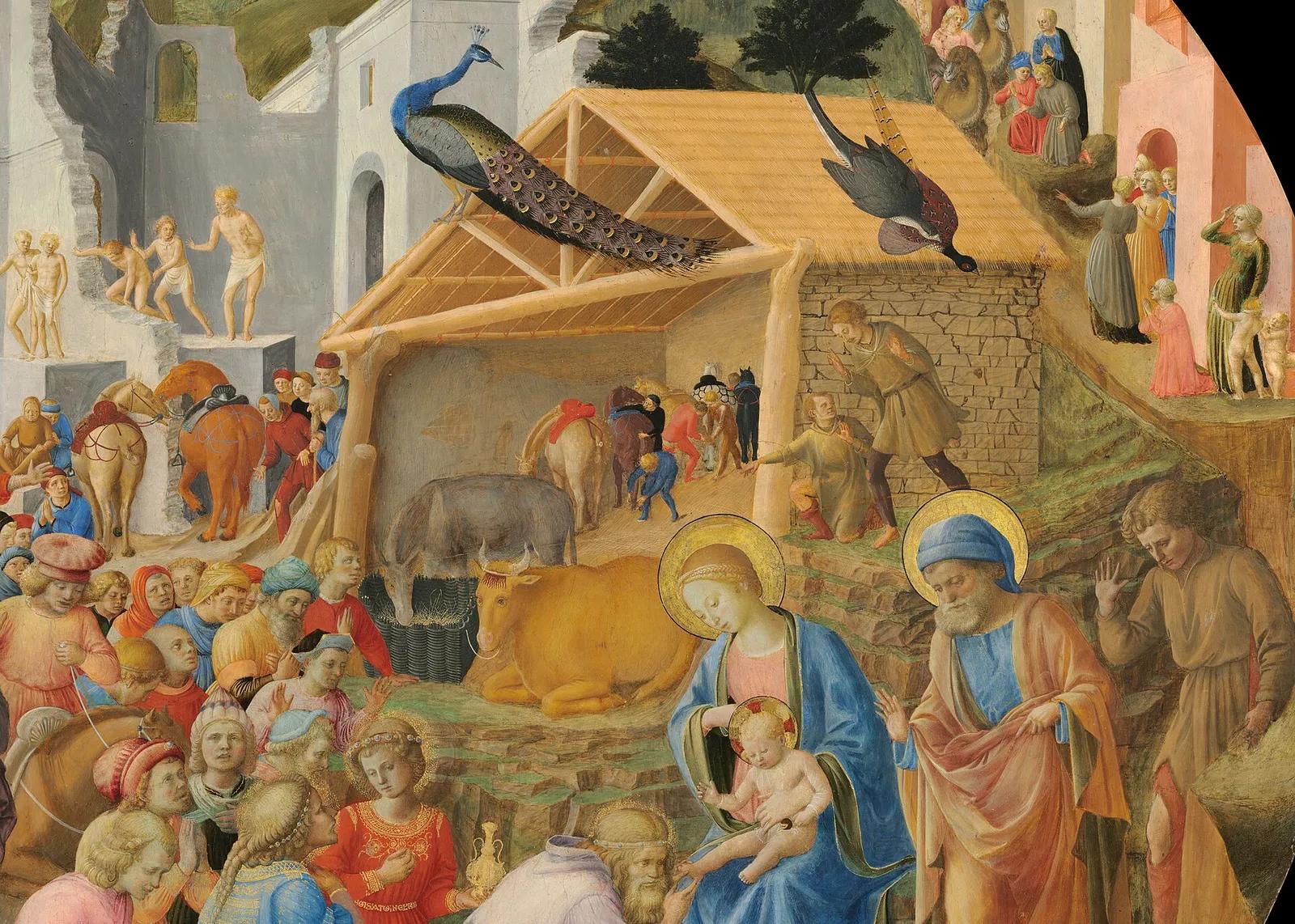
The painting is The Adoration of the Magi in the National Gallery of Art in Washington, a tondo, or circular panel, 137.3 centimetres across, painted in tempera on poplar in Florence between about 1440 and 1460. The museum attributes it to two friars, Fra Angelico and Fra Filippo Lippi. Below the peacock the Virgin, in blue, holds the Christ Child on her knee while the oldest king kneels at his feet. Joseph stands beside them; the ox and ass look on from the stable.
The peacock does not belong to the Gospel story. Matthew mentions a star, wise men and three gifts. To understand why a Florentine painter put the bird on the roof, we need a fifth-century bishop, a Florentine workshop that changed hands and a family that collected images of the Magi.
Why a peacock? A Christian symbol of eternal life
Since antiquity the flesh of the peacock was said not to decay. Saint Augustine tested the belief. In Book 21 of The City of God, written in the early fifth century, he describes a meal in Carthage at which a peacock was served, and the experiment that followed.
it happened at Carthage that a bird of this kind was cooked and served up to me, and, taking a suitable slice of flesh from its breast, I ordered it to be kept, and when it had been kept as many days as make any other flesh stinking, it was produced and set before me, and emitted no offensive smell.
Augustine adds that after thirty days the meat was unchanged and after a year only “a little more shrivelled, and drier”. He used the story to argue that God can give bodies properties beyond nature, including the power to endure for ever. Christian artists took the peacock as an emblem of immortality, paradise and the Resurrection. The National Gallery of Art notes that in Christianity the bird represented paradise or immortality.
Placed above the newborn Christ, then, the peacock looks forward from the birth to the Resurrection. Its position on the roof of a ramshackle stable, among ruins, sets incorruptible life above a world of decay.
Who painted it? Fra Angelico, Fra Filippo Lippi and two centuries of wrong names
The painting has been given to almost every leading Florentine painter of the fifteenth century. The current view, associated with Bernard Berenson’s studies and accepted by the National Gallery of Art, is that Fra Angelico and his workshop began it in the 1440s and left it unfinished, and that after Angelico’s death in 1455 Fra Filippo Lippi, a rival friar-painter, completed it. The Virgin’s face is usually kept for Angelico; the kings and much of the crowd are given to Lippi. A minority view, argued by Jeffrey Ruda, has Lippi beginning the work.
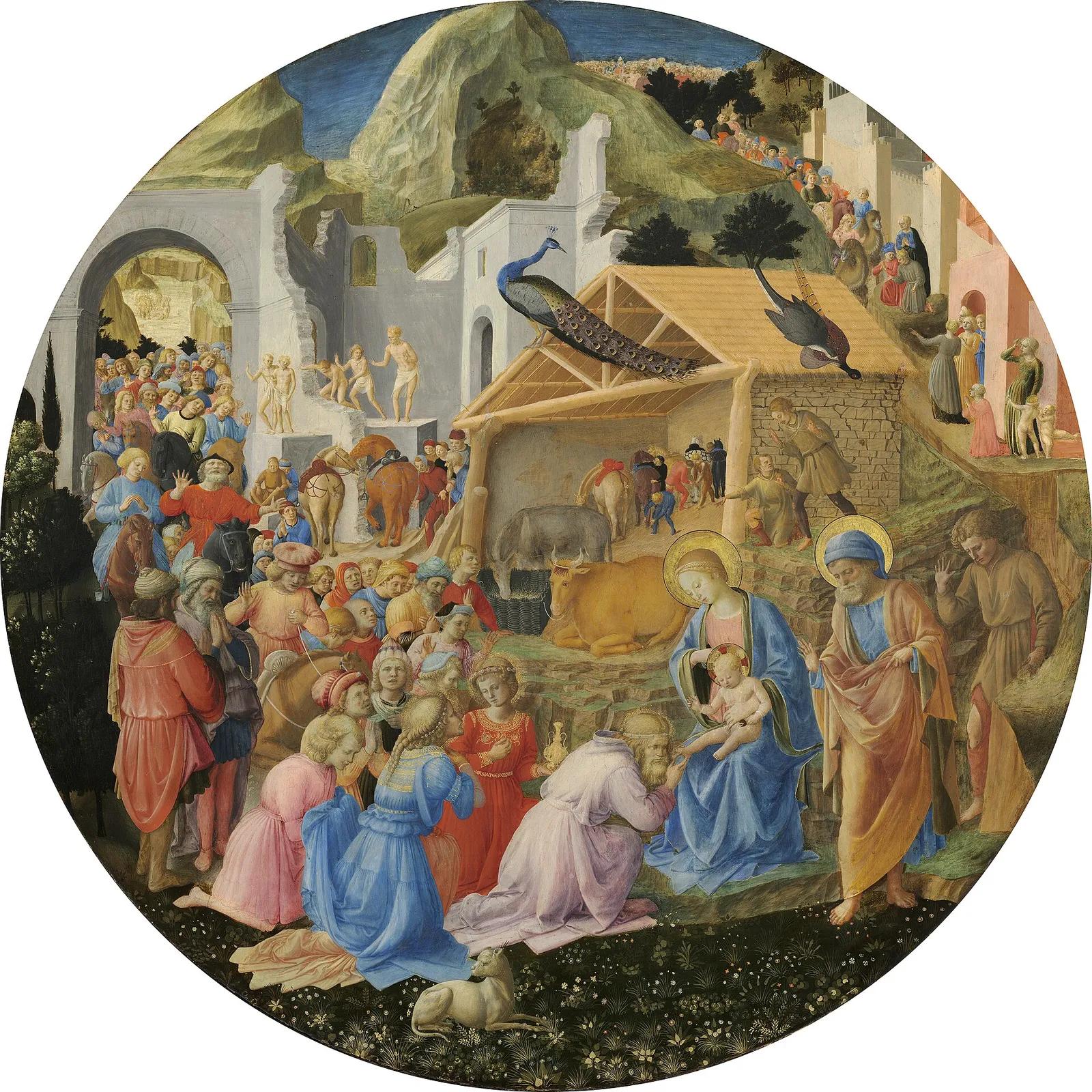
The peacock is part of that story. The bird, and the other birds on the roof, are painted over areas that were already finished rather than in spaces left for them, which suggests they were added late. The National Gallery of Art suggests that Lippi likely added the three birds after the rest of the painting was finished. Some scholars have proposed another late hand, Benozzo Gozzoli, Angelico’s former assistant; that remains a hypothesis.
The names attached to the panel over the centuries record changing tastes and a lot of guesswork. In 1810 it was sold in Florence as a Botticelli; in London in 1826 it was a Fra Angelico; in 1849 a Filippo Lippi; in 1874 a work by his son Filippino Lippi. In 1854 the German connoisseur Gustav Waagen called it Benozzo Gozzoli and noticed the birds, describing “two peacocks, somewhat too large in proportion”. The NGA’s provenance notes point out that his second peacock is in fact a different kind of bird.
Kings, camels, five naked youths and a pomegranate
The round format lets the procession of the Magi coil through the whole picture. It starts at top right, at a white-walled hill town, winds down past camels and riders, crosses behind the stable, swings through a great ruined arch on the left and spills into the foreground, where the kings kneel in rich robes. A white dog lies on the flowering meadow at the front. Townspeople, shepherds and women with children crowd the margins.
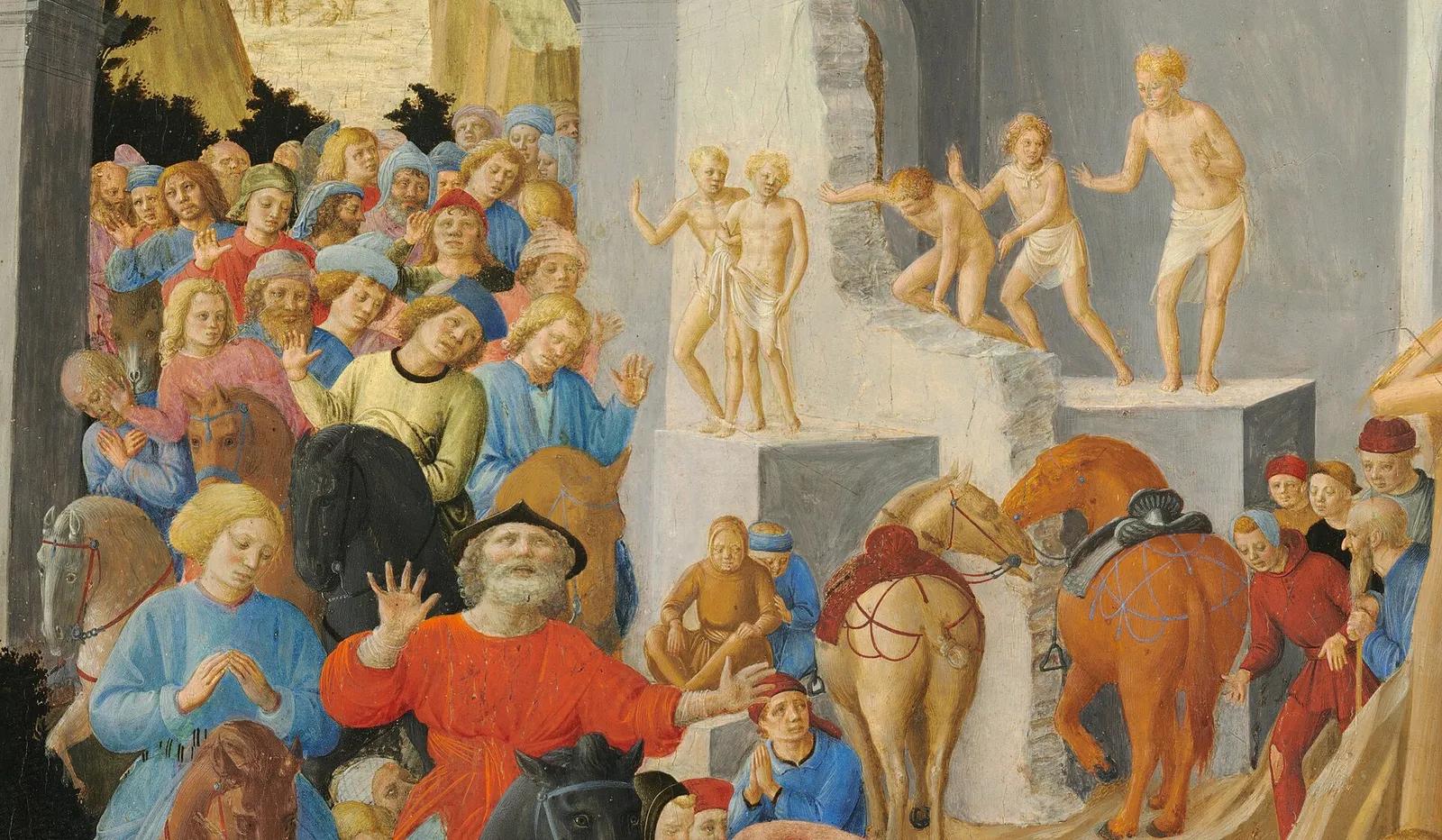
On the ruined wall stand five nude or almost nude young men, watching the procession pass. No source explains them. The National Gallery of Art’s online story suggests they may represent the ancient pagan religions that ended with the arrival of Christ; other readings take them as outcasts drawn into the new faith, or as bathers. Whatever their meaning, they are an early sign of Florentine artists’ interest in the nude figure.
- The pomegranate: the round fruit in the Christ Child’s hand. Its many seeds within one skin stood for many believers joined by one faith.
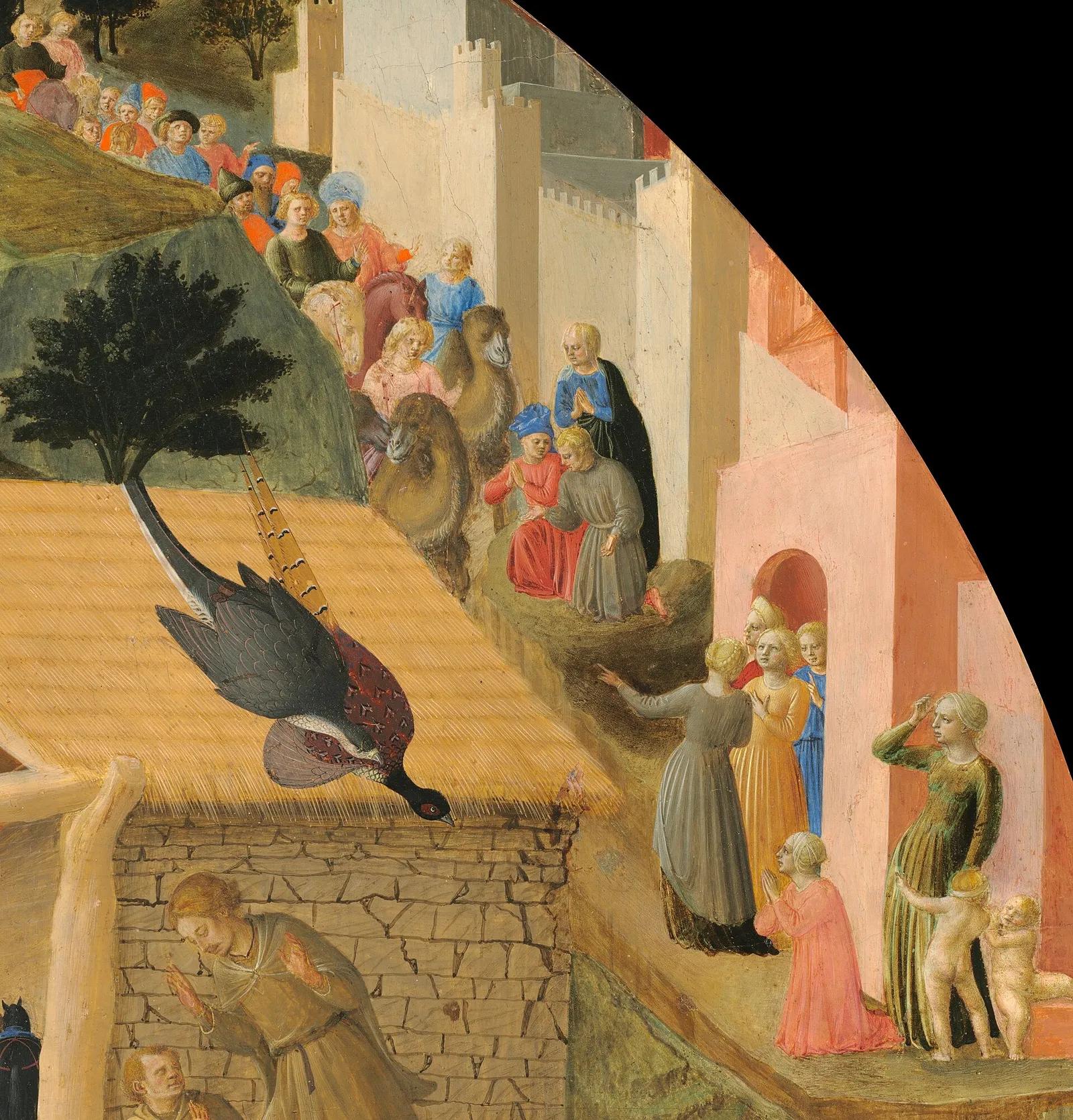
- The camels: look along the hillside path at upper right for a short line of them, an exotic touch for a Florentine audience.
- The hawk and the pheasant: to the right of the peacock, a bird of prey attacks a pheasant in mid-air above the roof.
- The ruins: classical masonry crumbling around the stable, a familiar way of showing the old world giving way to the new.
Did it hang in Lorenzo de’ Medici’s bedroom?
The Magi were a Medici subject. The family belonged to the Compagnia de’ Magi, a confraternity whose Epiphany procession passed their palace on the Via Larga, and they commissioned images of the kings from several artists. The National Gallery of Art believes the Medici paid for this painting, probably commissioned by Cosimo de’ Medici from Fra Angelico.
The key document is the inventory drawn up after the death of Lorenzo the Magnificent in 1492, known from a copy of 1512. In the large ground-floor room called Lorenzo’s bedroom, alongside Paolo Uccello’s three panels of the Battle of San Romano, it lists a large tondo of the Virgin, Christ and the Magi bringing gifts, by Fra Angelico, valued at 100 florins.
In the large ground-floor bedroom called Lorenzo’s bedroom...a large tondo...our Lady and our Lord and the Magi who come to bring offerings, from the hand of Fra Giovanni, f. 100
The NGA itself calls this slender evidence. The value is high: the six other paintings in the same room, including Uccello’s three battle panels, were valued together at 300 florins, which suggests the tondo was an elaborate composition. But no description is detailed enough to prove that the Washington picture is the one in the inventory. Some scholars have linked the peacock to a Medici device, but that reading is also unproven.
From Florence to Washington: the tondo’s journey
From the seventeenth century the tondo can probably be followed in the Guicciardini family in Florence, alongside another Adoration tondo now identified as Botticelli’s, in the National Gallery, London. The pair stayed together through a sale to a Napoleonic police commissioner, a London dealer and an English collector before they separated in 1849.
1440s
Probably begun by Fra Angelico and his workshop for the Medici.
1455
Fra Angelico dies in Rome; Fra Filippo Lippi probably completes the panel.
1492
A large Magi tondo by Fra Angelico is listed in Lorenzo de’ Medici’s bedroom.
1643
Two Adoration tondi recorded in the Guicciardini collection, Florence.
1810
Sold to the French police commissioner François-Honoré Dubois, as Botticelli.
1826
Offered in London by Samuel Woodburn as Fra Angelico.
1874
Bought at the Alexander Barker sale for Sir Francis Cook, as Filippino Lippi.
1947
Sold by the Cook family to the Samuel H. Kress Foundation, as Filippo Lippi.
1952
Given to the National Gallery of Art, Washington.
Source: National Gallery of Art provenance record, 1952.2.2
Before the Second World War the Cook family sent their most important pictures to the United States for safety. The tondo was exhibited in Toledo, Ohio, and in Canada, and the Kress Foundation bought it in 1947, just before it was due to return to England. It is still sometimes called the Cook Tondo.
How to look at the Adoration of the Magi tondo
In the gallery, start at the rim and travel inward the way the procession does, from the distant hill town to the kneeling king. It takes time; the tondo rewards slow reading. Then look up at the peacock and try to judge its size against the figures in the stable. The mismatch is the clearest visible sign that the bird was not part of the first plan.
- Compare the Virgin’s face, calm and simplified, with the livelier faces of the kings and courtiers. You are looking at the two painters’ different hands.
- Find the pomegranate in the Child’s hand and the dog lying on the grass.
- Look for the five figures on the ruin and decide for yourself what they are doing there.
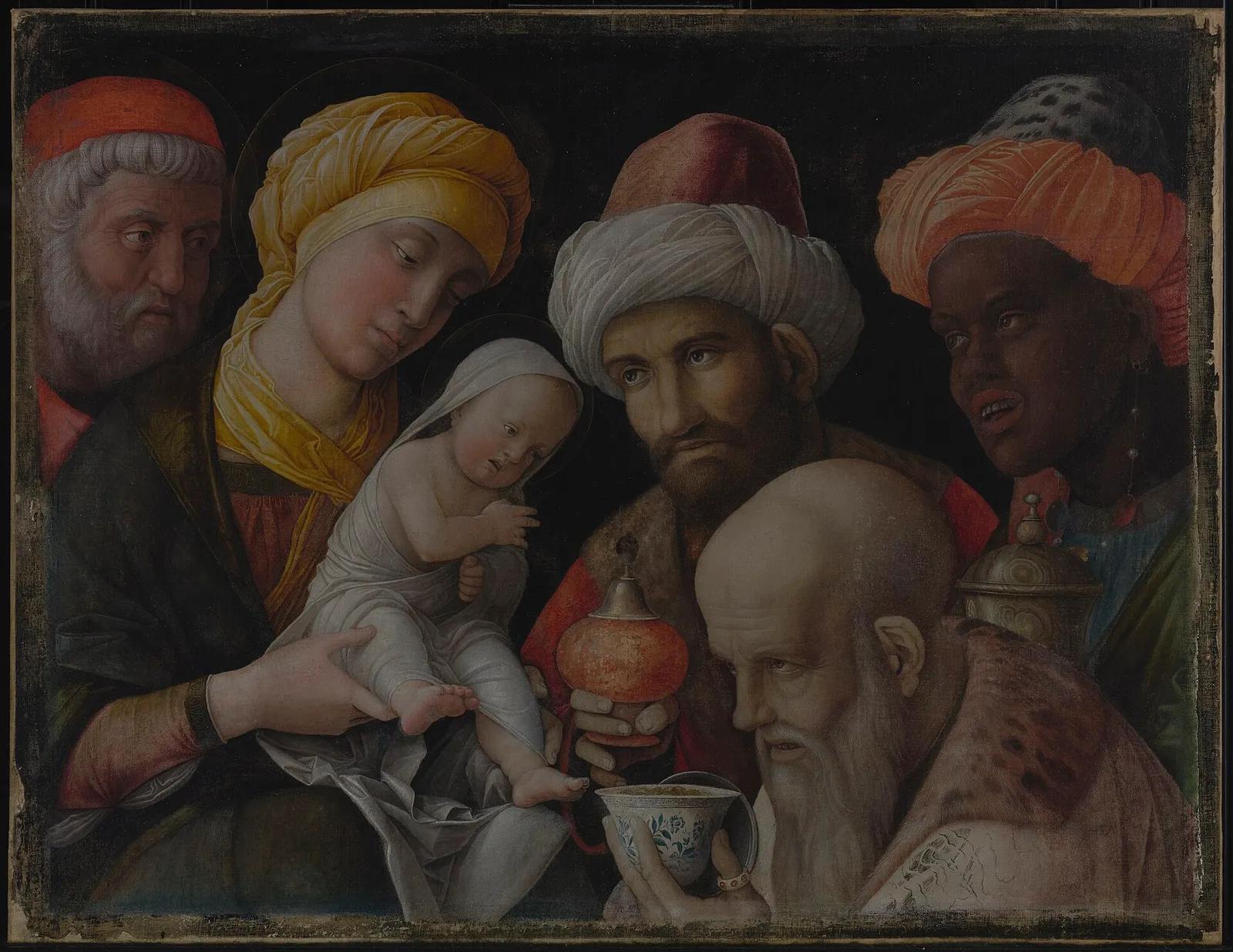
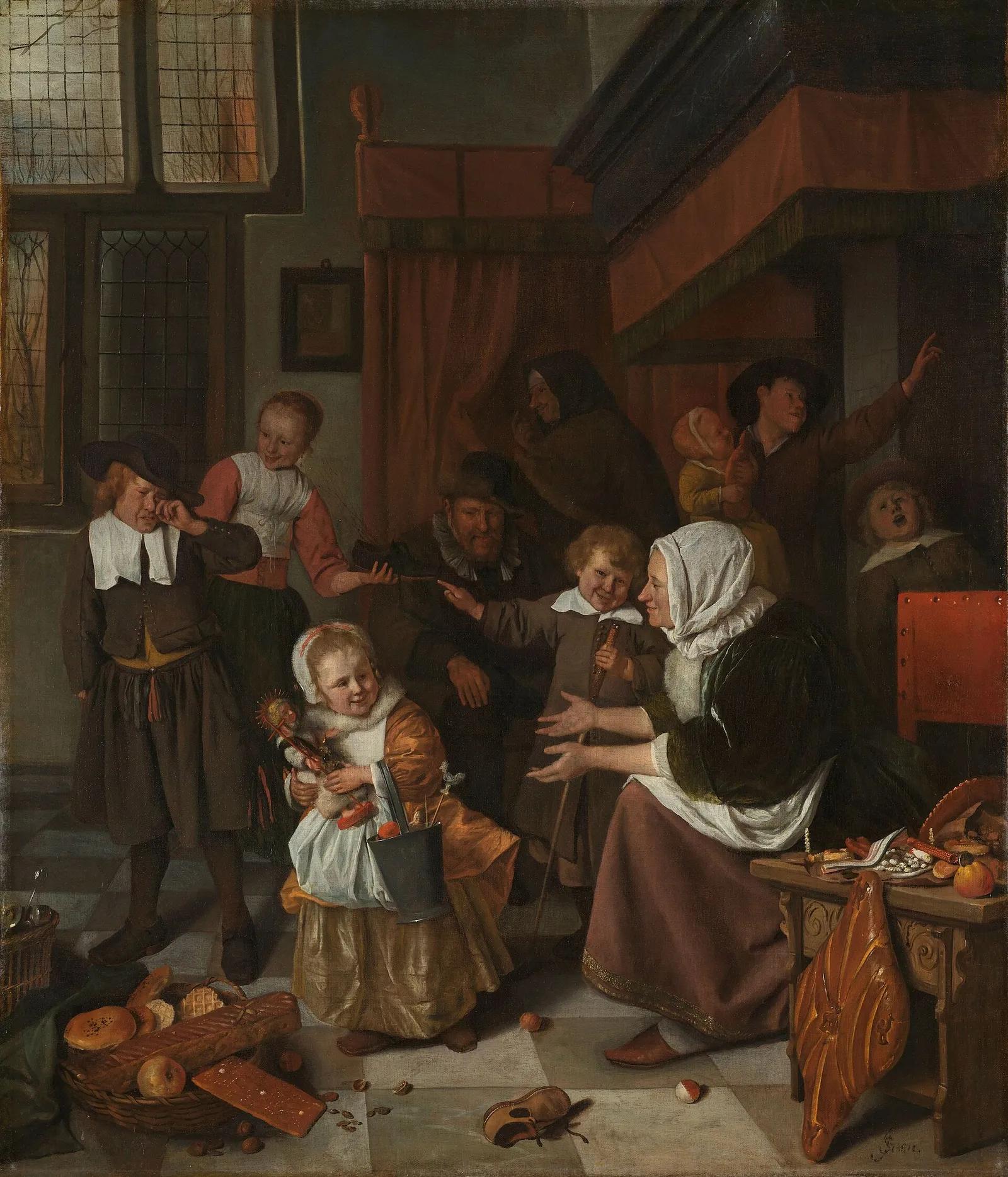
The Magi brought luxury goods from the East, and painters loved to show them. Compare the Chinese porcelain cup in Mantegna’s Adoration of the Magi, the Christmas customs of Jan Steen’s Feast of Saint Nicholas, and another Washington painting altered by later hands, Bellini’s Feast of the Gods.
Questions people ask
Why is there a peacock in the Adoration of the Magi?
Since antiquity peacock flesh was believed not to decay, a belief Saint Augustine tested and recorded in The City of God. Christian art adopted the bird as a symbol of immortality, paradise and the Resurrection. On the stable roof above the newborn Christ it points from the Nativity to eternal life. It was probably added late, over finished paint.
Who painted the Adoration of the Magi tondo in Washington?
The National Gallery of Art attributes it to Fra Angelico and Fra Filippo Lippi. The usual view is that Angelico and his workshop began it in the 1440s and that Lippi completed it after Angelico’s death in 1455. Over the centuries it was also sold as Botticelli, Filippo Lippi, Filippino Lippi and Benozzo Gozzoli.
What does the peacock symbolise in Christian art?
The peacock symbolises immortality and the Resurrection, because its flesh was thought to be incorruptible. In Nativity and Adoration scenes it links the birth of Christ to his victory over death. The idea goes back to early Christian art, where peacocks appear in catacomb paintings and on tombs as images of paradise.
Was the Adoration of the Magi tondo owned by the Medici?
Probably. The 1492 inventory of Lorenzo de’ Medici’s possessions lists a large tondo of the Magi by Fra Angelico in his ground-floor bedroom, valued at 100 florins. The National Gallery of Art considers this slender but real evidence that the Washington picture is the same work, though it cannot be proved.
Who are the naked men in the Adoration of the Magi tondo?
Five nude or nearly nude young men stand on a ruined wall at the left. No document explains them. The National Gallery of Art suggests they may represent the pagan religions that ended with Christ’s coming; other scholars see outcasts joining the new faith or simply bathers. They also show early Florentine interest in the nude.
Sources and further reading
- The Adoration of the Magi (1952.2.2), collection record and provenance, National Gallery of Art
- National Gallery of Art open data (objects.csv), National Gallery of Art, GitHub
- Fra Angelico and Fra Filippo Lippi’s The Adoration of the Magi, National Gallery of Art on Google Arts & Culture
- The City of God, Book XXI, translated by Marcus Dods, New Advent
- Adoration of the Magi (Fra Angelico and Filippo Lippi), Wikipedia
Images are public-domain or CC0 reproductions from Wikimedia Commons, credited under each figure. Interpretations are attributed to the scholars who hold them.
Keep looking
Andrea Mantegna
Mantegna’s Adoration of the Magi and the Chinese Porcelain Cup
Jan Havicksz. Steen
Jan Steen’s Feast of Saint Nicholas: Sinterklaas Before Santa Claus
Giovanni Bellini and Titian (landscape alterations attributed to Dosso Dossi)
The Feast of the Gods: A Painting Revisited by Three Artists
Know someone who should see this?
Send them the story of The Adoration of the Magi.