
Vinci Stories · Albrecht Dürer
Dürer's Rhinoceros: The Animal He Drew Without Ever Seeing It
In May 1515 a living rhinoceros was brought ashore at Lisbon, the first seen in Europe since ancient Rome. Within months, in Nuremberg, Albrecht Dürer had turned a merchant's letter and a rough sketch into a woodcut that would stand for the animal for more than two centuries, armour plates, invented horn and all.
- Work
- The Rhinoceros, 1515
- Where to see it
- National Gallery of Art (impression illustrated), Washington, DC
- Reading time
- 9 min
- Updated
Dürer's Rhinoceros: a woodcut of an animal he never saw
Albrecht Dürer's Rhinoceros is a single-sheet woodcut, about 24 by 30 centimetres, printed in Nuremberg in 1515. It shows an Indian rhinoceros in profile, filling the block from nose to tail, with five lines of German type above it and the word RHINOCERVS, the date and Dürer's monogram. It is one of the most copied animal images ever made. It is also, in several obvious ways, wrong. Dürer never saw the animal. He worked from a written description and a sketch that reached Nuremberg from Lisbon, and he filled the gaps with the knowledge he had: armour, engraving technique and ancient natural history.
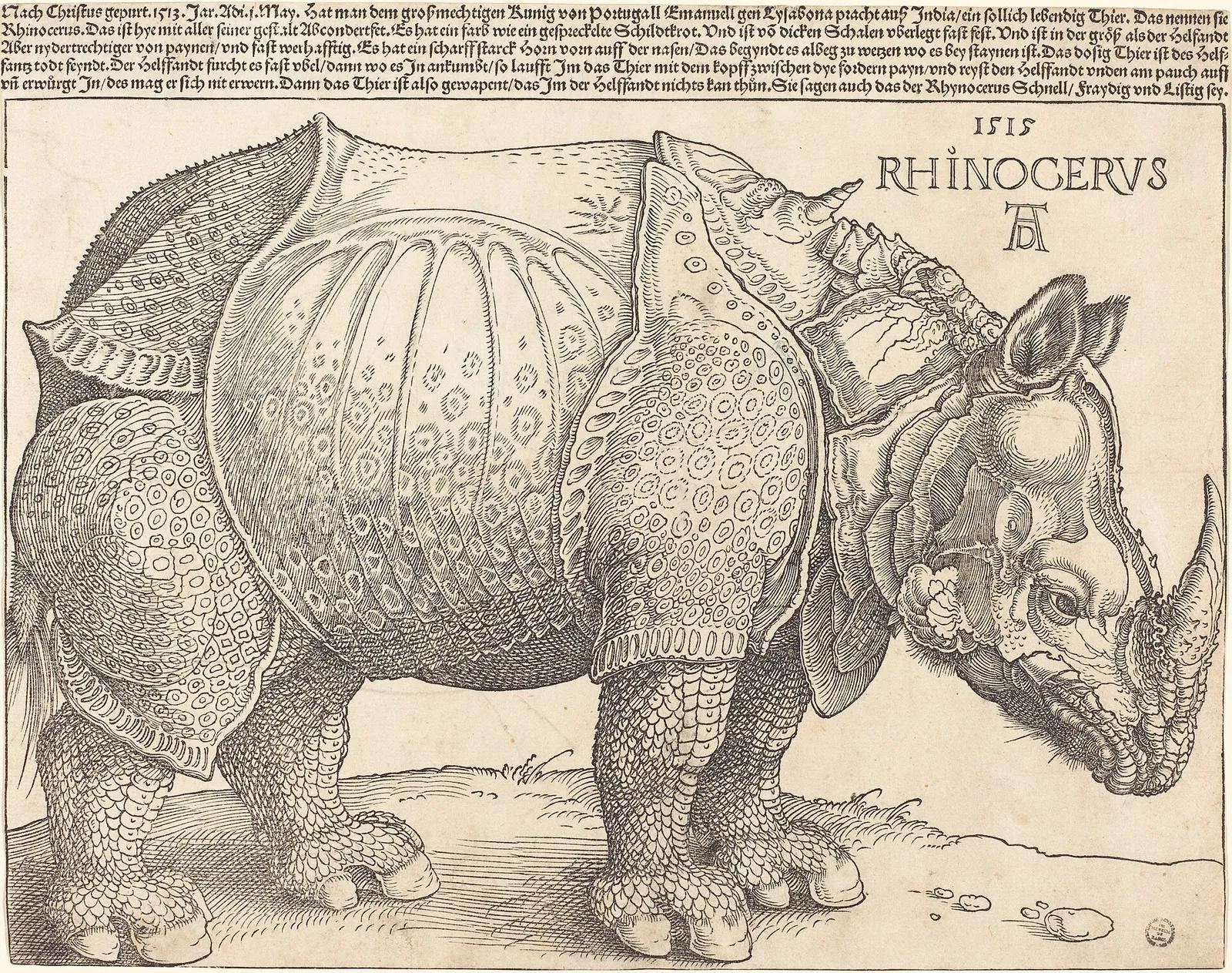
That combination is what makes the print worth looking at slowly. Some of what Dürer shows was reported accurately by people who had seen the animal. Some came from the Roman writer Pliny the Elder. And one detail, the little twisted horn on the shoulders, appears in no account of the living animal and became, in the words of the rhinoceros historian Kees Rookmaaker and his co-authors, the standard representation of the rhinoceros in books and artworks from 1545 onwards.
The Lisbon rhinoceros of 1515: from Gujarat to the Tagus
The animal was a gift of diplomacy. In 1514 Afonso de Albuquerque, governor of Portuguese India, sent envoys to Sultan Muzaffar Shah II of Gujarat seeking permission to build a fortress at Diu. They did not get it, but gifts were exchanged, and among them was a rhinoceros, called in Gujarati genda. Albuquerque sent it on to King Manuel I of Portugal. It sailed from Goa in January 1515 and, as Rookmaaker, Monson and Billia set out in the journal Pachyderm (2024), reached the harbour of Lisbon on 20 May 1515: the first rhinoceros seen alive in Europe since antiquity.
1514
Sultan Muzaffar Shah II of Gujarat gives a rhinoceros to Albuquerque's envoys.
20 May 1515
The rhinoceros arrives in Lisbon.
3 June 1515
Manuel I stages a fight with an elephant; the elephant flees.
1515
In Nuremberg, Dürer makes a pen drawing and then the woodcut. In Augsburg, Hans Burgkmair makes his own woodcut.
Dec 1515
Manuel sends the animal as a gift to Pope Leo X in Rome.
Late Jan 1516
The ship is wrecked in a storm off La Spezia; the rhinoceros, chained on deck, drowns.
1545
Dürer's image appears in Sebastian Münster's Cosmographia and becomes the standard rhinoceros in print.
After 1620
Willem Janssen reissues the worn block in Amsterdam with an olive-green tone block.
1741–1758
Clara, an Indian rhinoceros, tours Europe and is painted and drawn from life.
2013
An impression sells at Christie's New York for $866,500, an auction record for Dürer.
Source: K. Rookmaaker, J. Monson and E. Billia, Pachyderm 65 (2024); The Metropolitan Museum of Art (22.10.8); Christie's, New York, sale of 29 January 2013
The rhinoceros lived in Portugal for about seven months. In December 1515 Manuel decided to send it, with other gifts, to Pope Leo X. The ship was wrecked in a storm off La Spezia at the end of January 1516, and the animal drowned. Accounts say its body was recovered and the hide returned to Lisbon and stuffed; whether a stuffed rhinoceros ever reached Rome is uncertain.
Reading the inscription: five lines of German and a wrong date
The text above the animal is printed in German, in five lines in the first edition, and it is worth reading because it tells us what Dürer believed. It gives the date of arrival as 1 May 1513, two years too early, and says that the powerful king of Portugal had brought the living animal from India. It describes the colour as that of a speckled tortoise, says the beast is almost entirely covered with thick scales, is the size of an elephant but lower on its legs, and is almost invulnerable. It has a strong, sharp horn on the nose, which it sharpens on stones.
The second half of the text is about the elephant. The rhinoceros, it says, is the mortal enemy of the elephant; when they meet, it runs at the elephant with its head down between its forelegs and rips open its belly, and the elephant cannot defend itself. The animal is described as quick, lively and cunning. This is where the print stops reporting and starts quoting.
Pliny, the elephant and the fight in Lisbon
Pliny the Elder, writing his Natural History in the first century AD, recorded that the rhinoceros was a born enemy of the elephant, that it sharpened its horn on rocks before fighting and that it aimed at the elephant's belly, which it knew to be soft. Renaissance readers treated Pliny as an authority, and the arrival of a living rhinoceros was an opportunity to test him. On 3 June 1515 Manuel I had the animal brought out to face a young elephant from his menagerie. The elephant, according to the reports, turned and fled before a blow was struck.
News of the fight travelled with the news of the animal. Dürer's text repeats Pliny's account as fact: the stone-sharpened horn, the charge with the head lowered, the torn belly. The woodcut is therefore a fusion of two kinds of evidence, eyewitness description from Lisbon and ancient learning, and the text makes no distinction between them.
From a letter and a sketch: Dürer's drawing in the British Museum
The Moravian printer Valentim Fernandes, working in Lisbon, saw the rhinoceros and sent a description to merchants in Nuremberg in June 1515. His German letter is lost; an Italian copy survives in Florence. A sketch, now also lost, travelled with or alongside such reports. From these Dürer made a drawing in pen and brown ink, 27.4 by 42 centimetres, now in the British Museum. It came there with the collection of Sir Hans Sloane, whose bequest founded the museum in 1753.
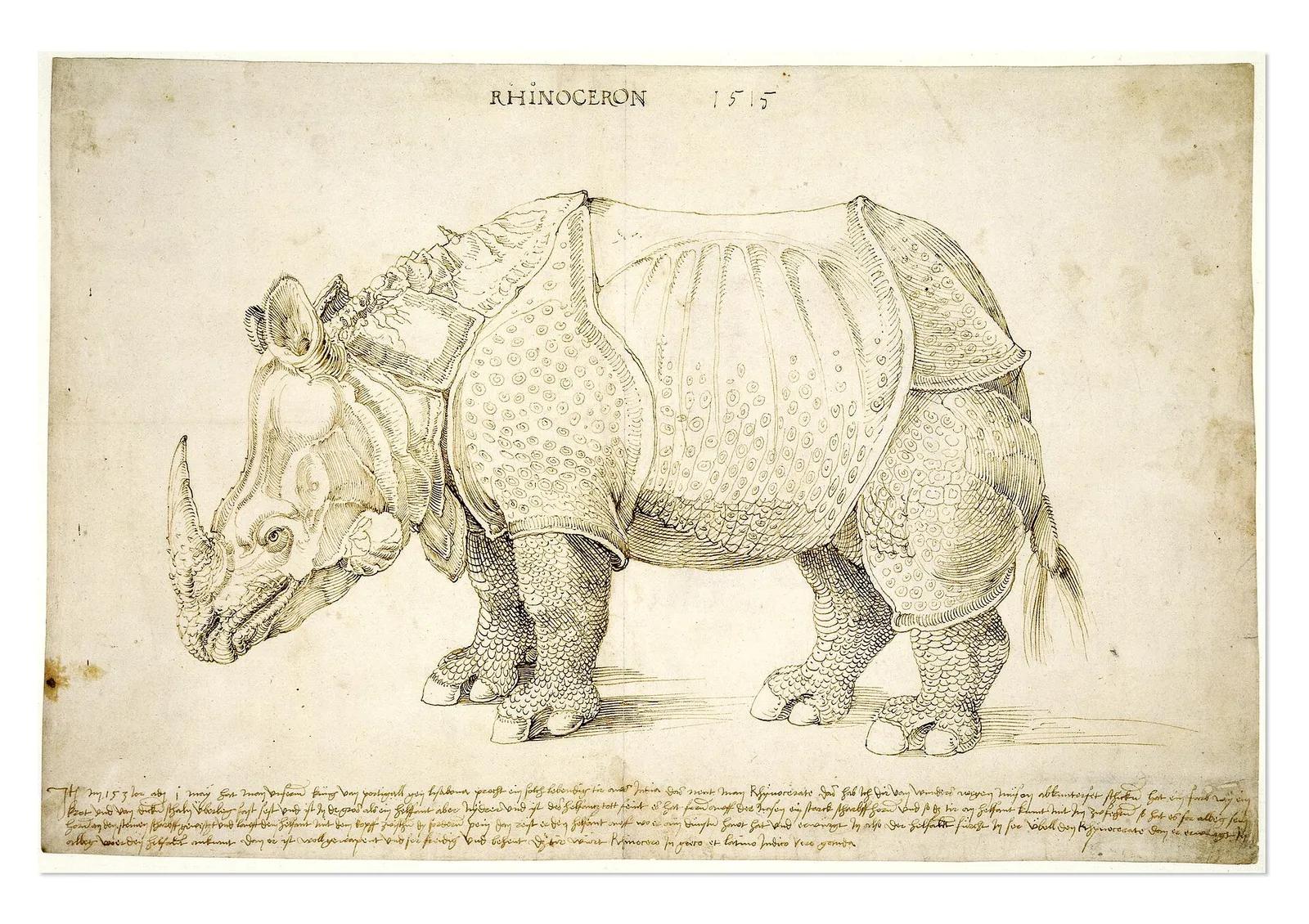
The drawing is the bridge between report and print. It carries a handwritten text, also with the wrong year, in which Dürer gives the animal its Indian name, Ganda. The armour is already there, the plates hatched as if they were polished steel, and so is the small horn on the shoulders. Compare it with the woodcut and you can see what the cutter of the block had to simplify: dense hatching becomes bolder parallel lines, and the scales on the legs become a regular pattern that prints well.
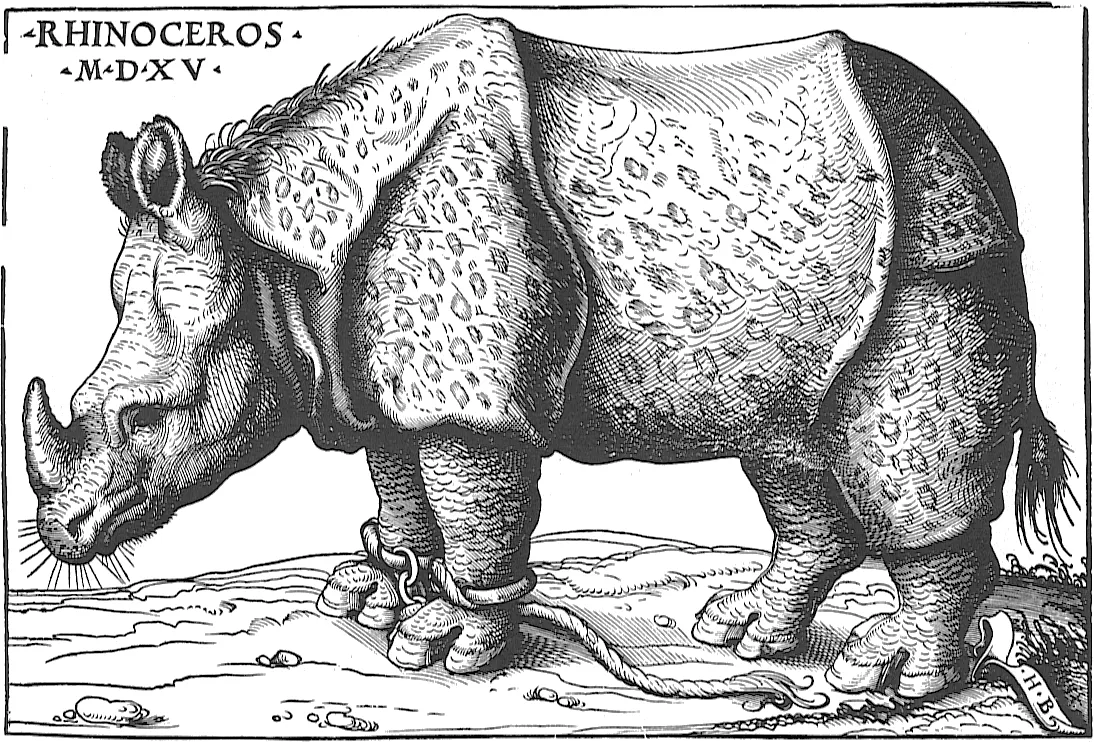
Dürer was not the only artist who tried. In Augsburg, in the same year, Hans Burgkmair produced a woodcut of the Lisbon rhinoceros from a different source. His animal has loose folds of skin, a single horn on the nose and no horn on its back, and a rope is tied round its foreleg, which suggests that his model was drawn from the shackled animal itself. Only one impression of Burgkmair's print is known, in the Albertina in Vienna. It was more accurate, and it had almost no influence.
What Dürer got right, and the “Dürer hornlet”
Put the woodcut beside a photograph of a living Indian rhinoceros (Rhinoceros unicornis) and the correspondence is closer than one might expect. The species does have a single horn on the nose. Its skin hangs in heavy folds at the neck, behind the shoulders and in front of the hind legs, which really do divide the body into sections, like plates of armour. The surface of the skin is covered in rounded bumps, and Dürer's rivets and scales may be his reading of those. He did not invent the idea of armour; he exaggerated something that was really there.
- Broadly right: the single nasal horn, the short thick legs, the division of the body by deep skin folds, the knobbly skin texture.
- Exaggerated: the folds turned into rigid plates with rivets; the knobbly skin turned into scales on the legs and a serrated edge on the rump.
- Borrowed from texts: the stone-sharpened horn and the enmity with the elephant, from Pliny.
- Invented: the small twisted horn on the shoulders, now called the Dürer hornlet.
The hornlet is the telling detail. Rookmaaker and his co-authors call it unlikely, though not impossible, that the Lisbon animal had such a feature. They identify at least sixteen works made up to about 1560 that show a rhinoceros without it, drawn or derived from the living animal, among them Burgkmair's print, a carved rhinoceros on the outside of the Tower of Belém near Lisbon of 1517 and a drawing in the margins of a printed Pliny. Every one of these lost out to Dürer. The hornlet is, in effect, his signature: wherever it appears, the image descends from his woodcut.
Editions, copies and Clara: two hundred years of a print
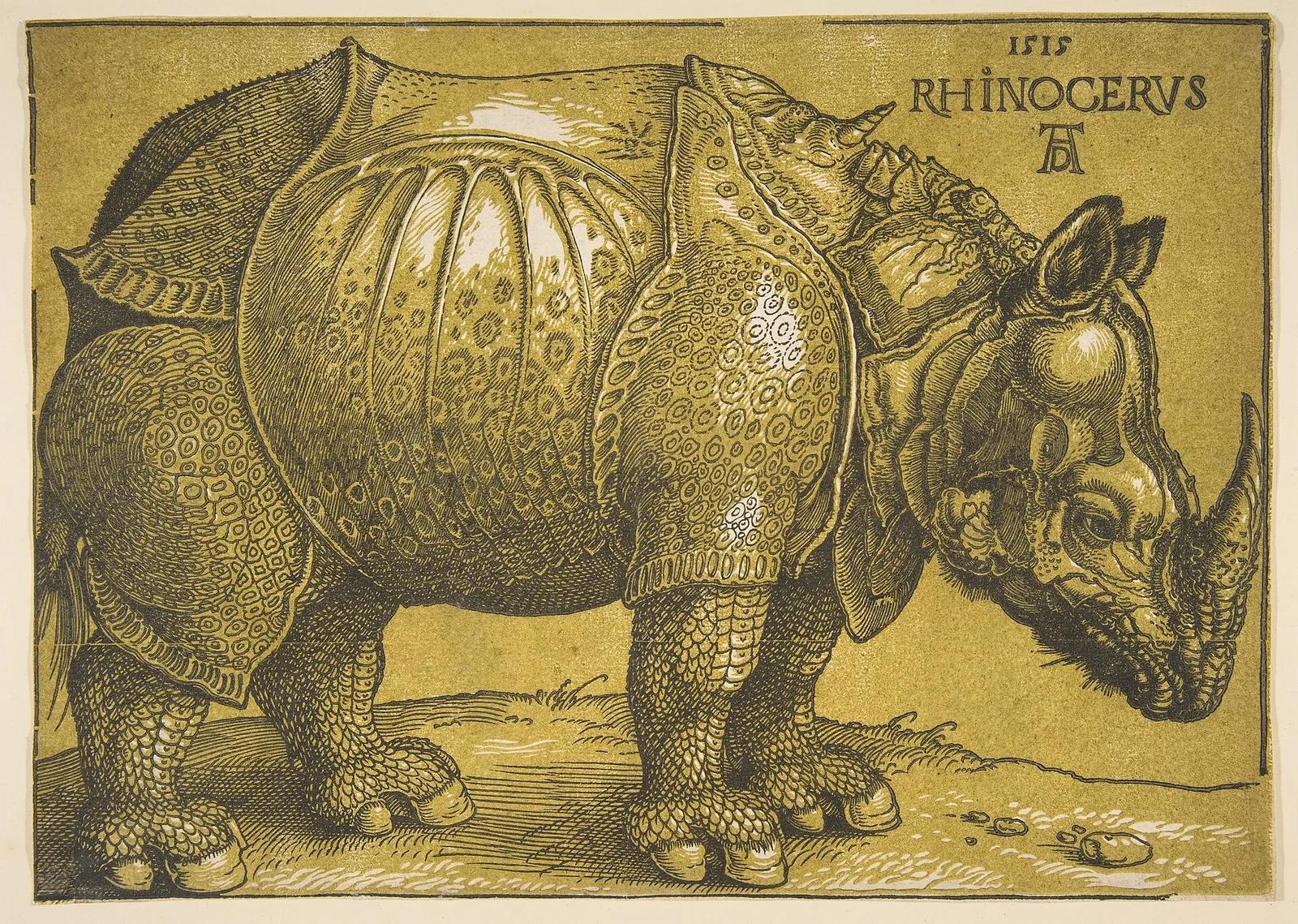
The woodblock outlived its designer by about a century. Dürer died in 1528; the block continued to be printed in later editions, eight in all according to the standard catalogues, including two in the 1540s and two later in the sixteenth century. As it wore and cracked, later printers adapted it. After 1620 the Amsterdam publisher Willem Janssen issued a chiaroscuro version with a second block printing a tone of olive green, and the Met's impression of that edition shows how the worn lines were disguised by colour. Impressions of the first edition, with the original five-line text, are rare: one sold at Christie's in New York on 29 January 2013 for $866,500, a record for Dürer at auction.
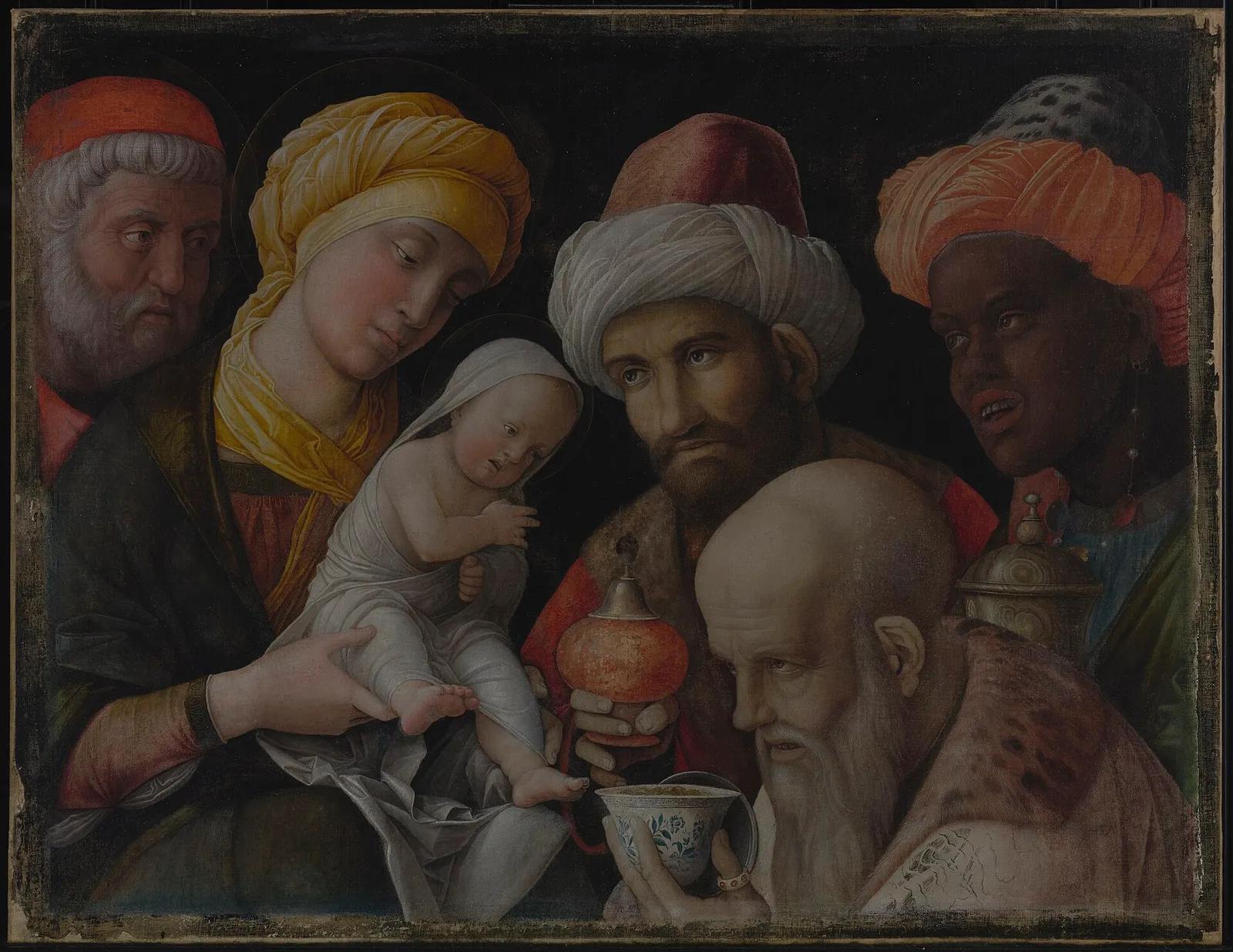
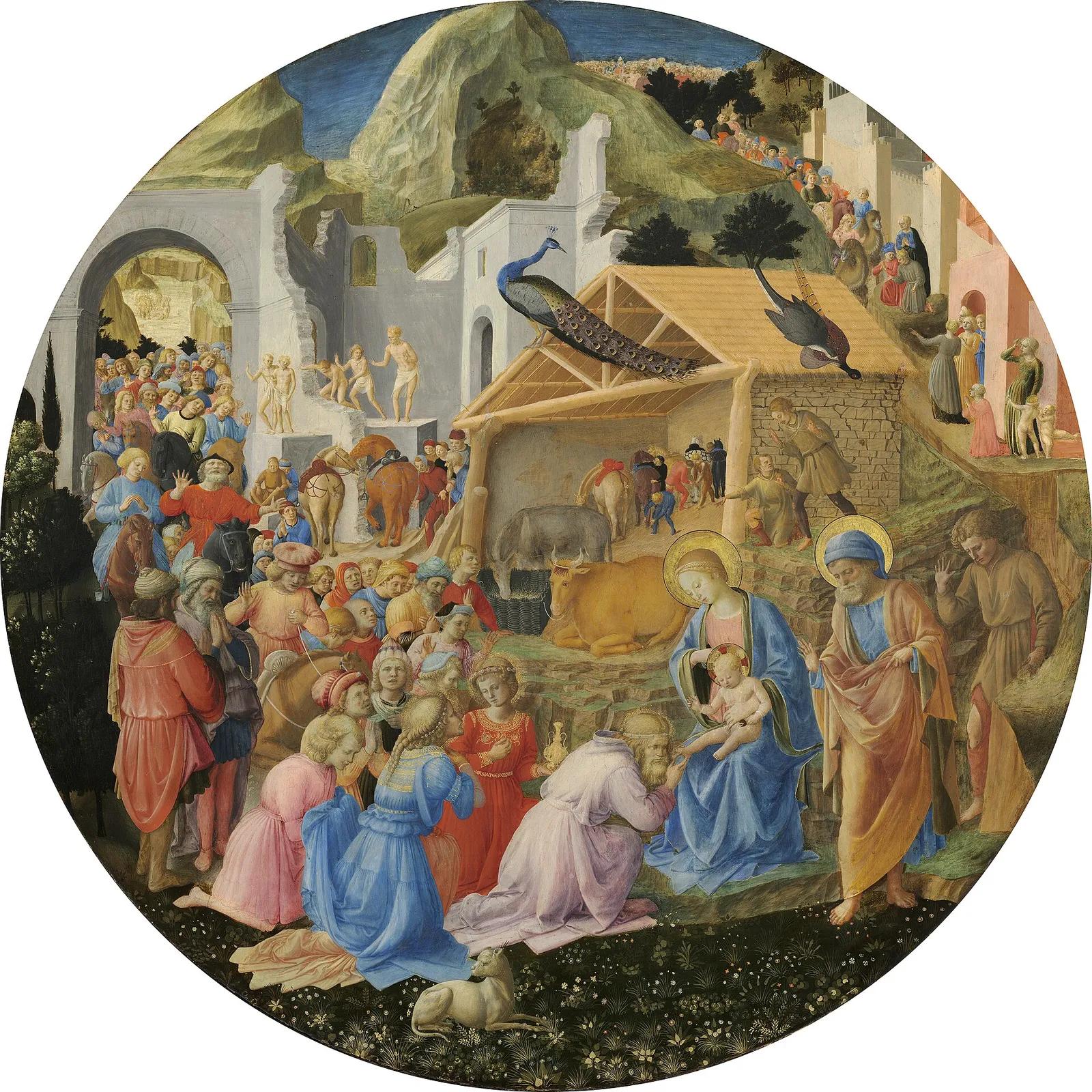
Copies spread the image much further than the block itself. Rookmaaker's research finds that Dürer's rhinoceros first appeared in a printed book in Sebastian Münster's Cosmographia in 1545, and Conrad Gessner used it in his Historia animalium of 1551, the foundational zoological encyclopaedia of the Renaissance. From there it passed into natural histories, tapestries, ceramics and decorative art for two hundred years. Like the porcelain cup in Mantegna's *Adoration* or the exotic peacock among the Magi, it shows how European artists absorbed the wider world through objects and reports rather than direct experience.
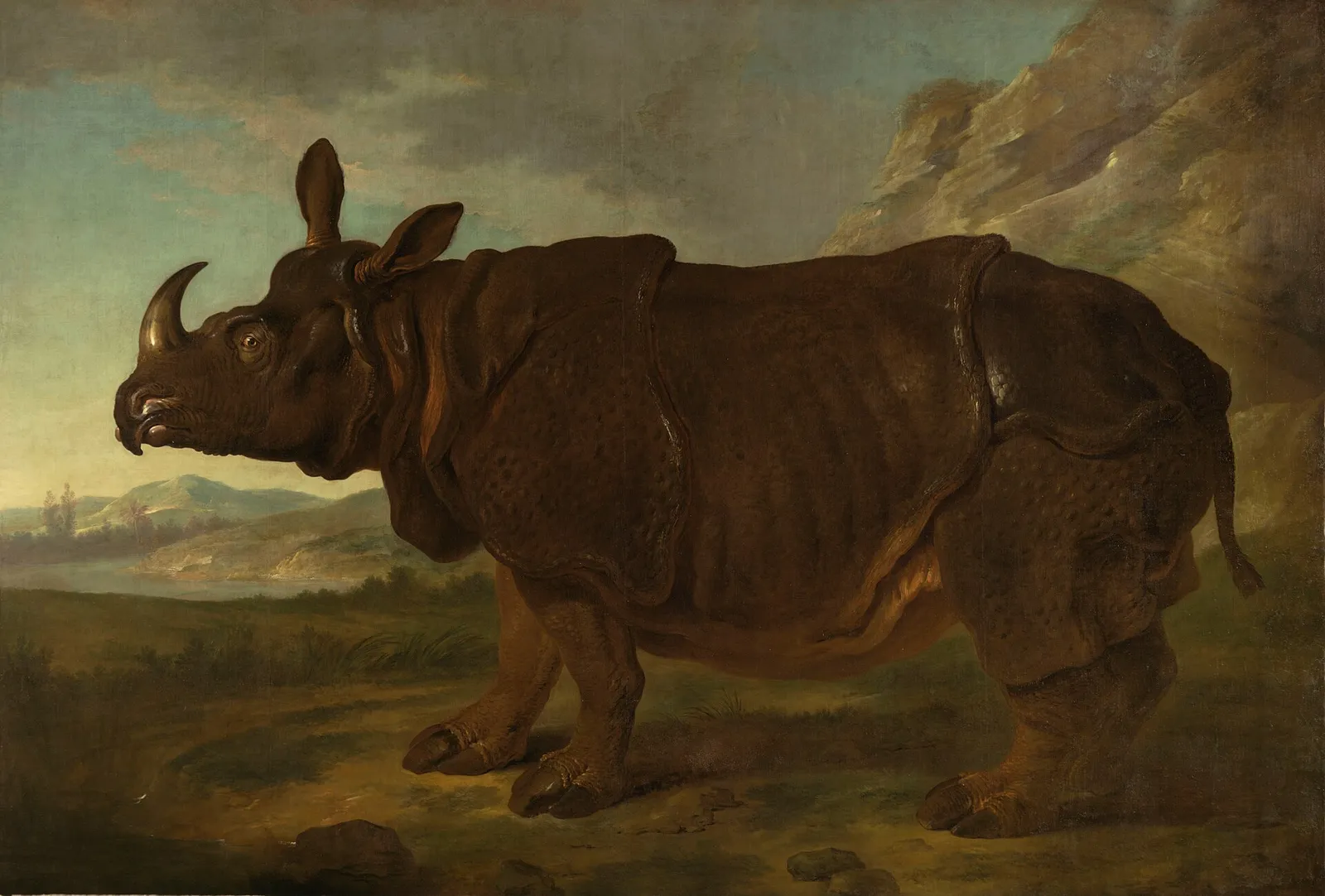
What finally displaced it was another living animal. In 1741 the Dutch sea captain Douwe Mout van der Meer brought a young female Indian rhinoceros, Clara, to Europe, and for seventeen years he exhibited her in cities from Berlin to Venice. Jean-Baptiste Oudry painted her life-size in Paris in 1749; Pietro Longhi showed her in a Venetian booth in 1751. These images, made from life, have the soft folds and no hornlet. After Clara, Dürer's rhinoceros gradually became what it is now: a famous work of art rather than a picture of an animal.
How to look at Dürer's Rhinoceros
Impressions are held by many print rooms, among them the National Gallery of Art in Washington, the Metropolitan Museum in New York and the British Museum, which also has the drawing. Prints are light-sensitive and rotate on and off display, so check before you go or ask to see one in a study room. Online, the high-resolution scans let you zoom in close.
Start with the text, then the animal. Look at the neck, where a segmented collar sits like the gorget of a suit of armour, and at the line of rivets running along the plate edges. Follow the scales down the legs. Then find the shoulder horn, small and spiralled, above the front plate. If you are looking at a later impression, check the text above: it may have been reset, and the cracks in the worn block may show as white breaks in the lines. Finally, put a photograph of a real Indian rhinoceros next to it. What is left once you subtract the armour is a surprisingly faithful animal.
Questions people ask
Did Dürer ever see a rhinoceros?
No. The animal arrived in Lisbon on 20 May 1515 and drowned off La Spezia in January 1516; Dürer was in Nuremberg throughout. He worked from a written description, probably the newsletter of the Lisbon printer Valentim Fernandes, and a sketch sent from Portugal, and he made a pen drawing, now in the British Museum, before designing the woodcut.
What is the Dürer hornlet?
The small twisted horn Dürer placed on the rhinoceros's shoulders. No Indian rhinoceros has one, and the many sixteenth-century images of the Lisbon animal not based on Dürer lack it. Because it was copied in almost every later image derived from his woodcut, the hornlet works as a marker of Dürer's influence.
Why does Dürer's rhinoceros look like it is wearing armour?
The Indian rhinoceros has heavy skin folds that divide its body into sections, and knobbly skin. Described in words and a rough sketch, these suggested plates; Dürer, who knew armour well, drew them as a gorget, breastplate and riveted plates. It is an exaggeration of a real feature rather than pure invention.
What happened to the Lisbon rhinoceros?
After a staged fight with an elephant on 3 June 1515, which the elephant fled, King Manuel I sent the rhinoceros to Pope Leo X in December 1515. The ship was wrecked in a storm off La Spezia at the end of January 1516 and the animal, chained on deck, drowned.
How much is a Dürer Rhinoceros print worth?
It depends heavily on edition and condition. Later impressions from the sixteenth and seventeenth centuries are more common. First-edition impressions, with the original five-line text, are rare: one sold at Christie's New York on 29 January 2013 for $866,500, then an auction record for any work by Dürer.
Sources and further reading
- K. Rookmaaker, J. Monson and E. M. E. Billia, Early depictions of the first Lisbon rhinoceros in the 16th century, Pachyderm 65 (2024), 168–179, IUCN SSC Pachyderm
- Albrecht Dürer, Rhinoceros, 1515, pen and brown ink (SL,5218.161), The British Museum
- Albrecht Dürer, The Rhinoceros, 1515, woodcut (19.73.159), The Metropolitan Museum of Art
- Albrecht Dürer, The Rhinoceros, chiaroscuro edition, after 1620 (22.10.8), The Metropolitan Museum of Art
- Dürer's Rhinoceros: art, science, and the Northern Renaissance, Smarthistory
- Dürer Rhino Sells for Record $866,500 at Christie's NYC, Bloomberg
- Dürer's Rhinoceros, Wikipedia
Images are public-domain or CC0 reproductions from Wikimedia Commons, credited under each figure. Interpretations are attributed to the scholars who hold them.
Keep looking
Know someone who should see this?
Send them the story of The Rhinoceros.