
Vinci Stories · John Quidor
The Headless Horseman Painting: How John Quidor's Pumpkin Gives the Story Away
In The Legend of Sleepy Hollow, Washington Irving lets the reader find a shattered pumpkin only after the chase is over. In 1858 the New York painter John Quidor put the pumpkin in the rider's raised hand. Read the painting against the text and it becomes a lesson in what an illustrator adds, and gives away.
- Work
- The Headless Horseman Pursuing Ichabod Crane, 1858
- Where to see it
- Smithsonian American Art Museum, Washington, D.C.
- Reading time
- 8 min
- Updated
The Headless Horseman painting at a glance
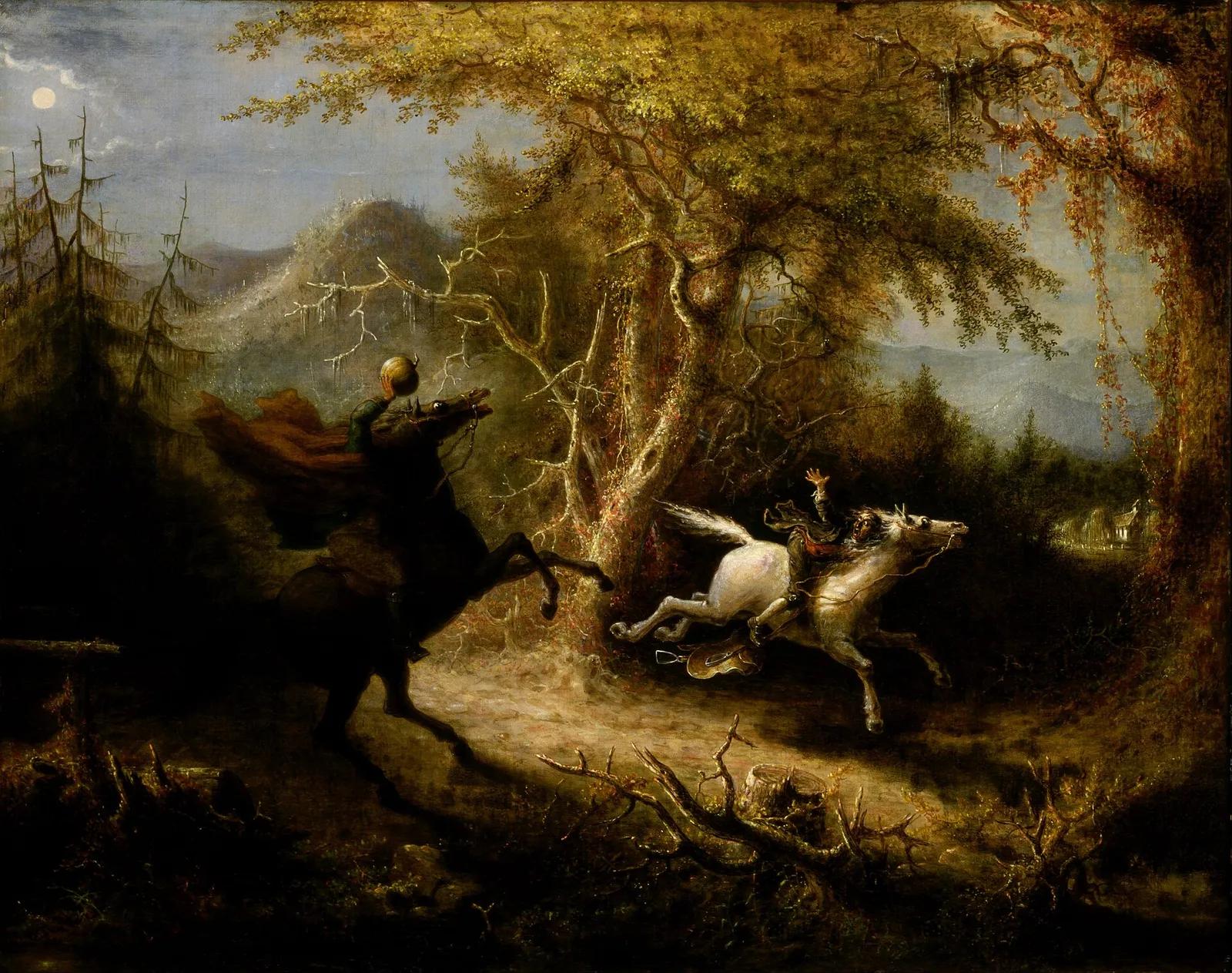
The best-known painting of the Headless Horseman is The Headless Horseman Pursuing Ichabod Crane, painted in 1858 by John Quidor (1801–1881) and now in the Smithsonian American Art Museum in Washington. It shows the climax of Washington Irving's The Legend of Sleepy Hollow: the gangling schoolmaster Ichabod Crane fleeing on a borrowed horse through a night wood while a cloaked, headless rider rears up behind him, arm raised to hurl the thing he carries. And the thing he carries is plainly a pumpkin.
What Washington Irving actually wrote about the chase
Irving published The Legend of Sleepy Hollow in 1820, in The Sketch Book of Geoffrey Crayon, Gent., and set it about thirty years earlier in a Dutch farming valley near Tarry Town on the Hudson. The local legend is of a Hessian trooper whose head was carried away by a cannon-ball in a battle of the Revolution, and who rides out at night in search of it. Ichabod, riding home late and dejected from a party at the Van Tassel farm, finds a large silent horseman keeping pace with him on a black horse. Then the rider crests a rise against the sky.
Ichabod was horror-struck on perceiving that he was headless!--but his horror was still more increased on observing that the head, which should have rested on his shoulders, was carried before him on the pommel of his saddle!
Irving keeps up the illusion to the end. As Ichabod clatters over the church bridge he looks back and sees the goblin rising in his stirrups and in the very act of hurling his head at him; he tries to dodge the horrible missile, but it strikes his skull with a tremendous crash. Only the next morning, when the villagers search the road, does the word appear. By the brook they find Ichabod's hat, and close beside it a shattered pumpkin. Brom Bones, who marries Katrina Van Tassel soon afterwards, laughs whenever the pumpkin is mentioned. The reader is left to put it together.
The pumpkin gives it away: invention or illustration?
Quidor paints the moment just before the throw, which Irving narrates from inside Ichabod's terror. But where Irving has the goblin hurl his head, Quidor shows a round, ribbed, orange object held high in the rider's hand. Anyone who has read the story knows what it is. The painting does not keep the secret; it lets the viewer in on Brom Bones's joke while Ichabod is still the victim of it. That shifts the tone from ghost story to comedy, which is how Irving's narrator half-tells it anyway.
Compare the canvas line by line with the text and Quidor's choices come into focus:
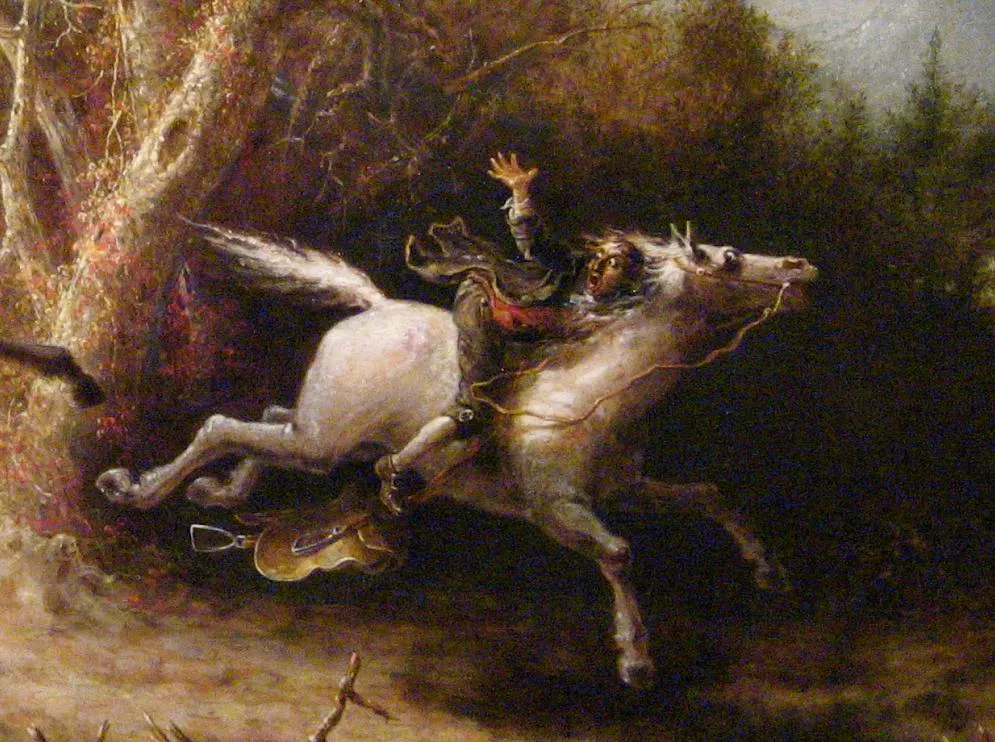
- The saddle. Irving has the girths give way in the hollow, and Ichabod hears Hans Van Ripper's Sunday saddle trampled under the pursuer's hooves. Quidor shows it falling from beneath Ichabod's horse, stirrup swinging.
- The horses. Irving gives the Hessian a black horse of powerful frame and Ichabod an old, gaunt plough-horse called Gunpowder. Quidor keeps the black horse but makes Gunpowder a pale, stretched-out galloper, which lets the two horses read against each other as dark and light.
- The church. Irving puts a whitewashed church on a green knoll just beyond the bridge. A pale building glimpsed among the trees at right may stand for it.
- The moon. Irving's night is dark and dismal, with stars sinking and clouds driving across the sky; he mentions the reflection of a silver star in the brook. Quidor adds a bright moon at top left, which he needs to light the scene.
- The season. Irving dwells on the autumn harvest, apples and pumpkins; Quidor fills the wood with copper, gold and red leaves and twisted, mossy trees.
Who was John Quidor? The painter who sued his teacher
John Quidor was born in Tappan, New York, on 26 January 1801, and grew up in New York City. At about seventeen he was apprenticed to the portrait painter John Wesley Jarvis, his only formal training. Around 1822 he sued Jarvis for breach of indenture, claiming he had been neglected; the jury awarded him $251.35 of the $2,500 he asked for. The victory did him little good, since winning meant admitting he had been badly taught.
From the mid-1820s Quidor painted scenes from American literature, above all from Irving's Legend of Sleepy Hollow and Rip Van Winkle and from James Fenimore Cooper. He first exhibited at the National Academy of Design in 1827. His literary paintings did not sell well, and the Smithsonian notes that he earned most of his New York income from decorative panels for fire engines, alongside signs and banners. After his studio burned in 1835 he moved to Quincy, Illinois, where he painted religious canvases, then returned to New York around 1851. He spent his last years with his daughter in Jersey City, where he died on 13 December 1881, largely forgotten.
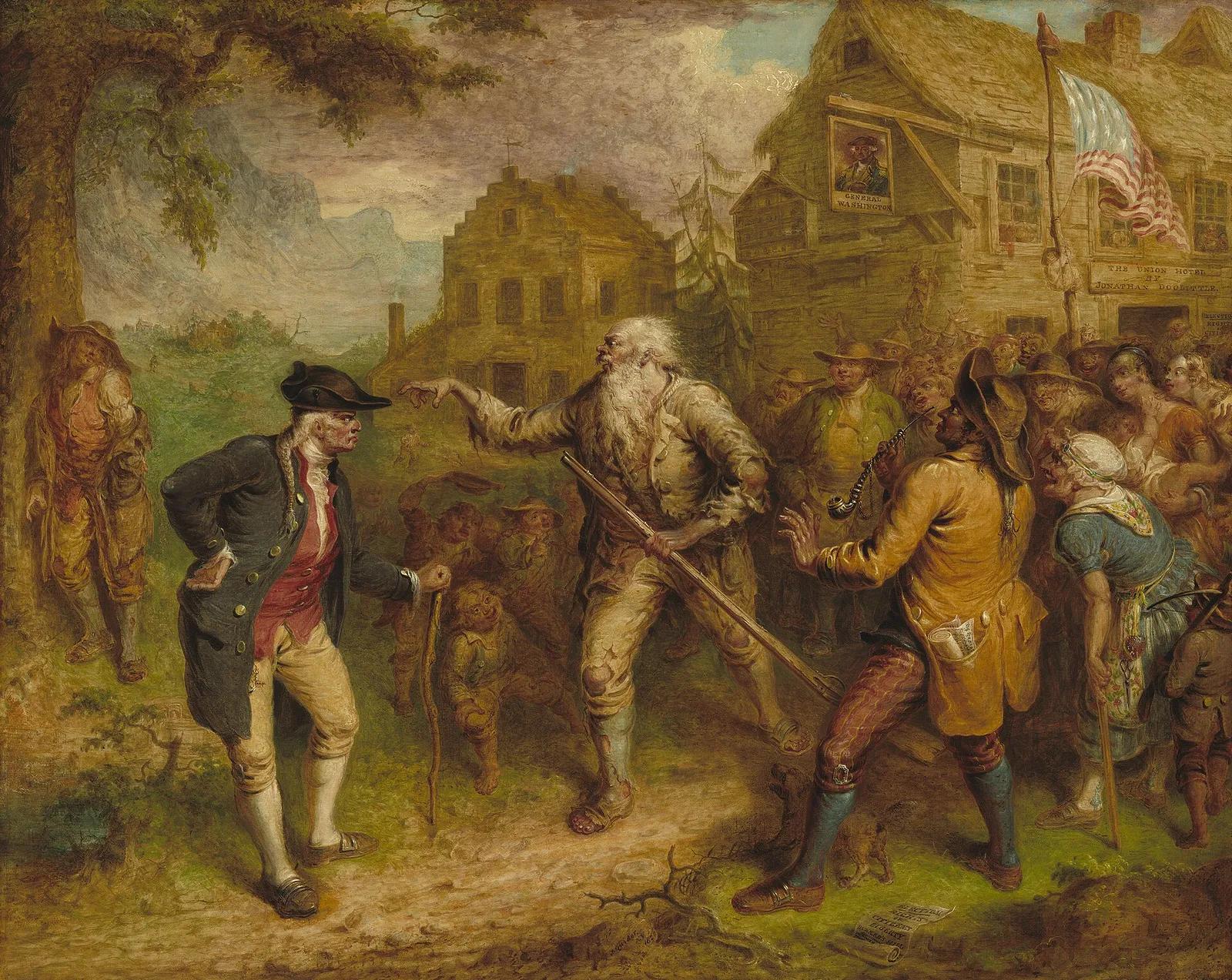
His reputation was revived in 1942, when John I. H. Baur of the Brooklyn Museum organised an exhibition and catalogue of his work. Today his paintings are in the National Gallery of Art, the Smithsonian, Yale, the Art Institute of Chicago and the Museum of Fine Arts, Boston, valued for exactly what puzzled his contemporaries: their wild, jostling, half-comic energy.
1801
John Quidor born in Tappan, New York, 26 January
1820
Washington Irving publishes The Legend of Sleepy Hollow in The Sketch Book
c. 1822
Quidor wins $251.35 in his suit against his teacher John Wesley Jarvis
c. 1828
Paints Ichabod Crane Flying from the Headless Horseman, with no horseman in sight
1835
Fire destroys his New York studio; he soon moves to Quincy, Illinois
1858
Paints The Headless Horseman Pursuing Ichabod Crane
1881
Dies in Jersey City, 13 December
1942
John I. H. Baur's Brooklyn Museum exhibition revives his reputation
1994
The painting enters the Smithsonian American Art Museum (1994.120)
Source: Smithsonian American Art Museum; Yale University Art Gallery; Historical Society of Quincy and Adams County; Project Gutenberg text of Irving
Two Headless Horseman paintings, thirty years apart
Quidor had painted the episode before. Ichabod Crane Flying from the Headless Horseman, about 1828, now at the Yale University Art Gallery, was his earliest Irving subject. It is almost all darkness: a lone white horse and its rider streak across a black wood, and the pursuer is left entirely to the imagination. Yale's catalogue notes that Quidor concentrates on the shared fear of rider and horse.
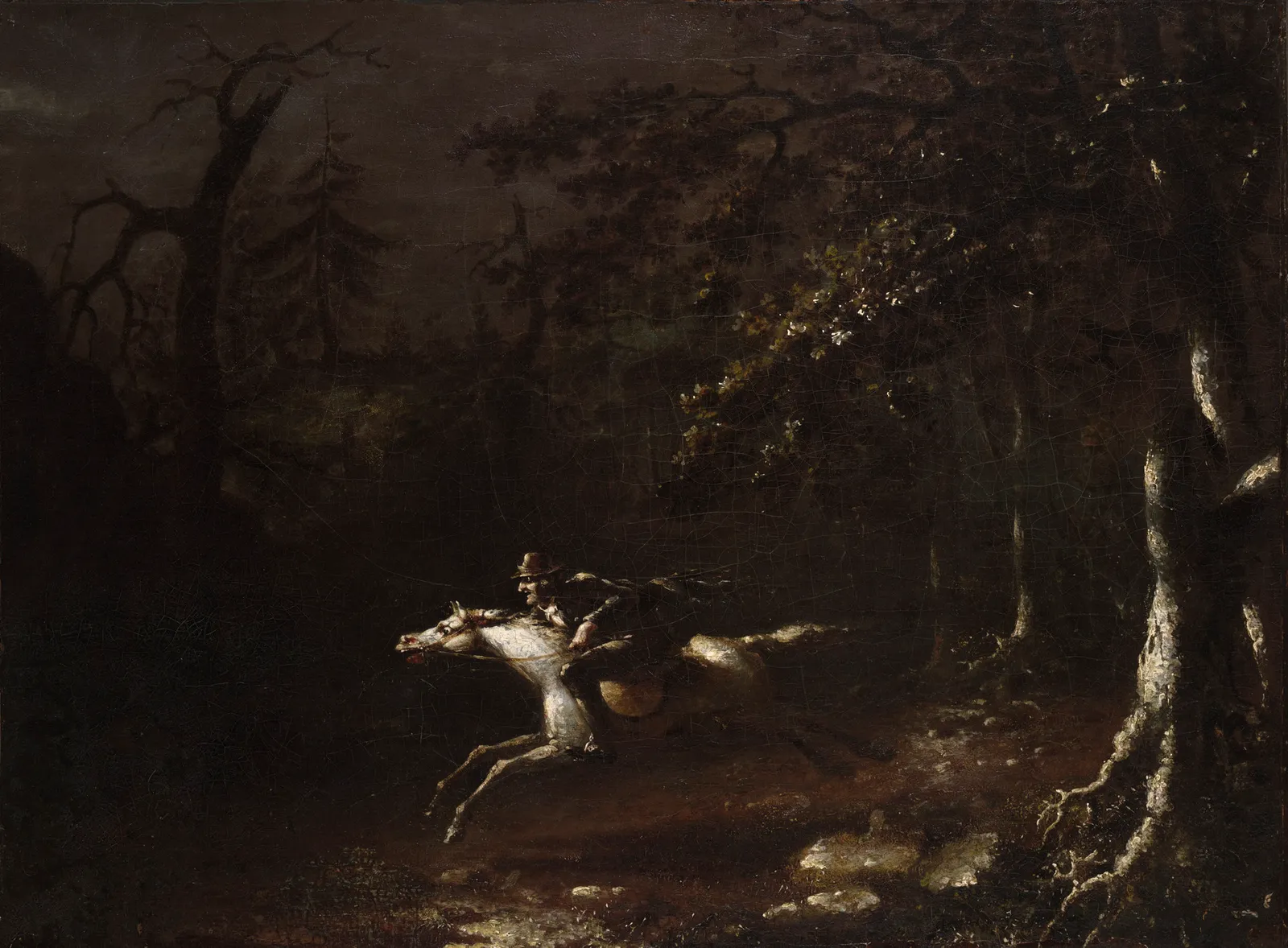
Set the two side by side and you can see a painter changing his mind about suspense. The young Quidor withheld the monster. The older Quidor shows it, moon-lit and rearing, and then undercuts it with a pumpkin. One is a ghost story; the other is a ghost story told by someone who knows the ending and enjoys it. Neither is a neutral illustration.
The 1858 picture also shows how far Quidor stood from the taste of his time. New York painting in the 1850s was dominated by the landscape painters later called the Hudson River School, with their calm, luminous valleys and carefully observed trees. Quidor borrows their scenery, the distant blue hills, the autumn colour, the framing trees, and then fills it with violent movement, caricatured faces and brushwork that looks almost scribbled in places. His figures are small and spindly, his horses stretched like rubber. Collectors who wanted either a dignified landscape or a sentimental story picture found little to buy, which helps explain why fire-engine panels paid his bills. It also explains why twentieth-century viewers, used to expressionism and caricature, found him so much easier to love.
Why Sleepy Hollow became a Halloween story
Irving's text never mentions Halloween. Its season is autumn, and it is thick with harvest: apples, cider, pumpkin pies and yellow pumpkins lying in the fields. The tale's link to 31 October grew later, as American Halloween customs, including the carved jack-o'-lantern, became popular in the late nineteenth and twentieth centuries, and as films and cartoons, notably Disney's 1949 version, retold the chase. A pumpkin-wielding rider is now a stock Halloween figure, and Quidor's canvas, painted long before that, already puts the pumpkin at the centre of the image.
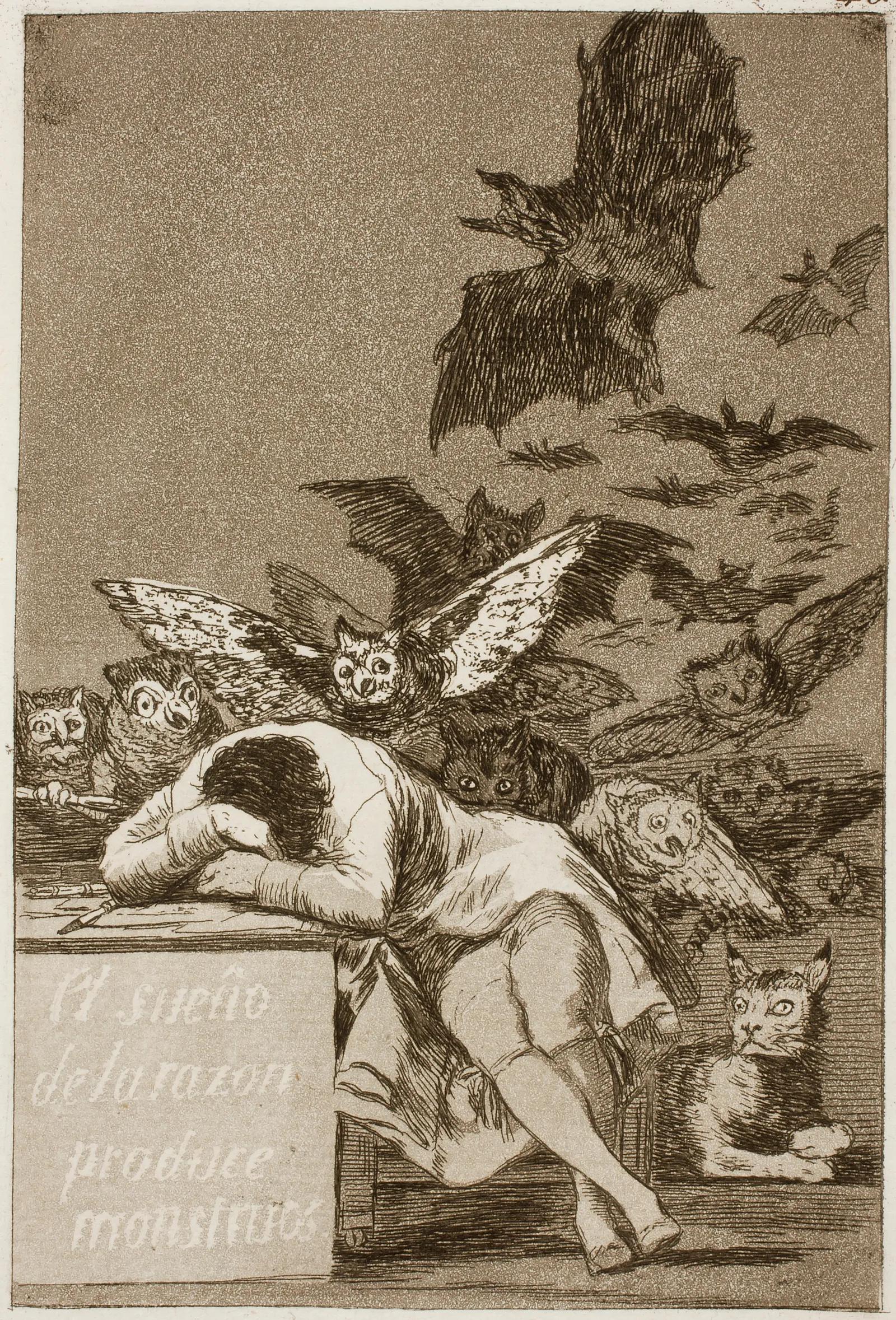
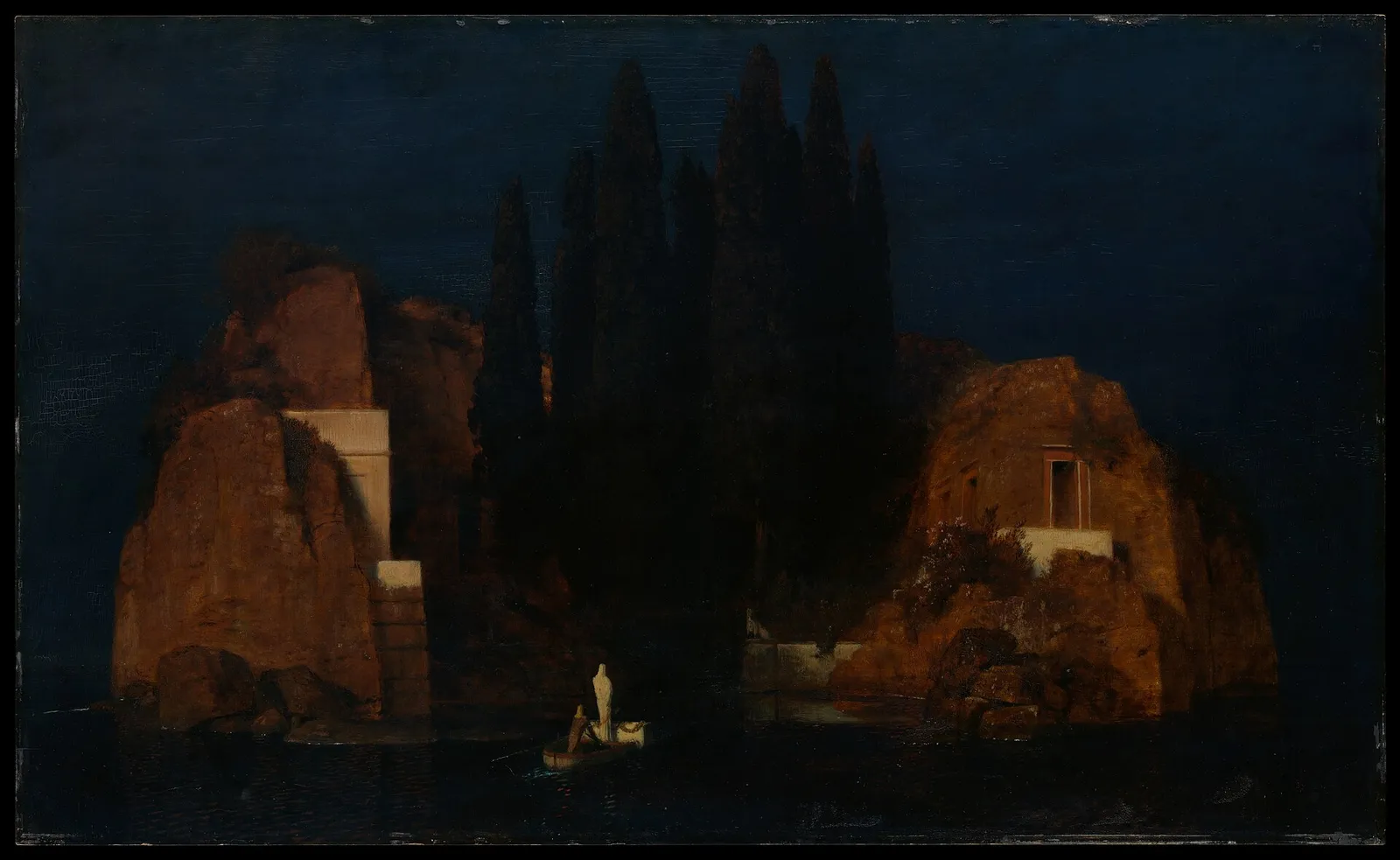
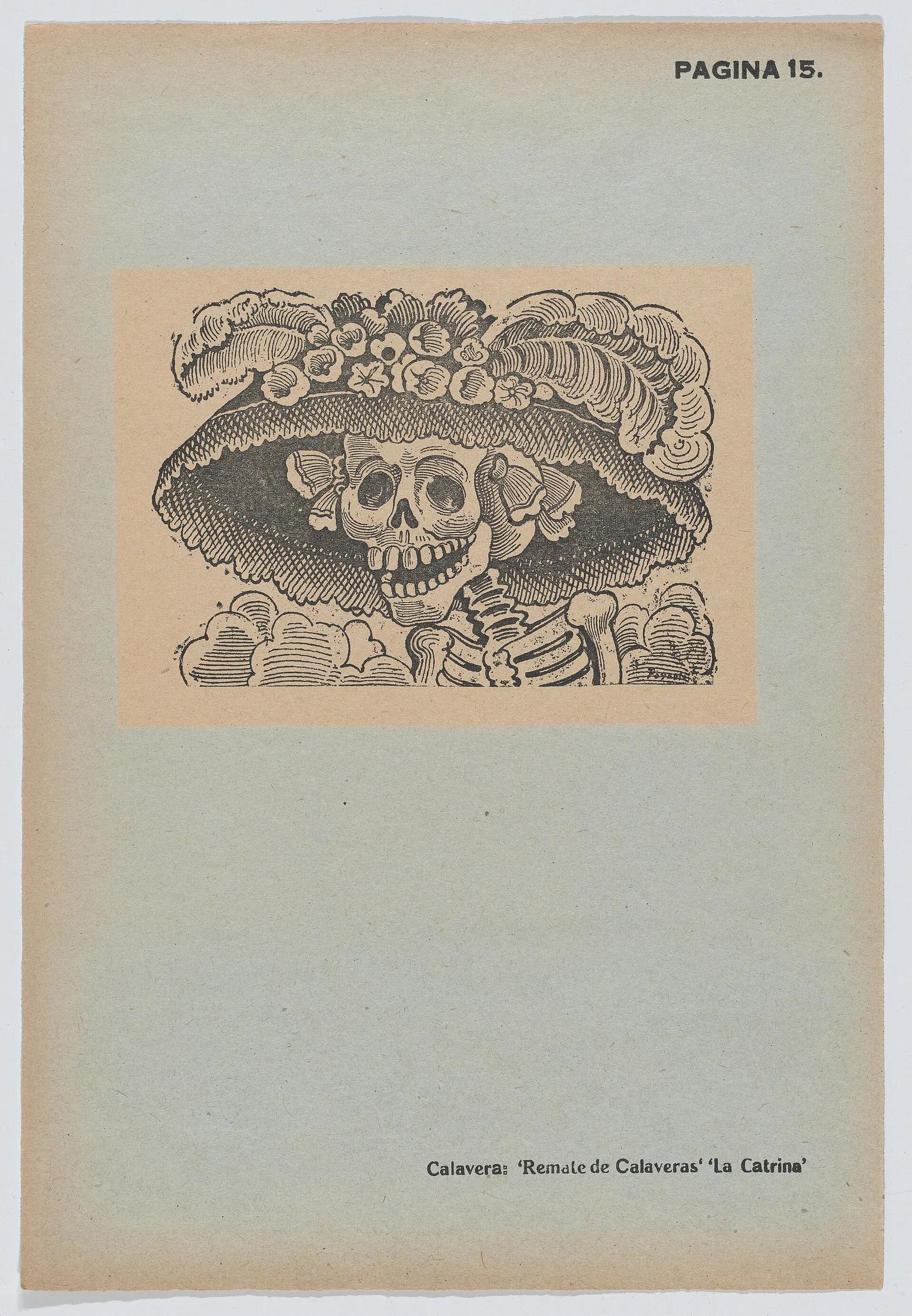
That makes it a useful companion to other autumn images of death and laughter, from Posada's grinning *Catrina* to Goya's *The Sleep of Reason Produces Monsters*, where imagination also breeds the creatures that frighten us. For a darker, more solemn nineteenth-century vision of the night journey, compare Böcklin's *Isle of the Dead*.
How to look at the Headless Horseman painting
The painting is at the Smithsonian American Art Museum, which lists it on the second floor of the East Wing; displays change, so check the museum's website before visiting. The museum also offers a high-resolution image through Smithsonian Open Access.
- Start at the moon, top left, and follow the light down to the pumpkin. Quidor uses the moonlight to pick out exactly the object Irving kept in shadow.
- Look for the headless neck: the cloak rises in a high collar where the head should be.
- Find the falling saddle and its stirrup under the grey horse.
- Notice how the dead, crooked branches in the foreground echo Ichabod's thin, flailing limbs.
- Then read the chase in Irving's text, a few pages long, and decide which version is more frightening.
The museum's own label calls Ichabod a pompous twit who is no match for the clever locals. Quidor seems to agree. His pumpkin is the punchline, delivered a moment too early, and that is what makes the painting such good company.
Questions people ask
Who painted The Headless Horseman Pursuing Ichabod Crane?
The New York painter John Quidor (1801–1881) painted it in 1858. It is oil on canvas, 68.3 by 86.1 centimetres, and belongs to the Smithsonian American Art Museum in Washington, D.C., accession number 1994.120. Quidor had already painted a darker version of the subject about 1828, now at the Yale University Art Gallery.
Does the Headless Horseman throw a pumpkin in The Legend of Sleepy Hollow?
Irving never says so outright. During the chase he describes the goblin hurling his head at Ichabod. Only the next morning do villagers find Ichabod's hat and, close beside it, a shattered pumpkin, and Brom Bones laughs whenever the pumpkin is mentioned. Readers infer the joke; Quidor's painting shows it.
Is The Legend of Sleepy Hollow a Halloween story?
Not in the text. Irving's 1820 tale is set in autumn and full of harvest imagery, but it never mentions Halloween. Its association with 31 October grew later, as the jack-o'-lantern became a Halloween custom and as films and cartoons, including Disney's 1949 version, retold the pumpkin-throwing chase.
Where can I see John Quidor's Headless Horseman painting?
It belongs to the Smithsonian American Art Museum in Washington, D.C., which has listed it in its second-floor East Wing galleries. Displays change, so check the museum's collection website before visiting. A high-resolution image is available through Smithsonian Open Access.
Who is the Headless Horseman in Sleepy Hollow?
In Washington Irving's story the Headless Horseman is the local ghost of a Hessian trooper, a German soldier fighting for the British, whose head was carried away by a cannon-ball in a battle of the Revolutionary War. He is said to ride at night in search of it. The tale strongly hints that Ichabod's pursuer was really his rival, Brom Bones.
Sources and further reading
- The Headless Horseman Pursuing Ichabod Crane, 1994.120, Smithsonian American Art Museum
- John Quidor: artist biography, Smithsonian American Art Museum
- Ichabod Crane Flying from the Headless Horseman, c. 1828, Yale University Art Gallery / Yale Center for British Art, Critique of Reason
- Fame takes half a century to reach 19th-century Quincy artist, Historical Society of Quincy and Adams County
- Washington Irving, The Legend of Sleepy Hollow, Project Gutenberg
Images are public-domain or CC0 reproductions from Wikimedia Commons, credited under each figure. Interpretations are attributed to the scholars who hold them.
Keep looking
Know someone who should see this?
Send them the story of The Headless Horseman Pursuing Ichabod Crane.